National Atmospheric Research Laboratory, Gadanki, AP, India.
National Atmospheric Research Laboratory, Gadanki, AP, India.
Sci Total Environ. 2021 Jan 1;750:141461. doi: 10.1016/j.scitotenv.2020.141461. Epub 2020 Aug 11.
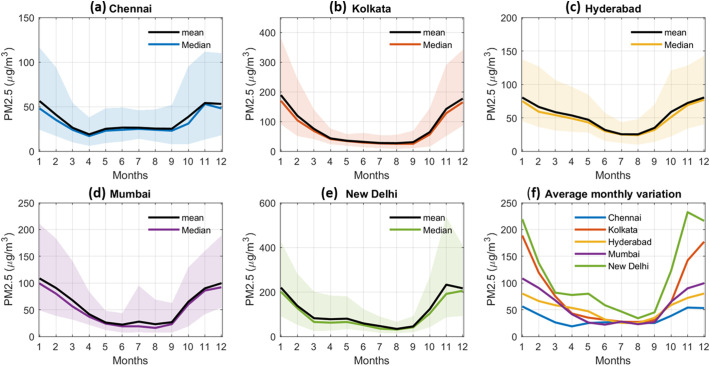
Fine particulate matter (PM) is the leading environmental risk factor that requires regular monitoring and analysis for effective air quality management. This work presents the variability, trend, and exceedance analysis of PM measured at US Embassy and Consulate in five Indian megacities (Chennai, Kolkata, Hyderabad, Mumbai, and New Delhi) for six years (2014-2019). Among all cities, Delhi is found to be the most polluted city followed by Kolkata, Mumbai, Hyderabad, and Chennai. The trend analysis for six years for five megacities suggests a statistically significant decreasing trend ranging from 1.5 to 4.19 μg/m (2%-8%) per year. Distinct diurnal, seasonal, and monthly variations are observed in the five cities due to the different site locations and local meteorology. All cities show the highest and lowest concentrations in the winter and monsoon months respectively except for Chennai which observed the lowest levels in April. All the cities consistently show morning peaks (08: 00-10:00 h) and the lowest level in late afternoon hours (15:00-16:00 h). We found that the PM levels in the cities exceed WHO standards and Indian NAAQS for 50% and 33% of days in a year except for Chennai. Delhi is found to have more than 200 days of exceedances in a year and experiences an average 15 number of episodes per year when the level exceeds the Indian NAAQS. The trends in the exceedance with a varying threshold (20-380 μg/m) suggest that not only is the annual mean PM decreasing in Delhi but also the number of exceedances is decreasing. This decrease can be attributed to the recent policies and regulations implemented in Delhi and other cities for the abatement of air pollution. However, stricter compliance of the National Clean Air Program (NCAP) policies can further accelerate the reduction of the pollution levels.
细颗粒物(PM)是主要的环境风险因素,需要进行定期监测和分析,以实现有效的空气质量管理。本研究报告了在印度五个特大城市(钦奈、加尔各答、海德拉巴、孟买和新德里)的美国大使馆和领事馆六年(2014-2019 年)期间测量的 PM 的可变性、趋势和超标分析。在所有城市中,德里被认为是污染最严重的城市,其次是加尔各答、孟买、海德拉巴和钦奈。五年特大城市的六年趋势分析表明,每年的浓度呈统计学显著下降趋势,范围为 1.5 至 4.19μg/m(2%-8%)。由于不同的站点位置和当地气象条件,五个城市的 PM 存在明显的日、季、月变化。除了钦奈,所有城市在冬季和季风月份的浓度最高和最低,除了钦奈,所有城市在冬季和季风月份的浓度最高和最低。除了钦奈,所有城市都显示出早晨高峰(约 08:00-10:00 h)和下午晚些时候(约 15:00-16:00 h)的最低水平。我们发现,除了钦奈外,这些城市的 PM 水平在一年中的 50%和 33%的天数超过了世卫组织标准和印度国家空气质量标准。德里每年有超过 200 天的超标天数,当水平超过印度国家空气质量标准时,每年平均有 15 次超标事件。随着阈值(20-380μg/m)的变化,超标趋势表明,德里不仅每年的平均 PM 浓度在下降,而且超标天数也在减少。这种下降可以归因于德里和其他城市最近实施的减少空气污染的政策和法规。然而,更严格地遵守国家清洁空气计划(NCAP)政策可以进一步加速污染水平的降低。