Ko Ye Eun, Jhee Jong Hyun
Department of Internal Medicine, Yonsei University College of Medicine, Seoul, Republic of Korea.
Division of Nephrology, Department of Internal Medicine, Gangnam Severance Hospital, Yonsei University College of Medicine, Seoul, Republic of Korea.
Clin Hypertens. 2023 Aug 15;29(1):23. doi: 10.1186/s40885-023-00248-3.
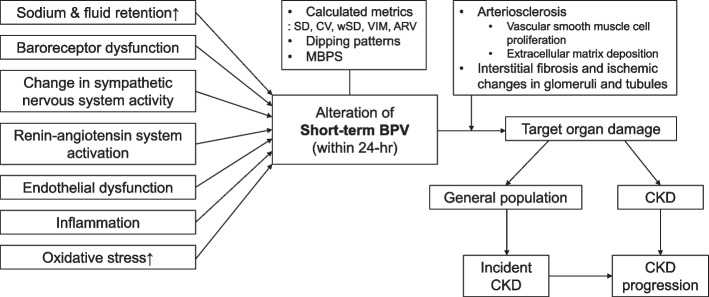
Short-term blood pressure variability (BPV) measured with ambulatory blood pressure (BP) monitoring has been demonstrated to be significant in predicting various clinical outcomes. Short-term BPV is distinguished from long-term BPV based on the time interval in which BP fluctuations are measured. Increased short-term BPV has been linked to detrimental effects on the microvascular structure and contributes to subclinical organ damage in the heart, blood vessels, and kidneys, regardless of the average 24-h BP levels. Short-term BPV can be defined by various measures, including calculated metrics (standard deviation, coefficient of variation, average real variability, weighted standard deviation, variability independent of the mean) or dipping patterns. Nevertheless, the additional role of short-term BPV beyond the predictive value of average 24-h BPs or established risk factors for cardiovascular disease and kidney disease remains unclear. In particular, longitudinal studies that evaluate the association between short-term BPV and kidney function impairment are limited and no conclusive data exist regarding which short-term BPV indicators most accurately reflect the prognosis of kidney disease. The issue of how to treat BPV in clinical practice is another concern that is frequently raised. This paper presents a review of the evidence for the prognostic role of short-term BPV in kidney outcomes. Additionally, this review discusses the remaining concerns about short-term BPV that need to be further investigated as an independent risk modifier.
动态血压监测所测量的短期血压变异性(BPV)已被证明在预测各种临床结局方面具有重要意义。短期BPV与长期BPV的区别在于测量血压波动的时间间隔。无论24小时平均血压水平如何,短期BPV增加都与对微血管结构的有害影响相关,并导致心脏、血管和肾脏的亚临床器官损害。短期BPV可以通过多种测量方法来定义,包括计算指标(标准差、变异系数、平均实际变异性、加权标准差、独立于均值的变异性)或血压波动模式。然而,短期BPV在24小时平均血压预测价值或已确定的心血管疾病和肾脏疾病危险因素之外的额外作用仍不清楚。特别是,评估短期BPV与肾功能损害之间关联的纵向研究有限,关于哪些短期BPV指标最准确反映肾脏疾病预后尚无确凿数据。临床实践中如何治疗BPV的问题是另一个经常被提出的关注点。本文对短期BPV在肾脏结局预后作用的证据进行了综述。此外,本综述讨论了关于短期BPV作为独立风险调节因素仍需进一步研究的其他关注点。