California Policy Lab, Institute for Research on Labor & Employment, University of California, Berkeley, Berkeley, CA, USA.
Social Interventions Research & Evaluation Network, University of California, San Francisco, San Francisco, CA, USA.
Can J Public Health. 2023 Oct;114(5):745-754. doi: 10.17269/s41997-023-00813-1. Epub 2023 Aug 15.
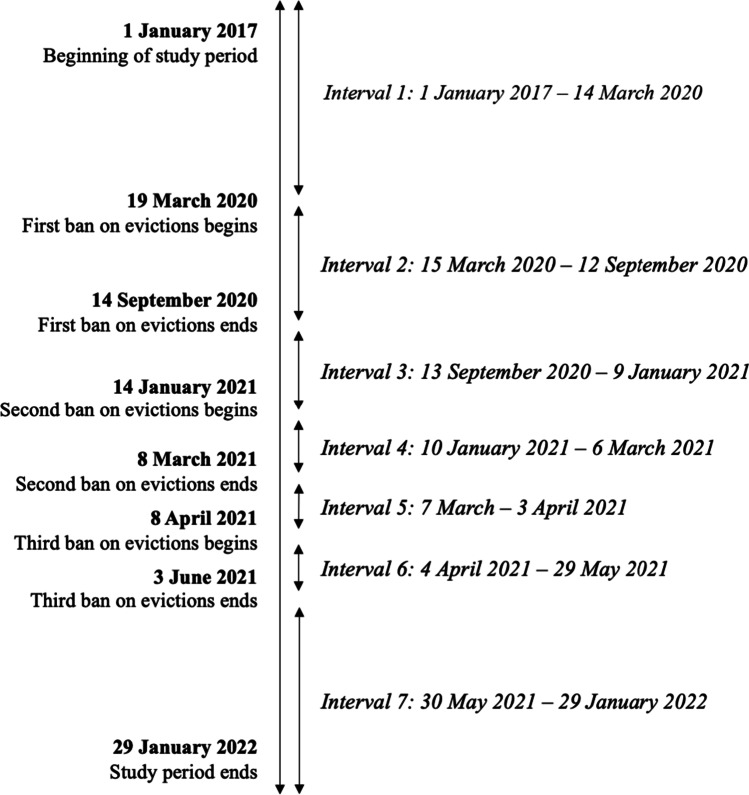
Bans on evictions were implemented to reduce the spread of COVID-19 and to protect vulnerable populations during a public health crisis. Our objective was to examine how three bans on eviction enforcement impacted eviction filings from March 2020 through January 2022 in Ontario, Canada.
Data were derived from eviction application records kept by the Ontario Landlord and Tenant Board. We used segmented regression analysis to model changes in the average weekly filing rates for evictions due to non-payment of rent (L1 filings) and reasons other than non-payment of rent (L2 filings).
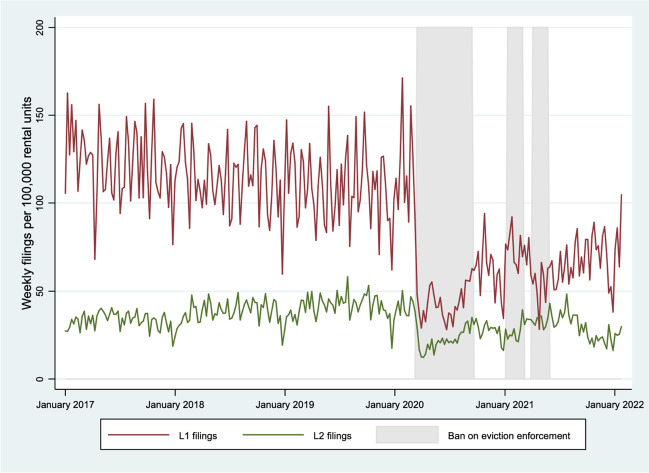
The average number of weekly L1 and L2 applications dropped by 67.5 (95% CI: 55.2, 79.9) and 31.7 (95% CI: 26.7, 36.6) filings per 100,000 rental dwellings, respectively, following the first ban on eviction enforcement (p < 0.0001). Notably, they did not fall to zero. Level changes during the second and third bans were insubstantial and slope changes for L2 applications varied throughout the study period. The L1 filing rate appeared to increase towards the end of the study period (slope change: 1.3; 95% CI: 0.1, 2.6; p = 0.0387).
Our findings suggest that while the first ban on eviction enforcement appeared to substantially reduce filing rates, subsequent bans were less effective and none of them eliminated eviction filings altogether. Enacting upstream policies that tackle the root causes of displacement would better equip jurisdictions during future public health emergencies.
为了减少 COVID-19 的传播并在公共卫生危机期间保护弱势群体,实施了禁止驱逐令。我们的目的是研究加拿大安大略省的三项禁止驱逐令执行的禁令如何影响 2020 年 3 月至 2022 年 1 月期间的驱逐申请。
数据来自安大略省房东和租户委员会保留的驱逐申请记录。我们使用分段回归分析来模拟由于未付租金(L1 申请)和非租金原因(L2 申请)而导致的每周平均驱逐申请率的变化。
在第一次禁止驱逐令执行后,每周 L1 和 L2 申请的平均数量分别减少了 67.5(95%CI:55.2,79.9)和 31.7(95%CI:26.7,36.6),每 10 万出租住宅(p < 0.0001)。值得注意的是,它们并没有降至零。在第二次和第三次禁令期间,变化幅度较小,L2 申请的斜率变化在整个研究期间有所不同。L1 申请率在研究期末似乎有所增加(斜率变化:1.3;95%CI:0.1,2.6;p = 0.0387)。
我们的研究结果表明,尽管第一次禁止驱逐令执行似乎大幅降低了申请率,但随后的禁令效果较差,没有一项完全消除了驱逐申请。制定解决流离失所根本原因的上游政策将使司法管辖区在未来的公共卫生紧急情况下更好地应对。