Institute of Physical Chemistry, University of Freiburg, Freiburg, Germany.
BIOSS and CIBSS Signalling Research Centres, University of Freiburg, Freiburg, Germany.
Nat Commun. 2023 Aug 15;14(1):4831. doi: 10.1038/s41467-023-40540-2.
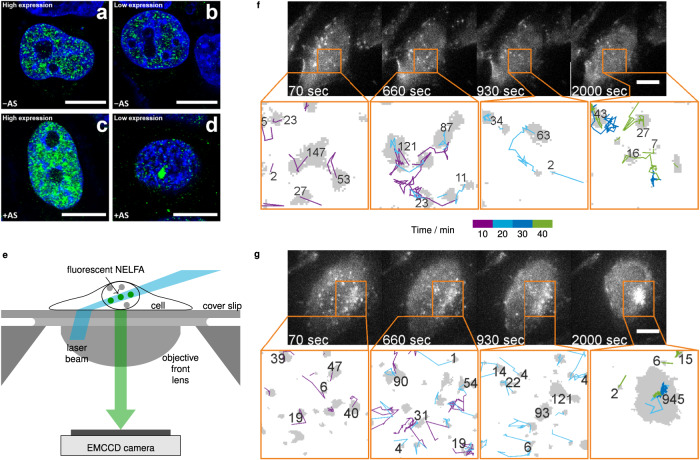
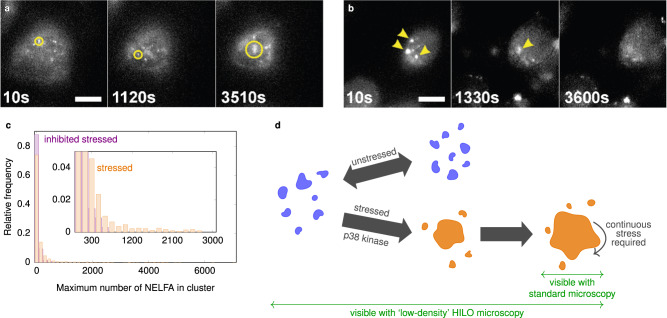
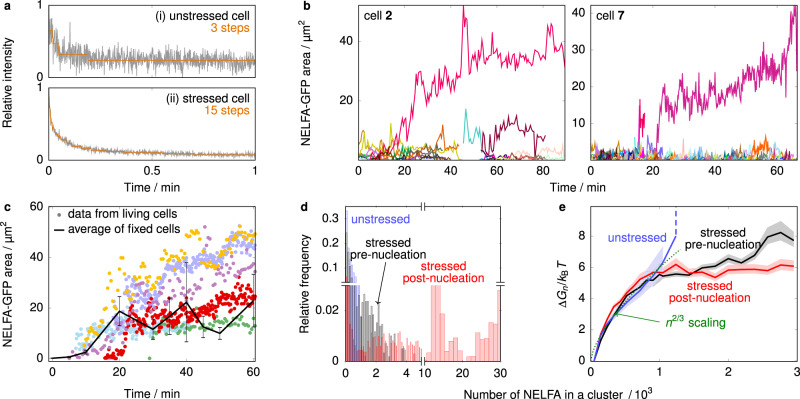
Our current understanding of biomolecular condensate formation is largely based on observing the final near-equilibrium condensate state. Despite expectations from classical nucleation theory, pre-critical protein clusters were recently shown to form under subsaturation conditions in vitro; if similar long-lived clusters comprising more than a few molecules are also present in cells, our understanding of the physical basis of biological phase separation may fundamentally change. Here, we combine fluorescence microscopy with photobleaching analysis to quantify the formation of clusters of NELF proteins in living, stressed cells. We categorise small and large clusters based on their dynamics and their response to p38 kinase inhibition. We find a broad distribution of pre-condensate cluster sizes and show that NELF protein cluster formation can be explained as non-classical nucleation with a surprisingly flat free-energy landscape for a wide range of sizes and an inhibition of condensation in unstressed cells.
我们目前对生物分子凝聚物形成的理解在很大程度上是基于观察最终的近平衡凝聚态。尽管有经典成核理论的预期,但最近在体外亚饱和条件下显示出预临界蛋白质簇的形成;如果类似的由几个分子以上组成的长寿命簇也存在于细胞中,我们对生物相分离的物理基础的理解可能会从根本上改变。在这里,我们将荧光显微镜与光漂白分析相结合,定量研究活细胞、应激细胞中 NELF 蛋白聚集体的形成。我们根据动力学和对 p38 激酶抑制的反应将小聚集体和大聚集体进行分类。我们发现预凝聚物聚集体大小的分布很广,并表明 NELF 蛋白聚集体的形成可以解释为非经典成核,对于广泛的大小范围具有令人惊讶的平坦自由能景观,并且在未受应激的细胞中抑制凝聚。