Thornton Matthew E, Hemsworth Jake, Hay Sam, Parkinson Patrick, Faulkner Stephen, Natrajan Louise S
Department of Chemistry, Faculty of Science and Engineering, The University of Manchester, Manchester, United Kingdom.
Department of Chemistry, Faculty of Science and Engineering, Manchester Institute of Biotechnology, The University of Manchester, Manchester, United Kingdom.
Front Chem. 2023 Jul 31;11:1232690. doi: 10.3389/fchem.2023.1232690. eCollection 2023.
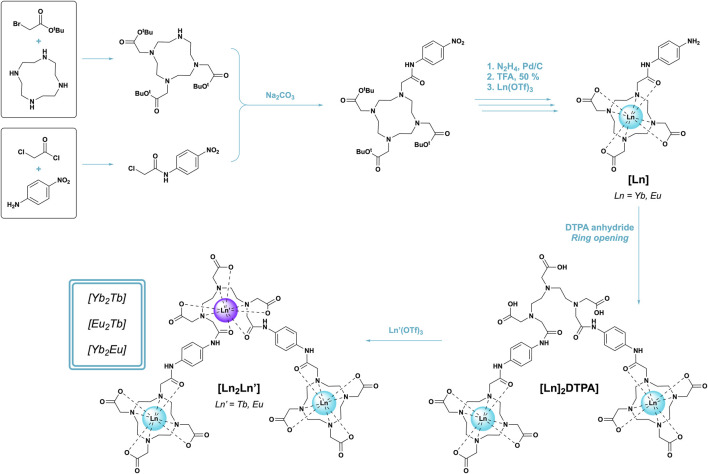
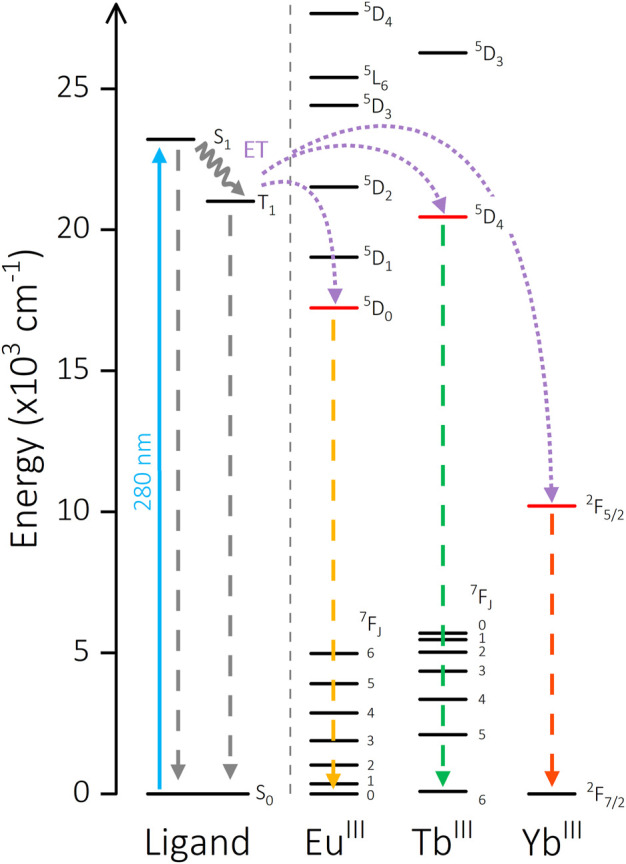
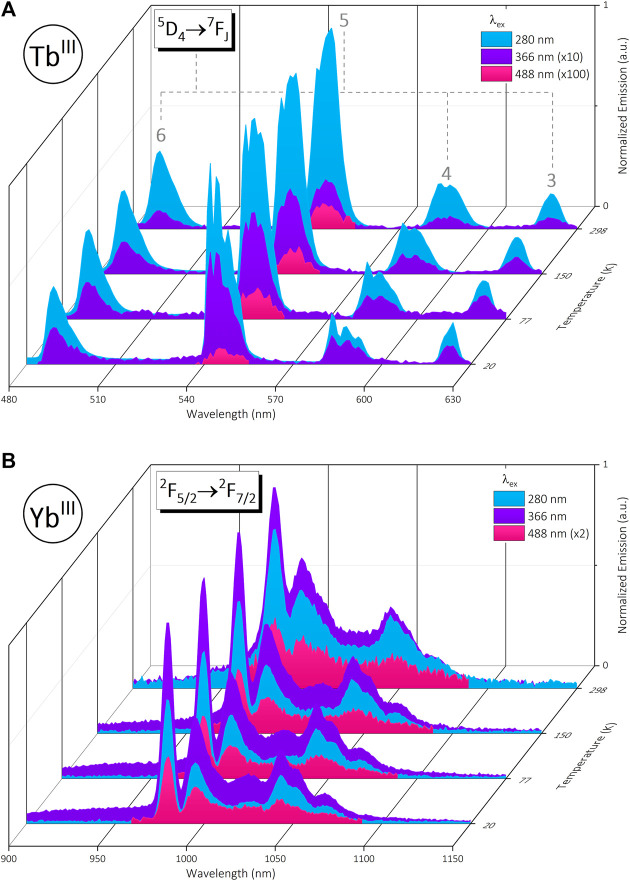
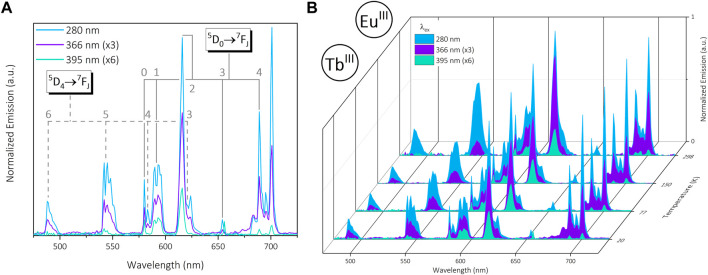
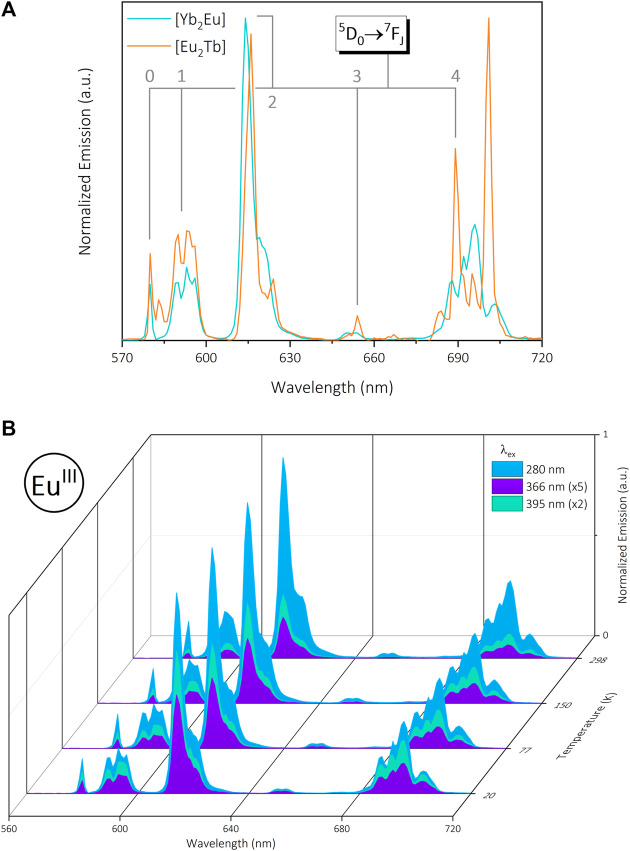
Macrocyclic lanthanide complexes have become widely developed due to their distinctive luminescence characteristics and wide range of applications in biological imaging. However, systems with sufficient brightness and metal selectivity can be difficult to produce on a molecular scale. Presented herein is the stepwise introduction of differing lanthanide ions in a bis-DO3A/DTPA scaffold to afford three trinuclear bimetallic [LnLn'] lanthanide complexes with site-specific, controlled binding [(YbTb), (EuTb), (YbEu)]. The complexes display simultaneous emission from all Ln centers across the visible (Tb, Eu) and near infra-red (Yb) spectrum when excited phenyl ligand sensitization at a wide range of temperatures and are consequently of interest for exploiting imaging in the near infra-red II biological window. Analysis of lifetime data over a range of excitation regimes reveals intermetallic communication between Tb and Eu centers and further develops the understanding of multimetallic lanthanide complexes.
大环镧系元素配合物因其独特的发光特性以及在生物成像中的广泛应用而得到了广泛的发展。然而,在分子尺度上制备具有足够亮度和金属选择性的体系可能具有挑战性。本文介绍了在双DO3A/DTPA支架中逐步引入不同的镧系离子,以得到三种具有位点特异性、可控结合的三核双金属[LnLn']镧系配合物[(YbTb)、(EuTb)、(YbEu)]。当在很宽的温度范围内通过苯基配体敏化激发时,这些配合物在可见光谱(Tb、Eu)和近红外光谱(Yb)范围内的所有Ln中心同时发射,因此对于在近红外II生物窗口中开发成像技术具有重要意义。对一系列激发条件下的寿命数据进行分析,揭示了Tb和Eu中心之间的金属间通信,并进一步加深了对多金属镧系配合物的理解。