Ministry of Education - Shanghai Key Laboratory of Children's Environmental Health, Xinhua Hospital, Shanghai Jiao Tong University School of Medicine, Shanghai, China.
Hainan Women and Children's Medical Center, Hainan, China.
Environ Health Perspect. 2023 Aug;131(8):87009. doi: 10.1289/EHP10831. Epub 2023 Aug 16.
Previous studies have reported that ambient temperature may affect perinatal outcomes. However, whether extreme temperature affects the risk of preterm birth (PTB) remains controversial. Studies on the associations of extreme temperature with PTB subtypes are lacking.
We aimed to investigate the associations of extreme climate events with the risks of PTB and its subtypes, discerning possible modifiers.
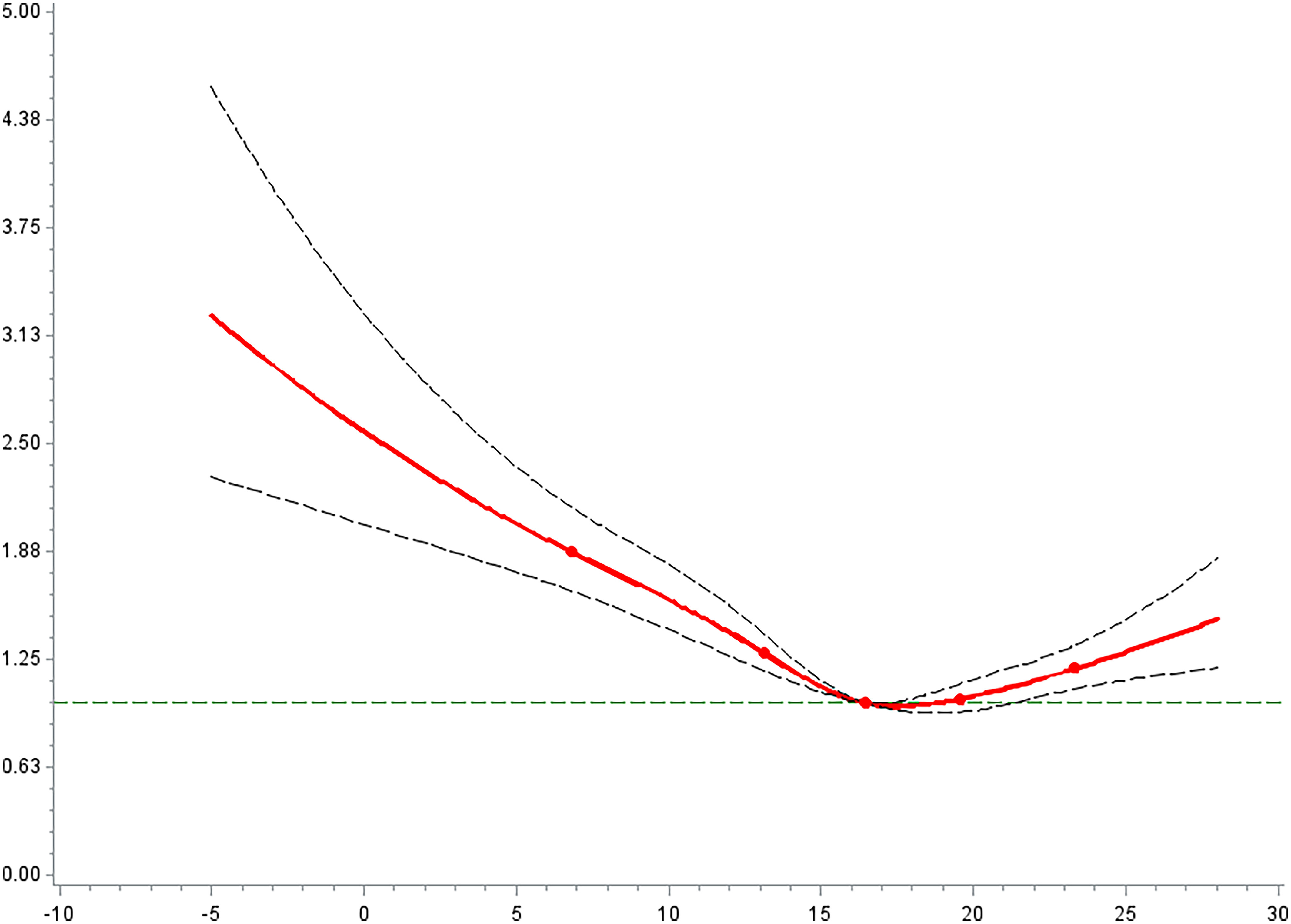
Data on all singleton deliveries were obtained from the China Labor and Delivery Survey (CLDS), a nationwide investigation implemented in 2015 and 2016. PTB was defined as gestational weeks and then categorized as early (24-34 wk) and late PTBs (35-36 wk), and clinical subtypes [spontaneous PTB, preterm premature rupture of the fetal membranes (PPROM), iatrogenic PTB]. Ambient temperature data were provided by the China National Weather Data Sharing System. Five heat indexes and five cold indexes were used to define heat waves and cold spells. Generalized linear mixed models with a random term by hospital unit were used to assess the associations of short-term prenatal extreme temperature exposure. The Cox proportional hazard regression model was applied to assess the nonlinear associations of low- or high-temperature exposure at the whole and different trimesters of pregnancy with the risk of PTB. Stratified analyses were conducted to assess the possible modification by geographic region and fetal sex.
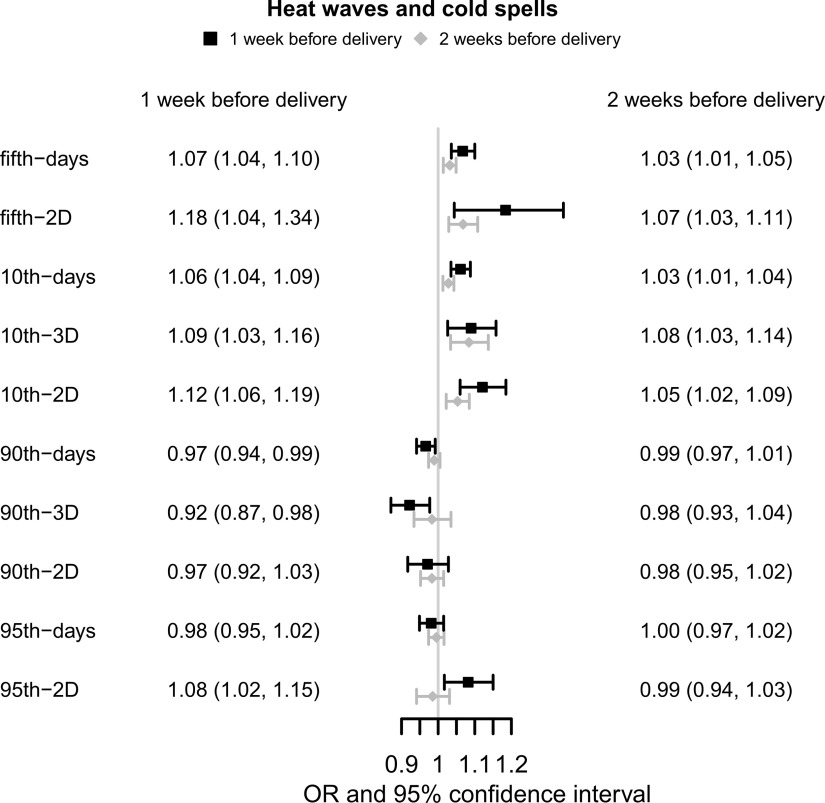
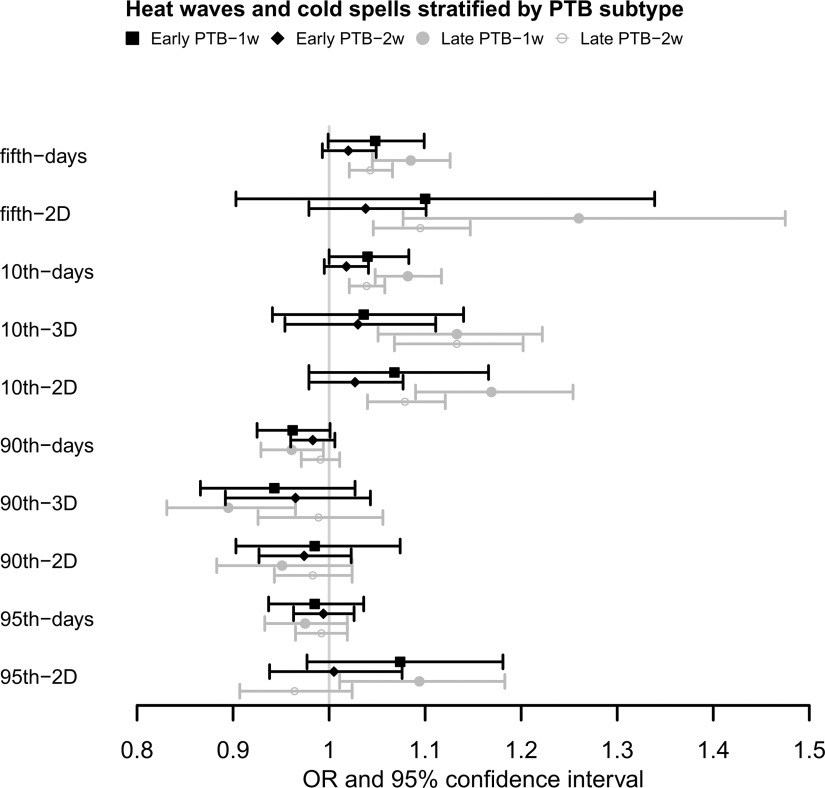
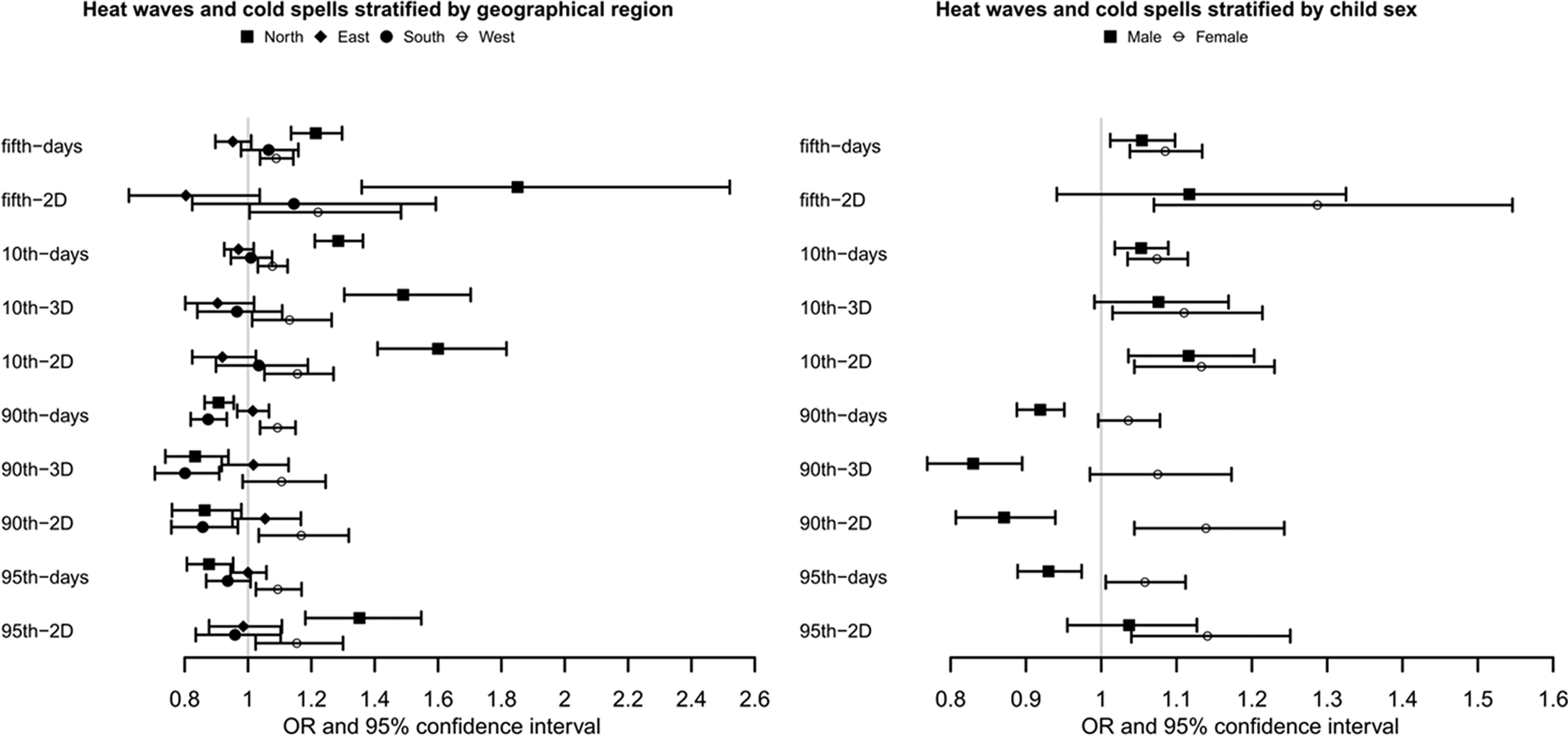
A total of 70,818 singleton births from 96 hospitals in China were included, among which 4,965 (7.01%) were PTBs. Exposure to extreme cold events 1 wk before delivery was associated with an increased PTB risk, with an adjusted odds ratio (aOR) [95% confidence intervals (CIs)] of 1.07 (95% CI: 1.04, 1.10) and 1.06 (1.04, 1.09) for the total days when the daily average temperature below the fifth percentile (fifth-days) and the 10th percentile (10th-days), 1.18 (1.04, 1.34) for the cold spells when the daily average temperature below the fifth percentile for two consecutive days (fifth-2D), 1.09 (1.03, 1.16) and 1.12 (1.06, 1.19) for the cold spells when the daily average temperature below the 10th percentile for three and two consecutive days (10th-3D and 10th-2D), respectively. Results of extreme temperature exposure during 2 weeks before delivery showed similarly significant associations. The association between cold spells and PTB tended to be stronger for late PTB than for early PTB. Cold spells were mainly associated with spontaneous PTB and late PPROM. A stratified analysis indicated that pregnant women in western and northern regions tended to be more sensitive to cold spells, and pregnant women with a female fetus appeared to be at a higher risk of PTB when exposed to cold spells. Pregnant women in late pregnancy were more susceptible to extreme temperatures. No significant or stable association was found between heat waves and preterm birth.
Exposure to cold spells was associated with an increased risk of PTB, especially late, spontaneous PTB and PPROM. The associations appeared to be more pronounced in the north and west regions and in pregnancies with female fetuses. https://doi.org/10.1289/EHP10831.
先前的研究报告称,环境温度可能会影响围产期结局。然而,极端温度是否会影响早产(PTB)的风险仍存在争议。关于极端温度与早产亚型之间关联的研究还很缺乏。
我们旨在研究极端气候事件与 PTB 及其亚型风险之间的关联,并确定可能的修饰因素。
从 2015 年和 2016 年实施的全国性调查中国劳动力与分娩调查(CLDS)中获取了所有单胎分娩的数据。PTB 定义为妊娠周数,然后分为早期(24-34 周)和晚期 PTB(35-36 周)以及临床亚型[自发性 PTB、早产胎膜早破(PPROM)、医源性 PTB]。环境温度数据由中国国家天气数据共享系统提供。使用五个热指数和五个冷指数来定义热浪和寒冷期。使用具有医院单位随机项的广义线性混合模型评估短期产前极端温度暴露的关联。应用 Cox 比例风险回归模型评估整个孕期和不同孕期的低温或高温暴露与 PTB 风险的非线性关联。进行分层分析以评估地理区域和胎儿性别可能的修饰作用。
共纳入了来自中国 96 家医院的 70818 例单胎分娩,其中 4965 例(7.01%)为 PTB。分娩前 1 周暴露于极端寒冷事件与 PTB 风险增加相关,总日数时的调整后优势比(aOR)[95%置信区间(CI)]为 1.07(95%CI:1.04,1.10)和 1.06(1.04,1.09)当每日平均温度低于第 5 百分位数(第 5 天)和第 10 百分位数(第 10 天)时,连续两天每日平均温度低于第 5 百分位数时的寒冷期(第 5-2D)的 aOR 为 1.18(1.04,1.34),当连续三天和两天每日平均温度低于第 10 百分位数时的寒冷期(第 10-3D 和第 10-2D)的 aOR 分别为 1.09(1.03,1.16)和 1.12(1.06,1.19)。分娩前 2 周极端温度暴露的结果也显示出类似的显著关联。寒冷期与 PTB 的关联在晚期 PTB 中比早期 PTB 更强。寒冷期主要与自发性 PTB 和晚期 PPROM 相关。分层分析表明,西部地区和北部地区的孕妇对寒冷期更为敏感,而暴露于寒冷期时,怀有女性胎儿的孕妇 PTB 的风险更高。孕妇在妊娠晚期更容易受到极端温度的影响。热浪与早产之间没有明显或稳定的关联。
暴露于寒冷期与 PTB 风险增加相关,尤其是晚期、自发性 PTB 和 PPROM。在北部和西部地区以及怀有女性胎儿的孕妇中,这种关联似乎更为明显。