• 文献检索
  • 文档翻译
  • 深度研究
  • 学术资讯
  • Suppr Zotero 插件Zotero 插件
  • 邀请有礼
  • 套餐&价格
  • 历史记录
应用&插件
Suppr Zotero 插件Zotero 插件浏览器插件Mac 客户端Windows 客户端微信小程序
定价
高级版会员购买积分包购买API积分包
服务
文献检索文档翻译深度研究API 文档MCP 服务
关于我们
关于 Suppr公司介绍联系我们用户协议隐私条款
关注我们

Suppr 超能文献

核心技术专利:CN118964589B侵权必究
粤ICP备2023148730 号-1Suppr @ 2026

文献检索

告别复杂PubMed语法,用中文像聊天一样搜索,搜遍4000万医学文献。AI智能推荐,让科研检索更轻松。

立即免费搜索

文件翻译

保留排版,准确专业,支持PDF/Word/PPT等文件格式,支持 12+语言互译。

免费翻译文档

深度研究

AI帮你快速写综述,25分钟生成高质量综述,智能提取关键信息,辅助科研写作。

立即免费体验

智能手机干预对大学生不健康饮酒的二级预防作用:随机对照试验。

Effect of a smartphone intervention as a secondary prevention for use among university students with unhealthy alcohol use: randomised controlled trial.

机构信息

Addiction Medicine, Lausanne University Hospital and University of Lausanne, Lausanne, Switzerland

Addiction Medicine, Lausanne University Hospital and University of Lausanne, Lausanne, Switzerland.

出版信息

BMJ. 2023 Aug 16;382:e073713. doi: 10.1136/bmj-2022-073713.

DOI:10.1136/bmj-2022-073713
PMID:37586742
原文链接:https://pmc.ncbi.nlm.nih.gov/articles/PMC10428135/
Abstract

OBJECTIVE

To estimate the effects of providing access to an alcohol intervention based on a smartphone.

DESIGN

Randomised controlled trial..

SETTING

Four higher education institutions in Switzerland.

PARTICIPANTS

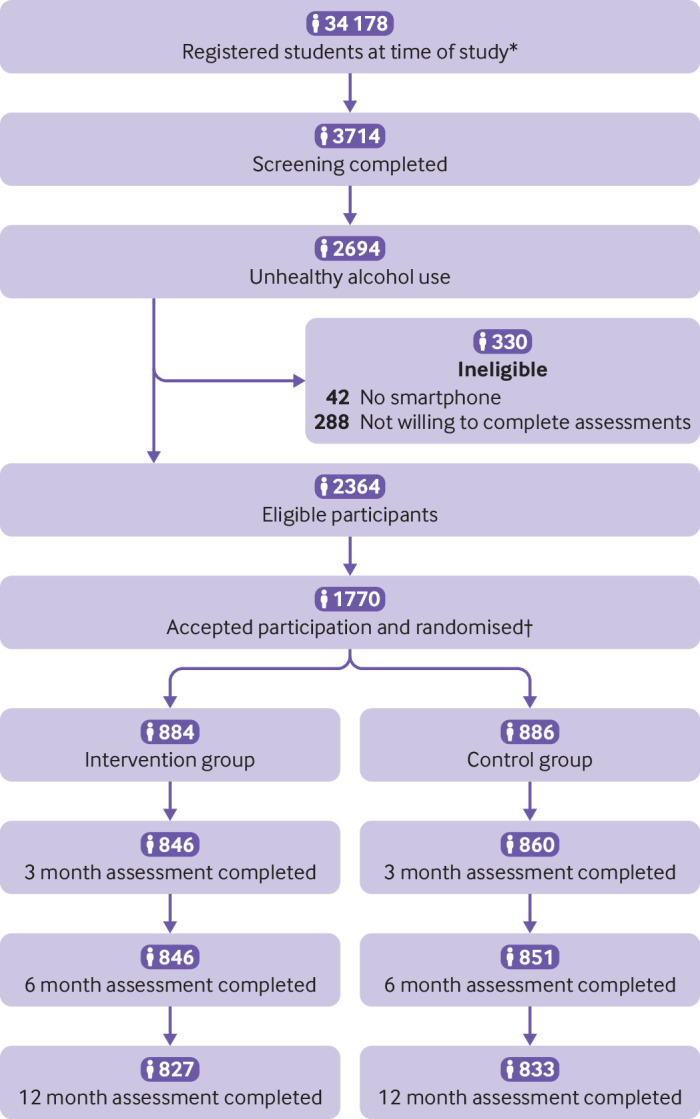
1770 students (≥18 years) who screened positive for unhealthy alcohol use (ie, a score on the alcohol use disorders identification test-consumption (AUDIT-C) of ≥4 for men and ≥3 for women) were randomly assigned by 1:1 allocation ratio in blocks of 10.

INTERVENTION

Providing access to a brief, smartphone based alcohol intervention.

OUTCOME MEASURES

The primary outcome studied was number of standard drinks per week at six months and the secondary outcome was number of heavy drinking days (past 30 days). Additional outcomes were maximum number of drinks consumed on one occasion, alcohol related consequences, and academic performance. Follow-up assessments occurred at months three, six, and 12. Data were analysed by intention to treat and by using generalised linear mixed models with random intercepts for the recruitment site and participants nested within the recruitment site, and with intervention ( control), time (three months six months; 12 months six months), and baseline outcome values as fixed effects.

RESULTS

Between 26 April 26 2021 and 30 May 2022, 1770 participants (intervention group (n=884); control group (n=886)) were included. Mean age was 22.4 years (standard deviation 3.07); 958 (54.1%) were women; and 1169 (66.0%) were undergraduate students, 533 (30.1%) were studying for a master's degree, 43 (2.4%) were studying for a doctorate, and 25 (1.4%) were students of other higher education programme. The baseline mean number of standard drinks per week was 8.59 (standard deviation 8.18); the baseline number of heavy drinking days was 3.53 (4.02). Of 1770 participants, follow-up rates were 1706 (96.4%) at three months, 1697 (95.9%) at six months, and 1660 (93.8%) at 12 months. Of 884 students randomly assigned to the intervention group, 738 (83.5%) downloaded the smartphone application. The intervention had a significant overall effect on the number of standard drinks per week (incidence rate ratio 0.90 (95% confidence interval 0.85 to 0.96)), heavy drinking days (0.89 (0.83 to 0.96)), and the maximum number of drinks consumed on one occasion (0.96 (0.93 to 1.00), P=0.029), indicating significantly lower drinking outcomes in the intervention group than in the control group during the follow-up period. The intervention did not affect alcohol related consequences or academic performance.

CONCLUSIONS

Providing access to the smartphone application throughout the 12 month follow-up was effective at limiting the average drinking volume of university students who had self-reported unhealthy alcohol use at baseline.

TRIAL REGISTRATION

ISRCTN 10007691.

https://cdn.ncbi.nlm.nih.gov/pmc/blobs/ccc9/10428135/2a8725a762a1/bern073713.f1.jpg
摘要

目的

评估通过智能手机提供酒精干预措施的效果。

设计

随机对照试验。

设置

瑞士的四所高等教育机构。

参与者

共有 1770 名(年龄≥18 岁)筛查出存在不健康饮酒行为(即酒精使用障碍识别测试-饮酒量(AUDIT-C)男性得分≥4,女性得分≥3)的学生被随机分为 1:1 分配比,分为 10 个块。

干预

提供基于智能手机的简短酒精干预措施。

主要结局指标

六个月时每周标准饮酒量和重度饮酒天数(过去 30 天)。次要结局指标包括一次饮酒量的最大值、酒精相关后果和学业表现。随访评估在三个月、六个月和十二个月进行。数据分析采用意向治疗分析和广义线性混合模型,使用随机截距对招募地点和嵌套在招募地点内的参与者进行分析,并将干预(对照组)、时间(三个月 六个月;十二个月 六个月)和基线结局值作为固定效应。

结果

在 2021 年 4 月 26 日至 2022 年 5 月 30 日期间,共纳入 1770 名参与者(干预组(n=884);对照组(n=886))。平均年龄为 22.4 岁(标准差 3.07);958 名(54.1%)为女性;1169 名(66.0%)为本科生,533 名(30.1%)为攻读硕士学位,43 名(2.4%)为攻读博士学位,25 名(1.4%)为其他高等教育项目的学生。基线每周标准饮酒量的平均值为 8.59(标准差 8.18);基线重度饮酒天数为 3.53(4.02)。在 1770 名参与者中,三个月时的随访率为 1706 名(96.4%),六个月时为 1697 名(95.9%),十二个月时为 1660 名(93.8%)。在随机分配到干预组的 884 名学生中,有 738 名(83.5%)下载了智能手机应用程序。干预措施对每周标准饮酒量(发病率比 0.90(95%置信区间 0.85 至 0.96))、重度饮酒天数(0.89(0.83 至 0.96))和单次饮酒量最大值(0.96(0.93 至 1.00))均有显著的总体影响,P=0.029),表明在随访期间,干预组的饮酒结果明显低于对照组。干预措施对酒精相关后果或学业表现没有影响。

结论

在 12 个月的随访期间,提供智能手机应用程序的使用权限可以有效限制自我报告基线时存在不健康饮酒行为的大学生的平均饮酒量。

试验注册

ISRCTN 10007691。

相似文献

1
Effect of a smartphone intervention as a secondary prevention for use among university students with unhealthy alcohol use: randomised controlled trial.智能手机干预对大学生不健康饮酒的二级预防作用:随机对照试验。
BMJ. 2023 Aug 16;382:e073713. doi: 10.1136/bmj-2022-073713.
2
Smartphone-based secondary prevention intervention for university students with unhealthy alcohol use identified by screening: study protocol of a parallel group randomized controlled trial.基于智能手机的大学生酒精使用障碍筛检后二级预防干预:一项平行群组随机对照试验研究方案。
Trials. 2020 Feb 17;21(1):191. doi: 10.1186/s13063-020-4145-2.
3
Web-based alcohol screening and brief intervention for university students: a randomized trial.基于网络的大学生酒精筛查和简短干预:一项随机试验。
JAMA. 2014 Mar 26;311(12):1218-24. doi: 10.1001/jama.2014.2138.
4
Smartphone application for unhealthy alcohol use: Pilot randomized controlled trial in the general population.智能手机应用程序用于不健康的饮酒行为:一般人群中的初步随机对照试验。
Drug Alcohol Depend. 2019 Feb 1;195:101-105. doi: 10.1016/j.drugalcdep.2018.12.002. Epub 2018 Dec 22.
5
A Brief Intervention With Instant Messaging or Regular Text Messaging Support in Reducing Alcohol Use: A Randomized Clinical Trial.即时通讯或常规短信支持的简短干预措施可减少饮酒:一项随机临床试验。
JAMA Intern Med. 2024 Jun 1;184(6):641-649. doi: 10.1001/jamainternmed.2024.0343.
6
Internet-based brief intervention for young men with unhealthy alcohol use: a randomized controlled trial in a general population sample.针对饮酒不健康的年轻男性的基于互联网的简短干预:一项在普通人群样本中的随机对照试验。
Addiction. 2015 Nov;110(11):1735-43. doi: 10.1111/add.13051. Epub 2015 Aug 13.
7
Four-year follow-up of an internet-based brief intervention for unhealthy alcohol use in young men.基于互联网的针对年轻男性不健康饮酒的简短干预的四年随访。
Addiction. 2018 Aug;113(8):1517-1521. doi: 10.1111/add.14179. Epub 2018 Mar 7.
8
Smartphone application for unhealthy alcohol use: A pilot study.智能手机应用程序用于不健康的饮酒行为:一项试点研究。
Subst Abus. 2017 Jul-Sep;38(3):285-291. doi: 10.1080/08897077.2017.1281860. Epub 2017 Jan 23.
9
Social norms information for alcohol misuse in university and college students.针对大学生酒精滥用问题的社会规范信息。
Cochrane Database Syst Rev. 2015 Jan 26;1:CD006748. doi: 10.1002/14651858.CD006748.pub3.
10
Psychosocial interventions to reduce alcohol consumption in concurrent problem alcohol and illicit drug users.减少同时存在酒精问题和非法药物使用问题者饮酒量的心理社会干预措施。
Cochrane Database Syst Rev. 2014 Dec 3(12):CD009269. doi: 10.1002/14651858.CD009269.pub3.

引用本文的文献

1
The Effectiveness of Mobile Health (mHealth) in Reducing Alcohol Consumption Among Adults in Developed Countries: A Systematic Review.移动健康(mHealth)对发达国家成年人减少酒精消费的有效性:一项系统综述。
Cureus. 2025 Aug 14;17(8):e90110. doi: 10.7759/cureus.90110. eCollection 2025 Aug.
2
Effectiveness of screening and ultra-brief intervention for hazardous drinking in primary care: pragmatic cluster randomised controlled trial.基层医疗中针对危险饮酒的筛查及超简短干预的有效性:实用整群随机对照试验
BMJ. 2025 Aug 12;390:e083985. doi: 10.1136/bmj-2024-083985.
3
A Novel Just-in-Time Intervention for Promoting Safer Drinking Among College Students: App Testing Across 2 Independent Pre-Post Trials.

本文引用的文献

1
Development of a Secondary Prevention Smartphone App for Students With Unhealthy Alcohol Use: Results From a Qualitative Assessment.为不健康饮酒的学生开发二级预防智能手机应用程序:定性评估结果
JMIR Hum Factors. 2023 Mar 7;10:e41088. doi: 10.2196/41088.
2
Health and cancer risks associated with low levels of alcohol consumption.与低水平饮酒相关的健康和癌症风险。
Lancet Public Health. 2023 Jan;8(1):e6-e7. doi: 10.1016/S2468-2667(22)00317-6.
3
Effectiveness of a digital intervention versus alcohol information for online help-seekers in Sweden: a randomised controlled trial.
一种促进大学生安全饮酒的新型即时干预措施:在两项独立的前后对照试验中进行应用测试
JMIR Hum Factors. 2025 Apr 10;12:e69873. doi: 10.2196/69873.
4
Effect of the MyDéfi Smartphone Application on Binge Drinking Among University Students: Protocol of a Double-Blind Multicenter Prospective National Randomized Controlled Trial Using Phosphatidylethanol as a Biomarker-The SMARTBINGE Trial.MyDéfi智能手机应用程序对大学生暴饮行为的影响:一项使用磷脂酰乙醇作为生物标志物的双盲多中心前瞻性全国随机对照试验方案——SMARTBINGE试验
Int J Methods Psychiatr Res. 2025 Jun;34(2):e70014. doi: 10.1002/mpr.70014.
5
The relationship between smartphone addiction and sleep quality in older adults: the mediating role of loneliness and depression.老年人智能手机成瘾与睡眠质量的关系:孤独感和抑郁的中介作用
BMC Nurs. 2025 Mar 6;24(1):253. doi: 10.1186/s12912-025-02883-7.
6
Smartphone-Based Intervention Targeting Norms and Risk Perception Among University Students with Unhealthy Alcohol Use: Secondary Mediation Analysis of a Randomized Controlled Trial.针对饮酒不健康的大学生的规范和风险认知的基于智能手机的干预措施:一项随机对照试验的二次中介分析
J Med Internet Res. 2025 Feb 6;27:e55541. doi: 10.2196/55541.
7
Emergency transportation for acute alcohol intoxication four years after the coronavirus disease 2019 pandemic: a retrospective observational study.新冠疫情大流行四年后急性酒精中毒的紧急转运:一项回顾性观察研究。
Environ Health Prev Med. 2024;29:53. doi: 10.1265/ehpm.24-00182.
8
A sex- and gender-based analysis of alcohol treatment intervention research involving youth: A methodological systematic review.基于性别和性别的青少年酒精治疗干预研究的方法学系统评价。
PLoS Med. 2024 Jun 3;21(6):e1004413. doi: 10.1371/journal.pmed.1004413. eCollection 2024 Jun.
9
Randomized controlled trial of a smartphone app designed to reduce unhealthy alcohol consumption.一款旨在减少不健康饮酒行为的智能手机应用程序的随机对照试验。
Internet Interv. 2024 May 17;36:100747. doi: 10.1016/j.invent.2024.100747. eCollection 2024 Jun.
10
Effectiveness of a smartphone app (Drink Less) versus usual digital care for reducing alcohol consumption among increasing-and-higher-risk adult drinkers in the UK: a two-arm, parallel-group, double-blind, randomised controlled trial.一款智能手机应用程序(少饮酒)与常规数字护理对减少英国饮酒风险增加及更高风险成年饮酒者酒精摄入量的效果比较:一项双臂、平行组、双盲随机对照试验。
EClinicalMedicine. 2024 Mar 24;70:102534. doi: 10.1016/j.eclinm.2024.102534. eCollection 2024 Apr.
数字干预与酒精信息对瑞典在线求助者的有效性:一项随机对照试验。
BMC Med. 2022 May 17;20(1):176. doi: 10.1186/s12916-022-02374-5.
4
Contrasting a Mobile App With a Conversational Chatbot for Reducing Alcohol Consumption: Randomized Controlled Pilot Trial.对比移动应用程序与对话式聊天机器人对减少酒精消费的作用:随机对照试验性研究
JMIR Form Res. 2022 May 16;6(5):e33037. doi: 10.2196/33037.
5
Digital Health Interventions for Delivery of Mental Health Care: Systematic and Comprehensive Meta-Review.用于提供精神卫生保健的数字健康干预措施:系统全面的元综述
JMIR Ment Health. 2022 May 12;9(5):e35159. doi: 10.2196/35159.
6
Changes in substance use and other reinforcing behaviours during the COVID-19 crisis in a general population cohort study of young Swiss men.瑞士年轻男性普通人群队列研究中新冠疫情危机期间物质使用及其他强化行为的变化
J Behav Addict. 2021 Oct 27;10(4):901-11. doi: 10.1556/2006.2021.00073.
7
The "Outcome Reporting in Brief Intervention Trials: Alcohol" (ORBITAL) Core Outcome Set: International Consensus on Outcomes to Measure in Efficacy and Effectiveness Trials of Alcohol Brief Interventions.简短干预试验结局报告:酒精(ORBITAL)核心结局集:酒精简短干预疗效和有效性试验中需要测量的结局的国际共识。
J Stud Alcohol Drugs. 2021 Sep;82(5):638-646. doi: 10.15288/jsad.2021.82.638.
8
Effectiveness of Smartphone-Based Physical Activity Interventions on Individuals' Health Outcomes: A Systematic Review.基于智能手机的身体活动干预对个体健康结果的有效性:系统评价。
Biomed Res Int. 2021 Aug 6;2021:6296896. doi: 10.1155/2021/6296896. eCollection 2021.
9
Rates of Attrition and Dropout in App-Based Interventions for Chronic Disease: Systematic Review and Meta-Analysis.基于应用程序的慢性病干预措施的脱落率和辍学率:系统评价和荟萃分析。
J Med Internet Res. 2020 Sep 29;22(9):e20283. doi: 10.2196/20283.
10
Smartphone apps for managing alcohol consumption: a literature review.智能手机应用程序管理饮酒:文献综述。
Addict Sci Clin Pract. 2020 May 7;15(1):17. doi: 10.1186/s13722-020-00190-x.