Evrard Bruno, Lefebvre Cyrielle, Spiry Paul, Hodler Charles, Chapellas Catherine, Youssef Baher, Gauthier François, Marais Loïc, Labrunie Anaïs, Douchez Marie, Senges Patrick, Cros Jérôme, Nathan-Denizot Nathalie
Medical-surgical ICU, Dupuytren Teaching Hospital, Limoges, France.
Inserm CIC, 1435, Dupuytren Teaching Hospital, Limoges, France.
BJA Open. 2022 Jul 31;3:100024. doi: 10.1016/j.bjao.2022.100024. eCollection 2022 Sep.
Tonsil surgery causes significant and challenging postoperative pain. The Analgesia Nociception Index (ANI) and videopupillometry are two techniques of interest to monitor nociception in adults and may predict postoperative morphine requirements. We hypothesised that these techniques could predict the need for morphine after tonsillectomy in children. The main objective was to assess the prognostic significance of ANI and videopupillometry, measured at the end of surgery, on morphine consumption determined by a Face, Legs, Activity, Cry, Consolability (FLACC) scale score >3 in the Post Anesthesia Care Unit (PACU).
A single-centre, prospective, interventional study evaluating children between 2 and 7 yr old undergoing tonsil surgery was performed. ANI and videopupillometry with tetanic stimulation were measured under general anaesthesia 4 min after the end of the surgical procedure. Each child was evaluated every 10 min by a nurse using the FLACC scale in the PACU and blinded to the measurements performed in the operating theatre.
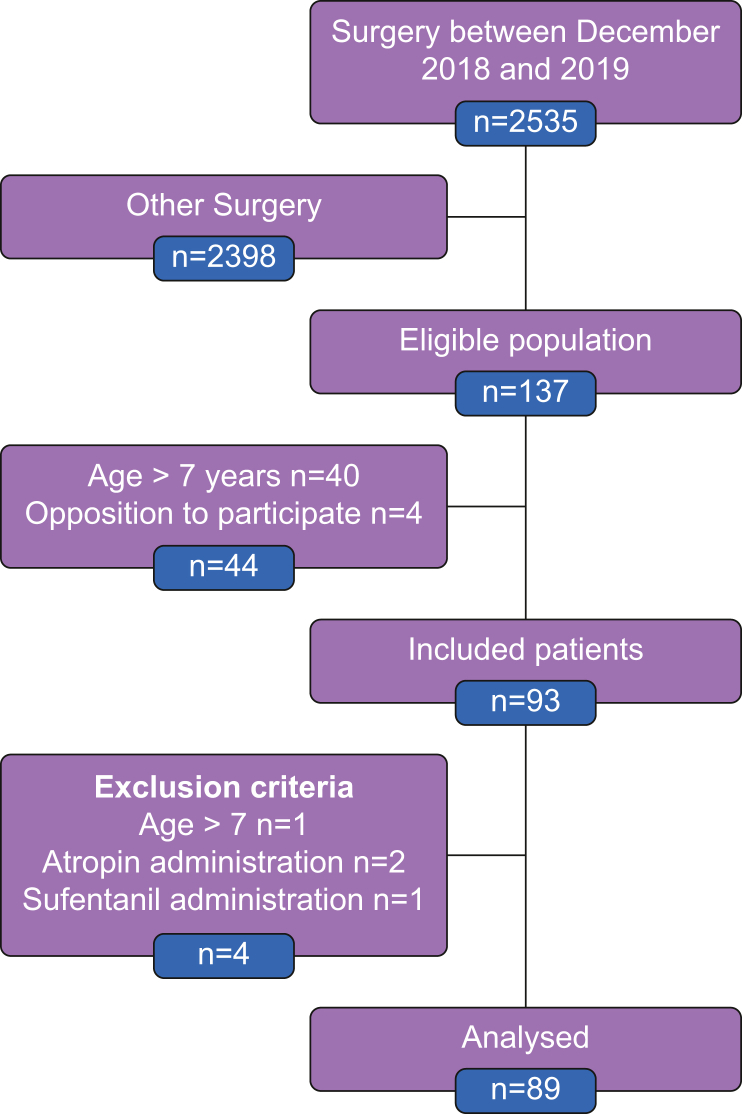
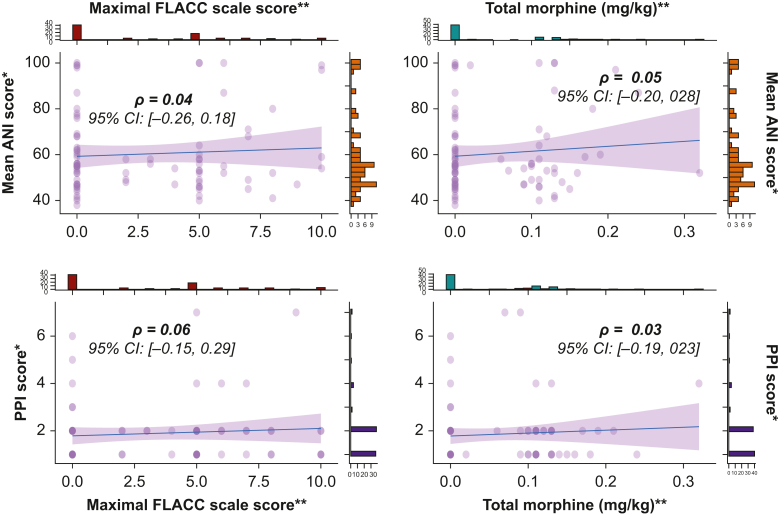
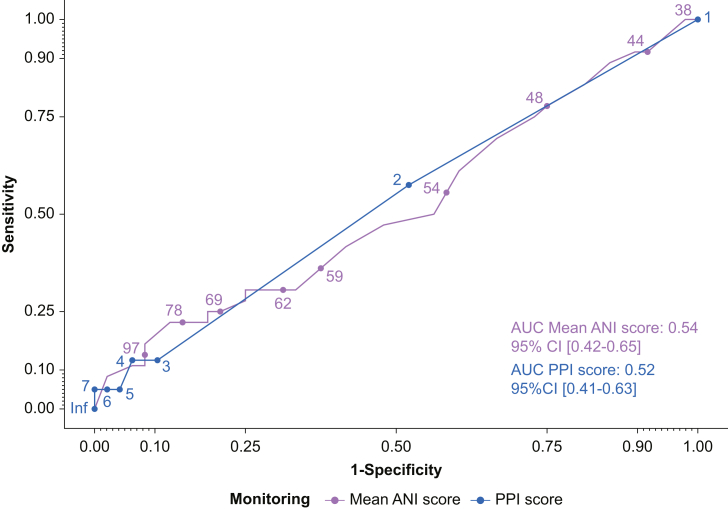
Eighty-nine children were analysed and 39 (44%) received morphine in the PACU. Neither ANI values nor videopupillometry values were predictive of postoperative morphine consumption (areas under the receiver operating characteristic curve 0.54, 95% confidence interval [CI; 0.42-0.65], and =0.57; and 0.52, 95% CI [0.41-0.63], and =0.69, respectively). Neither ANI values nor videopupillometry values were correlated to the maximum FLACC scale score in the PACU with ρ=0.04 (=0.71) and ρ=0.06 (=0.57), respectively.
Neither ANI nor videopupillometry performed at the end of surgery can predict morphine consumption in the PACU in children undergoing tonsillectomy.
扁桃体手术会导致显著且具有挑战性的术后疼痛。镇痛伤害感受指数(ANI)和视频瞳孔测量法是监测成人伤害感受的两种受关注技术,可能预测术后吗啡需求量。我们假设这些技术可预测儿童扁桃体切除术后对吗啡的需求。主要目的是评估手术结束时测量的ANI和视频瞳孔测量法对麻醉后护理单元(PACU)中通过面部、腿部、活动、哭闹、安慰度(FLACC)量表评分>3确定的吗啡消耗量的预后意义。
进行了一项单中心、前瞻性、干预性研究,评估2至7岁接受扁桃体手术的儿童。手术结束后4分钟在全身麻醉下测量ANI和强直刺激下的视频瞳孔测量法。在PACU中,护士每10分钟使用FLACC量表对每个儿童进行评估,且对手术室中进行的测量结果不知情。
分析了89名儿童的数据,其中39名(44%)在PACU中接受了吗啡治疗。ANI值和视频瞳孔测量法值均不能预测术后吗啡消耗量(受试者工作特征曲线下面积分别为0.54,95%置信区间[CI;0.42 - 0.65],P = 0.57;以及0.52,95% CI [0.41 - 0.63],P = 0.69)。ANI值和视频瞳孔测量法值与PACU中FLACC量表的最高评分均无相关性,相关系数分别为ρ = 0.04(P = 0.71)和ρ = 0.06(P = 0.57)。
对于接受扁桃体切除术的儿童,手术结束时进行的ANI和视频瞳孔测量法均不能预测PACU中的吗啡消耗量。