Castillo Mercado Juan Sebastián, Rojas Lievano Jorge, Zaldivar Brandon, Barajas Camilo, Fierro Guido, González Juan Carlos
Department of Orthopedics and Traumatology, Hospital Universitario Fundacion Santa Fe de Bogota, Bogota, Colombia.
Facultad de Medicina, Universidad de los Andes, Bogota, Colombia.
JSES Rev Rep Tech. 2022 Mar 23;2(3):277-284. doi: 10.1016/j.xrrt.2022.02.005. eCollection 2022 Aug.
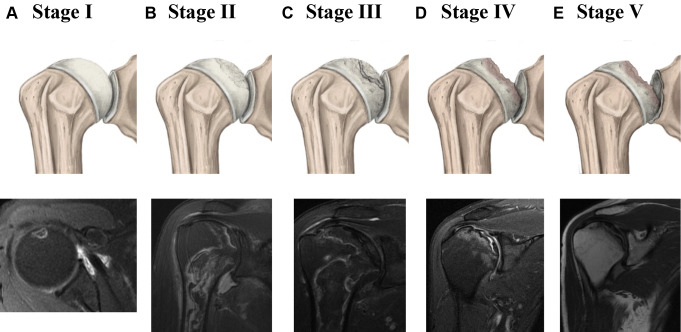
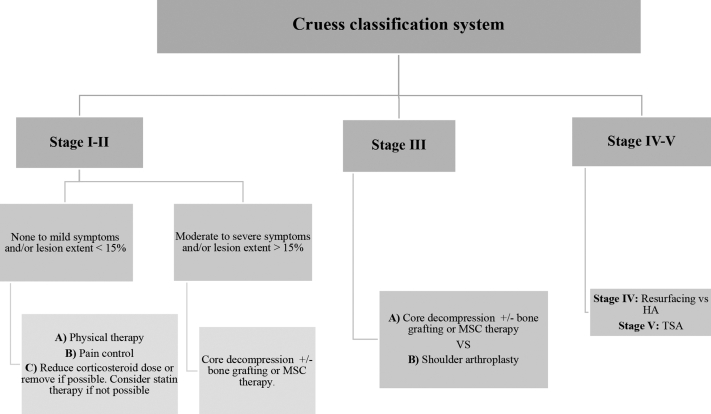
The humeral head is considered the second most common site for osteonecrosis to occur after the femoral head. As seen in the femoral head, the circulatory implications characteristic of this condition are attributable to the interaction between a genetic predisposition and the exposure to certain risk factors. There is no consensus regarding the pathogenesis of osteonecrosis, yet the final common pathway results in disrupted blood supply, increased intraosseous pressure, and bone death. Disease staging using radiography and magnetic resonance imaging is predictive of disease progression and can help the orthopedic surgeon to guide treatment. Although there is a myriad of treatment modalities, there is a lack of high-quality evidence to conclude what is the most appropriate treatment option for each stage of humeral head osteonecrosis. Nonoperative treatment is the preferred option in early-stage disease, and it may prevent disease progression. Nonetheless, in some cases, disease progression occurs despite nonoperative measures, and surgical treatment is required. The purpose of this article is to provide an updated review of the available evidence on risk factors, diagnosis, and treatment of atraumatic humeral head osteonecrosis.
肱骨头被认为是继股骨头之后骨坏死发生的第二常见部位。正如在股骨头中所见,这种疾病特有的循环影响归因于遗传易感性和接触某些危险因素之间的相互作用。关于骨坏死的发病机制尚无共识,但最终的共同途径会导致血液供应中断、骨内压升高和骨坏死。使用X线摄影和磁共振成像进行疾病分期可预测疾病进展,并有助于骨科医生指导治疗。尽管有多种治疗方式,但缺乏高质量证据来确定肱骨头骨坏死各阶段最合适的治疗方案。非手术治疗是早期疾病的首选方案,它可能会阻止疾病进展。然而,在某些情况下,尽管采取了非手术措施,疾病仍会进展,因此需要进行手术治疗。本文的目的是对非创伤性肱骨头骨坏死的危险因素、诊断和治疗的现有证据进行更新综述。