Division of Pulmonary Medicine, Department of Medicine, Keio University School of Medicine, Tokyo, Japan.
Department of Medicine, Icahn School of Medicine at Mount Sinai, Mount Sinai Beth Israel, NY, USA.
Oncologist. 2024 Jan 5;29(1):e108-e117. doi: 10.1093/oncolo/oyad187.
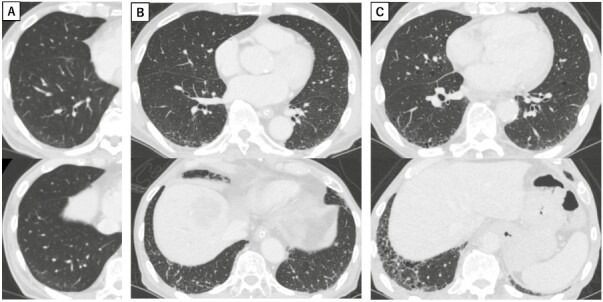
Immune checkpoint inhibitors (ICIs) have demonstrated efficacy over previous cytotoxic chemotherapies in clinical trials among various tumors. Despite their favorable outcomes, they are associated with a unique set of toxicities termed as immune-related adverse events (irAEs). Among the toxicities, ICI-related pneumonitis has poor outcomes with little understanding of its risk factors. This retrospective study aimed to investigate whether pre-existing interstitial lung abnormality (ILA) is a potential risk factor for ICI-related pneumonitis.
Patients with non-small cell lung cancer, malignant melanoma, renal cell carcinoma, and gastric cancer, who was administered either nivolumab, pembrolizumab, or atezolizumab between September 2014 and January 2019 were retrospectively reviewed. Information on baseline characteristics, computed tomography findings before administration of ICIs, clinical outcomes, and irAEs were collected from their medical records. Pre-existing ILA was categorized based on previous studies.
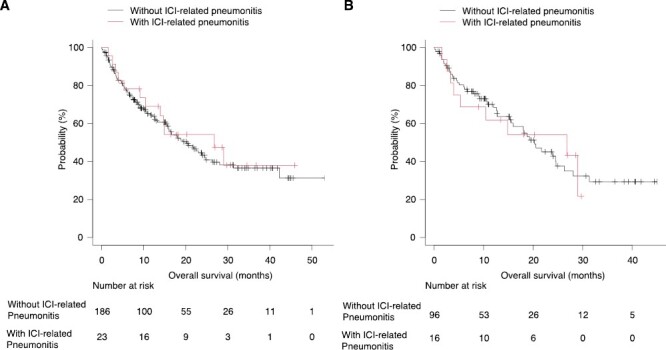
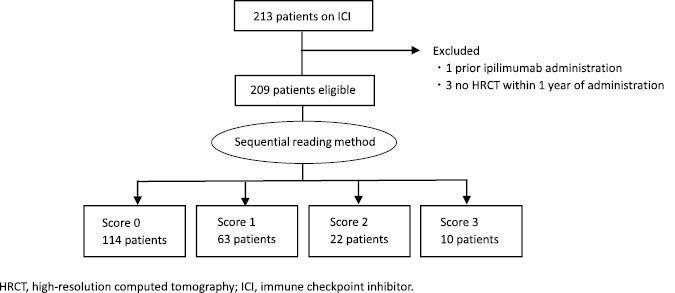
Two-hundred-nine patients with a median age of 68 years were included and 23 (11.0%) developed ICI-related pneumonitis. While smoking history and ICI agents were associated with ICI-related pneumonitis (P = .005 and .044, respectively), the categories of ILA were not associated with ICI-related pneumonitis (P = .428). None of the features of lung abnormalities were also associated with ICI-related pneumonitis. Multivariate logistic analysis indicated that smoking history was the only significant predictor of ICI-related pneumonitis (P = .028).
This retrospective study did not demonstrate statistically significant association between pre-existing ILA and ICI-related pneumonitis, nor an association between radiologic features of ILA and ICI-related pneumonitis. Smoking history was independently associated with ICI-related pneumonitis. Further research is warranted for further understanding of the risk factors of ICI-related pneumonitis.
免疫检查点抑制剂(ICIs)在各种肿瘤的临床试验中已经证明优于以前的细胞毒性化疗药物。尽管它们的疗效良好,但它们与一组被称为免疫相关不良事件(irAEs)的独特毒性相关。在这些毒性中,ICI 相关的肺炎的预后较差,对其危险因素的了解甚少。这项回顾性研究旨在探讨预先存在的间质性肺异常(ILA)是否是 ICI 相关肺炎的潜在危险因素。
回顾性分析了 2014 年 9 月至 2019 年 1 月期间接受纳武利尤单抗、帕博利珠单抗或阿替利珠单抗治疗的非小细胞肺癌、恶性黑色素瘤、肾细胞癌和胃癌患者。从病历中收集了基线特征、ICI 前的计算机断层扫描结果、临床结果和 irAEs 信息。根据先前的研究对预先存在的 ILA 进行了分类。
共纳入 209 例患者,中位年龄为 68 岁,23 例(11.0%)发生 ICI 相关肺炎。吸烟史和 ICI 药物与 ICI 相关肺炎相关(P =.005 和.044),但 ILA 类别与 ICI 相关肺炎无关(P =.428)。肺异常的特征也与 ICI 相关肺炎无关。多变量逻辑分析表明,吸烟史是 ICI 相关肺炎的唯一显著预测因子(P =.028)。
这项回顾性研究未显示预先存在的 ILA 与 ICI 相关肺炎之间存在统计学显著关联,也未显示 ILA 的影像学特征与 ICI 相关肺炎之间存在关联。吸烟史与 ICI 相关肺炎独立相关。需要进一步研究以进一步了解 ICI 相关肺炎的危险因素。