Africa Health Research Institute, KwaZulu-Natal, South Africa; Nelson R Mandela School of Medicine, University of KwaZulu-Natal, Durban, South Africa.
Africa Health Research Institute, KwaZulu-Natal, South Africa.
Lancet Glob Health. 2023 Sep;11(9):e1372-e1382. doi: 10.1016/S2214-109X(23)00239-5.
The convergence of infectious diseases and non-communicable diseases in South Africa is challenging to health systems. In this analysis, we assessed the multimorbidity health needs of individuals and communities in rural KwaZulu-Natal and established a framework to quantify met and unmet health needs for individuals living with infectious and non-communicable diseases.
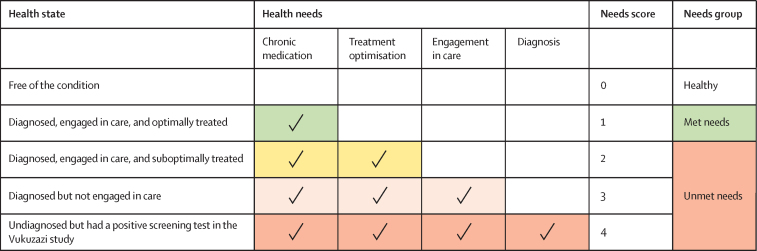
We analysed data collected between May 25, 2018, and March 13, 2020, from participants of a large, community-based, cross-sectional multimorbidity survey (Vukuzazi) that offered community-based HIV, hypertension, and diabetes screening to all residents aged 15 years or older in a surveillance area in the uMkhanyakude district in KwaZulu-Natal, South Africa. Data from the Vukuzazi survey were linked with data from demographic and health surveillance surveys with a unique identifier common to both studies. Questionnaires were used to assess the diagnosed health conditions, treatment history, general health, and sociodemographic characteristics of an individual. For each condition (ie, HIV, hypertension, and diabetes), individuals were defined as having no health needs (absence of condition), met health needs (condition that is well controlled), or one or more unmet health needs (including diagnosis, engagement in care, or treatment optimisation). We analysed met and unmet health needs for individual and combined conditions and investigated their geospatial distribution.
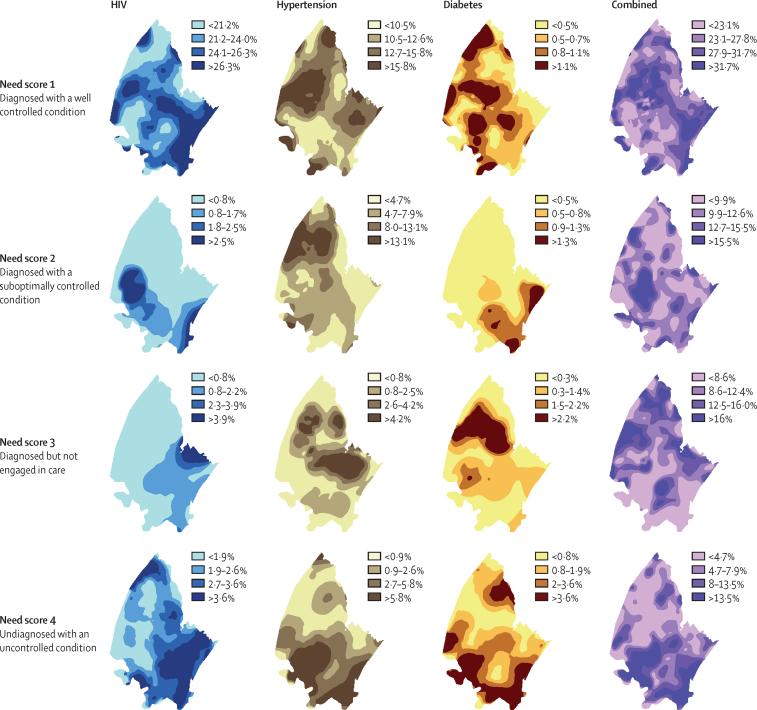
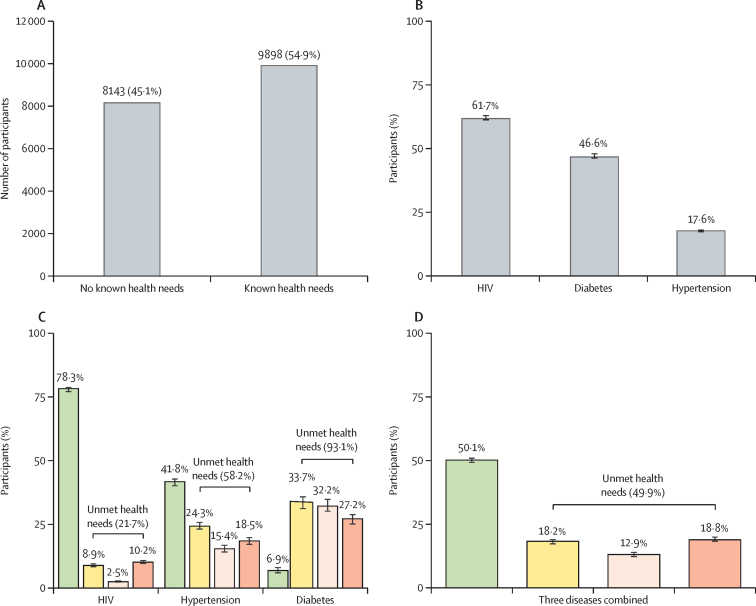
Of 18 041 participants who completed the survey (12 229 [67·8%] were female and 5812 [32·2%] were male), 9898 (54·9%) had at least one of the three chronic diseases measured. 4942 (49·9%) of these 9898 individuals had at least one unmet health need (1802 [18·2%] of 9898 needed treatment optimisation, 1282 [13·0%] needed engagement in care, and 1858 [18·8%] needed a diagnosis). Unmet health needs varied by disease; 1617 (93·1%) of 1737 people who screened positive for diabetes, 2681 (58·2%) of 4603 people who screened positive for hypertension, and 1321 (21·7%) of 6096 people who screened positive for HIV had unmet health needs. Geospatially, met health needs for HIV were widely distributed and unmet health needs for all three conditions had specific sites of concentration; all three conditions had an overlapping geographical pattern for the need for diagnosis.
Although people living with HIV predominantly have a well controlled condition, there is a high burden of unmet health needs for people living with hypertension and diabetes. In South Africa, adapting current, widely available HIV care services to integrate non-communicable disease care is of high priority.
Fogarty International Center and the National Institutes of Health, the Bill & Melinda Gates Foundation, the South African Department of Science and Innovation, the South African Medical Research Council, the South African Population Research Infrastructure Network, and the Wellcome Trust.
For the isiZulu translation of the abstract see Supplementary Materials section.
传染病和非传染性疾病在南非的交汇对卫生系统构成了挑战。在这项分析中,我们评估了夸祖鲁-纳塔尔省农村地区个人和社区的多种疾病健康需求,并建立了一个框架来量化患有传染病和非传染性疾病的个人的满足和未满足的健康需求。
我们分析了 2018 年 5 月 25 日至 2020 年 3 月 13 日期间从南非夸祖鲁-纳塔尔省乌姆坎加德区监测区参与一项大型基于社区的多疾病横断面调查(Vukuzazi)的参与者收集的数据。该调查为所有 15 岁及以上的居民提供了社区层面的艾滋病毒、高血压和糖尿病筛查。Vukuzazi 调查的数据与人口和健康监测调查的数据通过两项研究共有的唯一标识符进行了关联。调查问卷用于评估个人的已确诊健康状况、治疗史、总体健康状况和社会人口特征。对于每种疾病(即艾滋病毒、高血压和糖尿病),个体被定义为没有健康需求(不存在疾病)、满足健康需求(病情得到良好控制)或存在一个或多个未满足的健康需求(包括诊断、参与治疗或治疗优化)。我们分析了个体和联合疾病的满足和未满足的健康需求,并调查了它们的地理空间分布。
在完成调查的 18041 名参与者中(12229 名[67.8%]为女性,5812 名[32.2%]为男性),9898 名(54.9%)至少患有三种慢性疾病中的一种。在这 9898 名患者中,有 4942 名(49.9%)存在至少一种未满足的健康需求(1802 名[18.2%]需要治疗优化,1282 名[13.0%]需要参与治疗,1858 名[18.8%]需要诊断)。未满足的健康需求因疾病而异;在筛查出的 1737 名糖尿病患者中,有 1617 名(93.1%)、在筛查出的 4603 名高血压患者中,有 2681 名(58.2%)和在筛查出的 6096 名艾滋病毒患者中,有 1321 名(21.7%)存在未满足的健康需求。从空间上看,艾滋病毒的健康需求得到了广泛满足,所有三种疾病都有特定的集中地区;所有三种疾病的诊断需求都有重叠的地理模式。
尽管艾滋病毒感染者的病情主要得到了良好控制,但高血压和糖尿病感染者存在很大的未满足健康需求。在南非,调整现有的、广泛可用的艾滋病毒护理服务,将非传染性疾病护理纳入其中,是当务之急。
美国国立卫生研究院福格蒂国际中心、比尔及梅琳达·盖茨基金会、南非科学与创新部、南非医学研究理事会、南非人口研究基础设施网络和惠康基金会。