Digital Epidemiology Laboratory, University of Cincinnati, Cincinnati, OH, USA
Digital Epidemiology Laboratory, University of Cincinnati, Cincinnati, OH, USA.
BMJ Glob Health. 2024 Jan 4;9(1):e012730. doi: 10.1136/bmjgh-2023-012730.
As people living with HIV (PLHIV) are experiencing longer survival, the co-occurrence of HIV and non-communicable diseases has become a public health priority. In response to this emerging challenge, we aimed to characterise the spatial structure of convergence of chronic health conditions in an HIV hyperendemic community in KwaZulu-Natal, South Africa.
In this cross-sectional study, we used data from a comprehensive population-based disease survey conducted in KwaZulu-Natal, South Africa, which collected data on HIV, diabetes and hypertension. We implemented a novel health needs scale to categorise participants as: diagnosed and well-controlled (Needs Score 1), diagnosed and suboptimally controlled (Score 2), diagnosed but not engaged in care (Score 3) or undiagnosed and uncontrolled (Score 4). Scores 2-4 were indicative of unmet health needs. We explored the geospatial structure of unmet health needs using different spatial clustering methods.
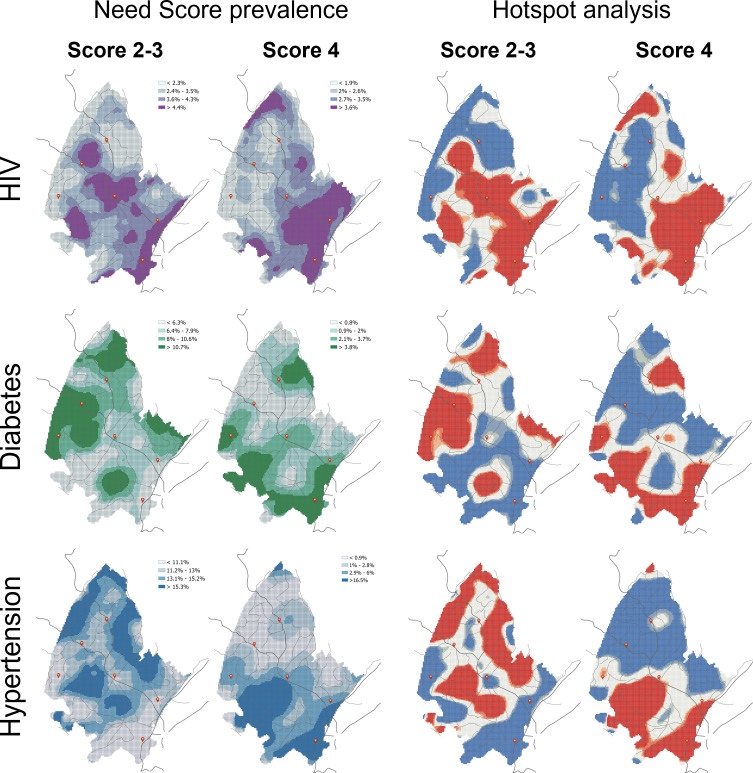
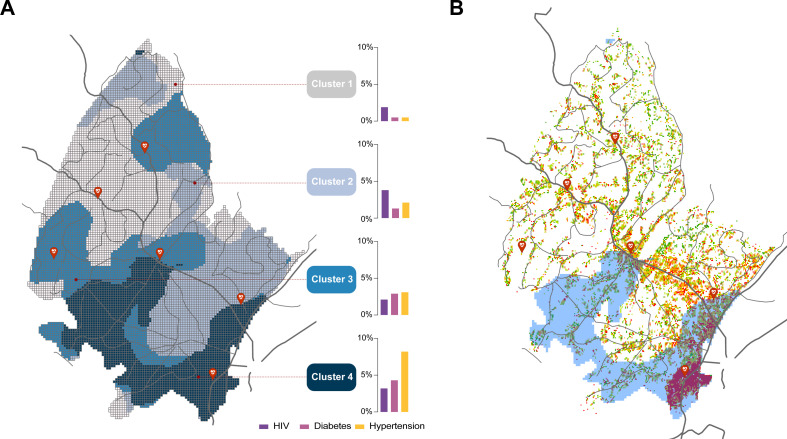
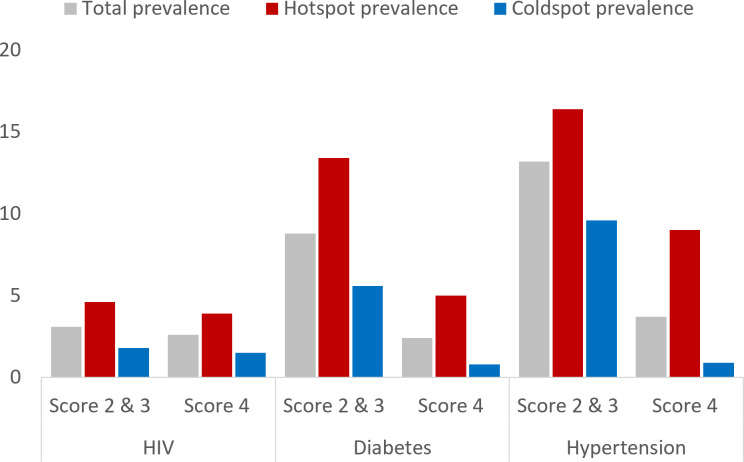
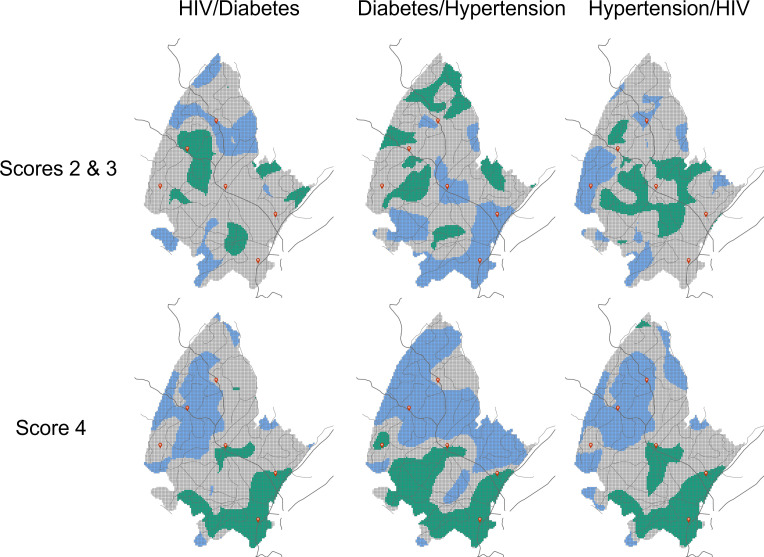
The analytical sample comprised 18 041 individuals. We observed a similar spatial structure for HIV among those with combined needs Score 2-3 (diagnosed but uncontrolled) and Score 4 (undiagnosed and uncontrolled), with most PLHIV with unmet needs clustered in the southern urban and peri-urban areas. Conversely, a high prevalence of need Scores 2 and 3 for diabetes and hypertension was mostly distributed in the more rural central and northern part of the surveillance area. A high prevalence of need Score 4 for diabetes and hypertension was mostly distributed in the rural southern part of the surveillance area. Multivariate clustering analysis revealed a significant overlap of all three diseases in individuals with undiagnosed and uncontrolled diseases (unmet needs Score 4) in the southern part of the catchment area.
In an HIV hyperendemic community in South Africa, areas with the highest needs for PLHIV with undiagnosed and uncontrolled disease are also areas with the highest burden of unmet needs for other chronic health conditions, such as diabetes and hypertension. Our study has revealed remarkable differences in the distribution of health needs across the rural to urban continuum even within this relatively small study site. The identification and prioritisation of geographically clustered vulnerable communities with unmet health needs for both HIV and non-communicable diseases provide a basis for policy and implementation strategies to target communities with the highest health needs.
随着艾滋病毒感染者(PLHIV)的存活时间延长,艾滋病毒和非传染性疾病的同时发生已成为公共卫生的重点。针对这一新兴挑战,我们旨在描述南非夸祖鲁-纳塔尔省一个艾滋病毒高度流行社区中慢性健康状况趋同的空间结构。
在这项横断面研究中,我们使用了南非夸祖鲁-纳塔尔省一项全面的基于人群的疾病调查的数据,该调查收集了艾滋病毒、糖尿病和高血压的数据。我们实施了一种新的健康需求量表,将参与者分为以下几类:已确诊且控制良好(需求评分 1)、已确诊但控制不佳(评分 2)、已确诊但未接受治疗(评分 3)或未确诊且未控制(评分 4)。评分 2-4 表示存在未满足的健康需求。我们使用不同的空间聚类方法探索了未满足的健康需求的地理空间结构。
分析样本包括 18041 人。我们观察到那些同时存在需求评分 2-3(已确诊但未控制)和评分 4(未确诊且未控制)的艾滋病毒患者具有相似的空间结构,大多数未满足需求的 PLHIV 集中在南部城区和城郊地区。相反,糖尿病和高血压需求评分 2 和 3 的高患病率主要分布在监测区域更农村的中部和北部。糖尿病和高血压需求评分 4 的高患病率主要分布在监测区域南部的农村地区。多变量聚类分析显示,在监测区域南部未确诊和未控制疾病(未满足需求评分 4)的个体中,三种疾病存在显著重叠。
在南非一个艾滋病毒高度流行的社区中,未确诊和未控制疾病的 PLHIV 需求最高的地区也是糖尿病和高血压等其他慢性健康状况未满足需求负担最重的地区。我们的研究揭示了即使在这个相对较小的研究地点,从农村到城市的连续体上,健康需求的分布也存在显著差异。确定和优先考虑艾滋病毒和非传染性疾病均有未满足健康需求的地理上聚集的弱势社区,为针对需求最高的社区制定政策和实施战略提供了依据。