Digital Health, Institute of Health Research and Innovation, University of the Highlands and Islands, Inverness, UK.
Cardiology Unit, Raigmore Hospital, NHS Highland, Inverness, Scotland, UK.
Sci Rep. 2023 Aug 17;13(1):13376. doi: 10.1038/s41598-023-39451-5.
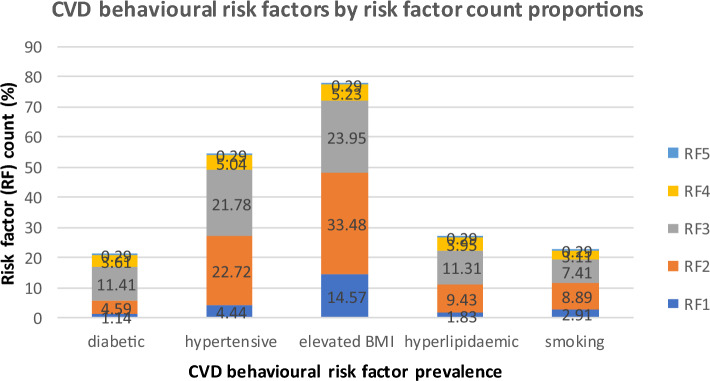
This study aims to (1) assess the distribution of variables within the population and the prevalence of cardiovascular disease (CVD) behavioural risk factors in patients, (2) identify target risk factor(s) for behaviour modification intervention, and (3) develop an analytical model to define cluster(s) of risk factors which could help make any generic intervention more targeted to the local patient population. Study patients with at least one CVD behavioural risk factor living in a rural region of the Scottish Highlands. The study used the STROBE methodology for cross-sectional studies. Demographic and clinical data of patients (n = 2025) in NHS Highlands hospital were collected at the point of admission for PCI between 04.01.2016 and 31.12.2019. Collected data distributions were analysed by CVD behavioural risk factors for prevalence, associations, and direction of associations. Cluster definition was measured by assignment of a unit score each for the overall level of prevalence and significance of associations, and general logistics modelling for direction and significance of the risk. The mean (SD) age was 69.47(± 10.93) years [95% CI (68.99-69.94)]. The key risk factors were hyperlipidaemia, hypertension, and elevated body mass index (BMI). Approximately 40% of the population have multiple risk factor counts of two. Analytical measures revealed a population risk factor cluster with elevated BMI [77.5% (1570/2025)] that is mostly either hyperlipidaemic [9.43%, co-eff. (17), P = 0.007] or hypertensive [22.72%, co-eff. (17), P = 0.99] as key risk factor clusters. Carefully modelled analyses revealed clustered risk associated with elevated BMI. This information would support a strategy for targeting risk factor clusters in novel interventions to improve implementation efficiency. Exposure to and outcome of an elevated BMI is linked more to the population's socio-economic outcomes rather than to regional rurality or urbanity.
(1)评估人群中变量的分布以及患者心血管疾病 (CVD) 行为风险因素的流行率;(2)确定行为修正干预的目标风险因素;(3)开发分析模型以确定可帮助使任何通用干预措施更针对当地患者人群的风险因素群。研究对象为居住在苏格兰高地农村地区的至少有一种 CVD 行为风险因素的患者。本研究使用 STROBE 方法进行横断面研究。2016 年 4 月 1 日至 2019 年 12 月 31 日期间,在 NHS 高地医院因 PCI 入院的患者 (n=2025) 的人口统计学和临床数据在入院时收集。通过 CVD 行为风险因素分析数据分布的流行率、关联和关联方向。通过为总体流行率和关联显著性分配单位分数以及为风险的方向和显著性分配通用物流建模来定义聚类定义。平均(SD)年龄为 69.47(±10.93)岁[95%置信区间(68.99-69.94)]。主要风险因素为高脂血症、高血压和体重指数 (BMI) 升高。大约 40%的人群有两个以上的风险因素计数。分析措施揭示了一个具有升高 BMI 的人群风险因素群[77.5% (1570/2025)],这主要是高脂血症[9.43%,系数(17),P=0.007]或高血压[22.72%,系数(17),P=0.99]作为关键风险因素群。经过精心建模的分析揭示了与升高 BMI 相关的聚类风险。这些信息将支持针对新干预措施中的风险因素群的策略,以提高实施效率。暴露于升高的 BMI 及其结果与人群的社会经济结果更相关,而与区域农村或城市性无关。