Carey Katherine J, Hotvedt Peter, Mummy David G, Lee Kristine E, Denlinger Loren C, Schiebler Mark L, Sorkness Ronald L, Jarjour Nizar N, Hatt Charles R, Galban Craig J, Fain Sean B
Department of Medical Physics, University of Wisconsin-Madison, Madison, WI, United States.
Department of Radiology, University of Wisconsin-Madison, Madison, WI, United States.
Front Physiol. 2023 Aug 1;14:1178339. doi: 10.3389/fphys.2023.1178339. eCollection 2023.
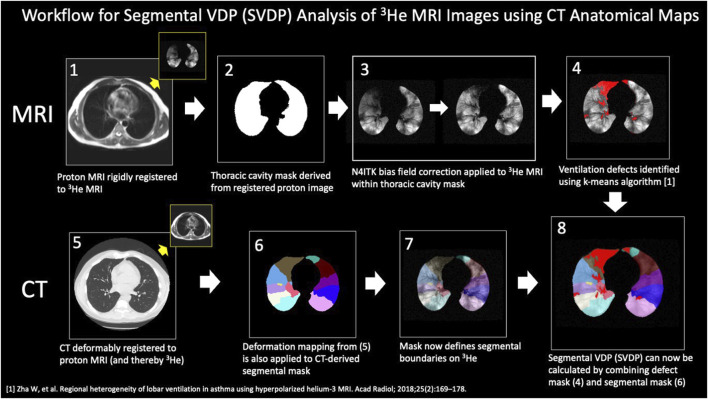
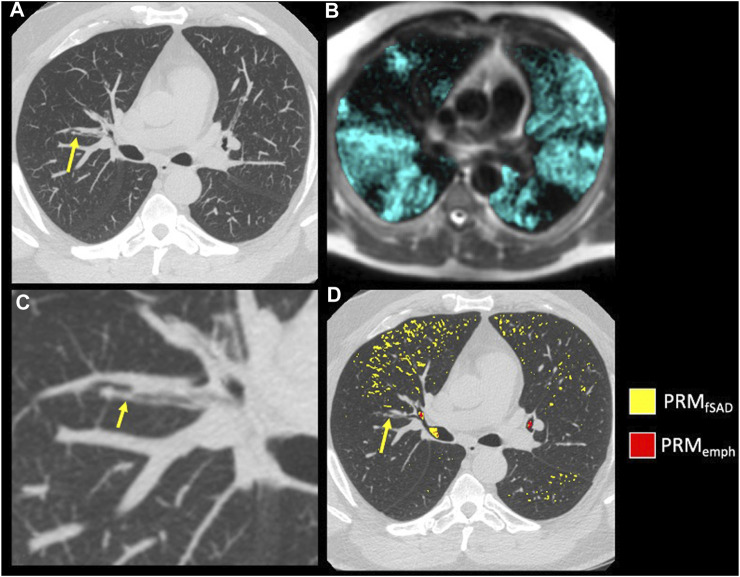
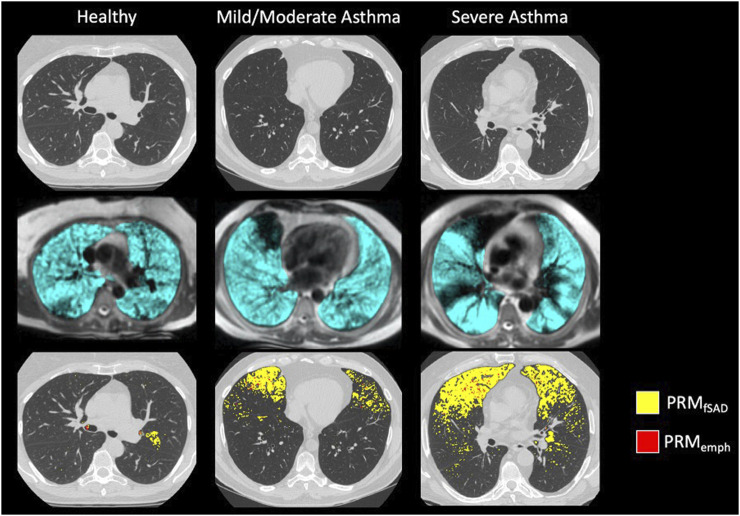
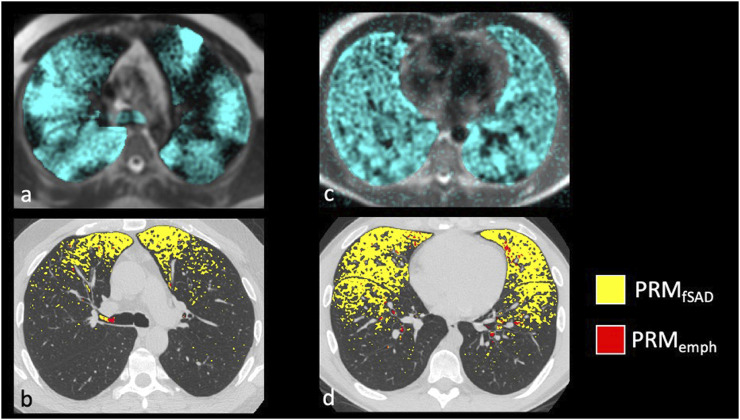
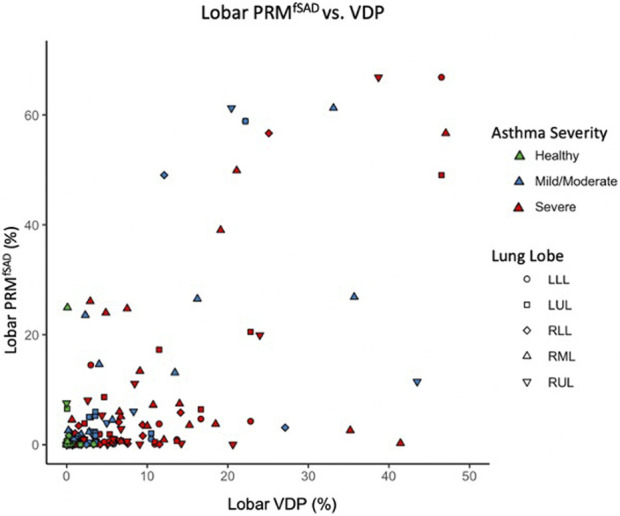
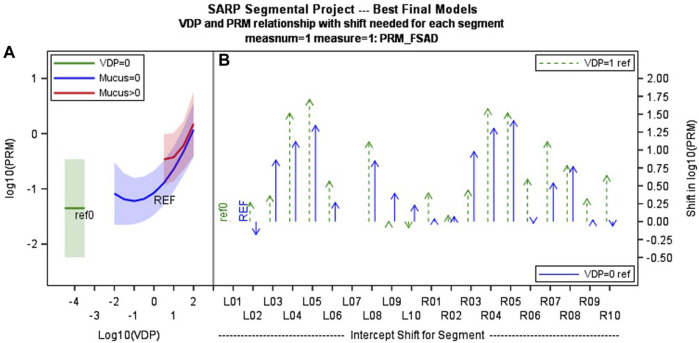
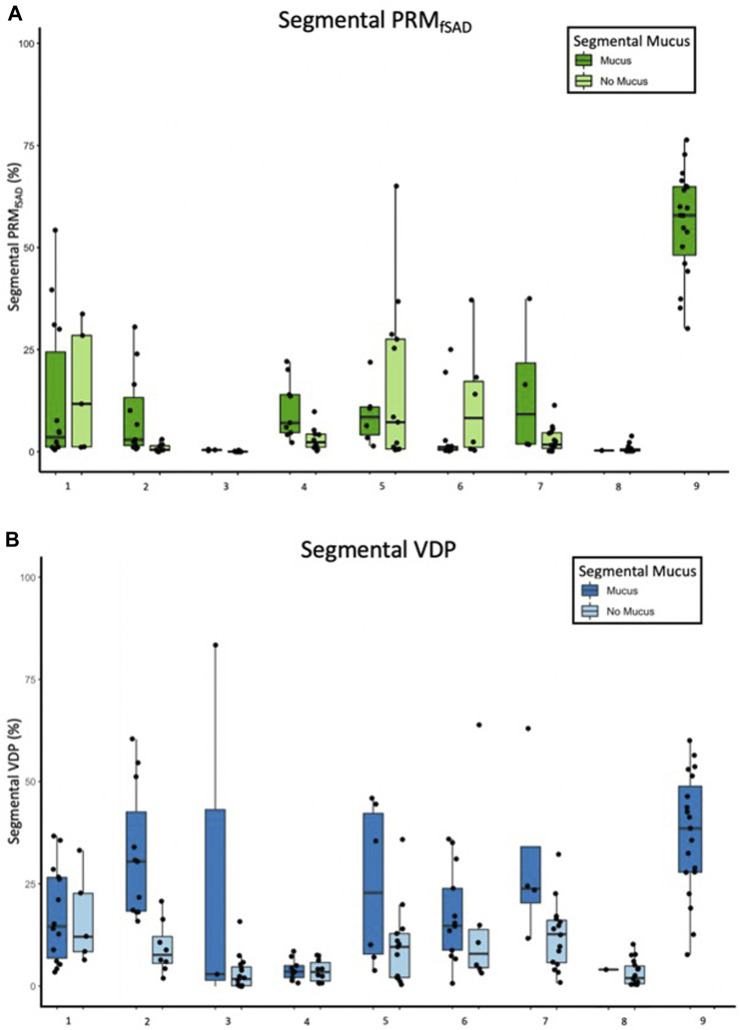
The purpose of this study was to anatomically correlate ventilation defects with regions of air trapping by whole lung, lung lobe, and airway segment in the context of airway mucus plugging in asthma. A total of 34 asthmatics [13M:21F, 13 mild/moderate, median age (range) of 49.5 (36.8-53.3) years and 21 severe, 56.1 (47.1-62.6) years] and 4 healthy subjects [1M:3F, 38.5 (26.6-52.2) years] underwent HP He MRI and CT imaging. HP He MRI was assessed for ventilation defects using a semi-automated k-means clustering algorithm. Inspiratory and expiratory CTs were analyzed using parametric response mapping (PRM) to quantify markers of emphysema and functional small airways disease (fSAD). Segmental and lobar lung masks were obtained from CT and registered to HP He MRI in order to localize ventilation defect percent (VDP), at the lobar and segmental level, to regions of fSAD and mucus plugging. Spearman's correlation was utilized to compare biomarkers on a global and lobar level, and a multivariate analysis was conducted to predict segmental fSAD given segmental VDP (sVDP) and mucus score as variables in order to further understand the functional relationships between regional measures of obstruction. On a global level, fSAD was correlated with whole lung VDP ( = 0.65, < 0.001), mucus score ( = 0.55, < 0.01), and moderately correlated (-0.60 r -0.56, < 0.001) to percent predicted (%p) FEV1, FEF25-75 and FEV1/FVC, and more weakly correlated to FVC%p (-0.38 -0.35, < 0.001) as expected from previous work. On a regional level, lobar VDP, mucus scores, and fSAD were also moderately correlated (r from 0.45-0.66, < 0.01). For segmental colocalization, the model of best fit was a piecewise quadratic model, which suggests that sVDP may be increasing due to local airway obstruction that does not manifest as fSAD until more extensive disease is present. sVDP was more sensitive to the presence of a mucus plugs overall, but the prediction of fSAD using multivariate regression showed an interaction in the presence of a mucus plugs when sVDP was between 4% and 10% ( < 0.001). This multi-modality study in asthma confirmed that areas of ventilation defects are spatially correlated with air trapping at the level of the airway segment and suggests VDP and fSAD are sensitive to specific sources of airway obstruction in asthma, including mucus plugs.
本研究的目的是在哮喘气道黏液阻塞的背景下,从全肺、肺叶和气道节段层面,对通气缺陷与气体陷闭区域进行解剖学关联分析。共有34例哮喘患者[13例男性:21例女性,13例轻度/中度,中位年龄(范围)为49.5(36.8 - 53.3)岁,21例重度,56.1(47.1 - 62.6)岁]和4例健康受试者[1例男性:3例女性,38.5(26.6 - 52.2)岁]接受了氦质子磁共振成像(HP He MRI)和CT成像检查。使用半自动k均值聚类算法评估HP He MRI的通气缺陷情况。利用参数反应映射(PRM)分析吸气和呼气CT,以量化肺气肿和功能性小气道疾病(fSAD)的指标。从CT中获取肺段和肺叶掩码,并将其配准到HP He MRI,以便在肺叶和肺段层面将通气缺陷百分比(VDP)定位到fSAD和黏液阻塞区域。采用Spearman相关性分析在整体和肺叶水平比较生物标志物,并进行多变量分析,以节段性VDP(sVDP)和黏液评分作为变量预测节段性fSAD,从而进一步了解区域阻塞指标之间的功能关系。在整体水平上,fSAD与全肺VDP(r = 0.65,P < 0.001)、黏液评分(r = 0.55,P < 0.01)相关,与预测值百分比(%p)FEV1、FEF25 - 75和FEV1/FVC中度相关(-0.60 ≤ r ≤ -0.56,P < 0.001),与FVC%p的相关性较弱(-0.38 ≤ r ≤ -0.35,P < 0.001),这与之前的研究结果相符。在区域水平上,肺叶VDP、黏液评分和fSAD也呈中度相关(r为0.45 - 0.66,P < 0.01)。对于节段性共定位,最佳拟合模型是分段二次模型,这表明sVDP可能因局部气道阻塞而增加,直到出现更广泛的疾病才表现为fSAD。总体而言,sVDP对黏液阻塞的存在更敏感,但当sVDP在4%至10%之间时,多变量回归预测fSAD显示在存在黏液阻塞时有相互作用(P < 0.