Sondore Dace, Trušinskis Kārlis, Linde Matīss, Briede Ieva, Narbute Inga, Jēgere Sanda, Griķis Kārlis, Štrenge Kārlis, Ērglis Andrejs
Latvian Centre of Cardiology, Pauls Stradins Clinical University Hospital, Riga, Latvia.
Department of Internal Diseases, Faculty of Medicine, Riga Stradins University, Riga, Latvia.
J Clin Transl Res. 2023 Jul 12;9(4):253-260. eCollection 2023 Aug 31.
Atherosclerosis is considered to be a systemic disease; however, evidence exists on the heterogeneous nature of atherosclerotic disease. To date, continuous research seeks to determine the morphological differences between carotid and coronary artery disease. This study aimed to evaluate the relationship of morphological characteristics assessed by virtual histology intravascular ultrasound (VH-IVUS) between carotid and coronary plaque composition among patients with and without a history of cerebrovascular events.
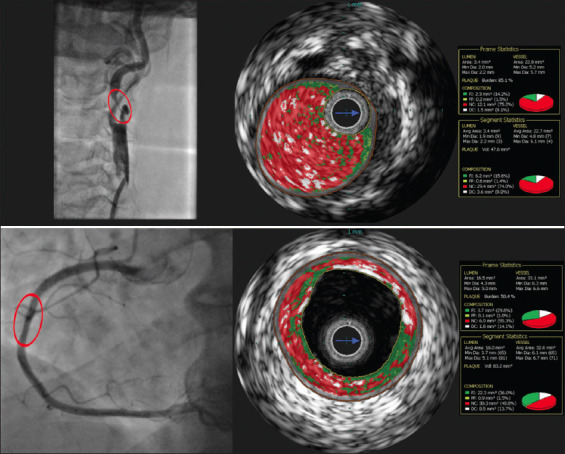
This study was a single-center prospective study ( = 100; age 69.6 ± 8.4). All patients were scheduled for carotid or coronary artery stenting and underwent VH-IVUS examination of the carotid and coronary arteries before intervention.
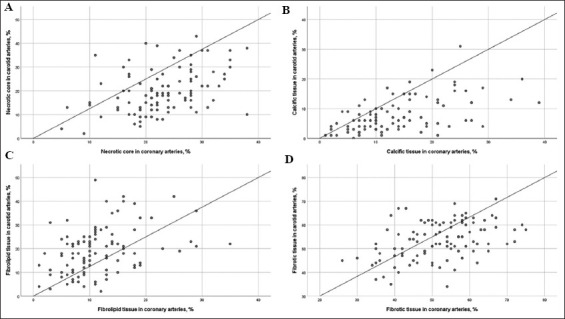
There was a modest, but statistically significant correlation between the carotid and coronary necrotic core ([NC] r = 0.46, < 0.01), fibrofatty ([FF] r = 0.38, < 0.01), dense calcium (r = 0.56, < 0.01), and fibrous (r = 0.42, < 0.01) plaque composition. The high amount of NC was detected in both arteries of the carotid artery stenting (CAS) group with higher proportion in the coronary artery (20.2% ± 9.4 % vs. 22.7% ± 6.8%, = 0.02). More fibrolipid content was observed in carotid plaque compared to coronary (19.6% ± 9.9% vs. 12.2% ± 8.1%, < 0.01). Patients with a history of cerebrovascular events had a numerically greater proportion of necrotic tissue in the carotid artery compared to asymptomatic and symptomatic CAS group patients (23.5% ± 10.7% vs. 18.9% ± 8.2% and 18.7% ± 9.5%, = 0.11).
The percentage of all analyzed plaque components was moderately correlated between coronary and carotid artery plaques. Nevertheless, the proportion of NC plaque tissue was greater in the coronary arteries, while the carotid arteries showed more %FF atherosclerotic lesions. CAS group patients with a history of cerebrovascular events had a tendency of greater proportion of necrotic tissue in analyzed carotid plaques compared to others in the CAS group.
In this study, we found that patients with a history of cerebrovascular event had a tendency of increased NC content in culprit lesion of carotid artery. Complementary use of non-invasive and invasive imaging modalities allows to detect high-risk atherosclerotic plaques and adjust treatment strategy.
动脉粥样硬化被认为是一种全身性疾病;然而,有证据表明动脉粥样硬化疾病具有异质性。迄今为止,持续的研究致力于确定颈动脉和冠状动脉疾病之间的形态学差异。本研究旨在评估在有和没有脑血管事件病史的患者中,通过虚拟组织学血管内超声(VH-IVUS)评估的颈动脉和冠状动脉斑块成分的形态学特征之间的关系。
本研究为单中心前瞻性研究(n = 100;年龄69.6±8.4)。所有患者均计划进行颈动脉或冠状动脉支架置入术,并在干预前接受颈动脉和冠状动脉的VH-IVUS检查。
颈动脉和冠状动脉的坏死核心([NC] r = 0.46,P < 0.01)、纤维脂肪([FF] r = 0.38,P < 0.01)、致密钙(r = 0.56,P < 0.01)和纤维(r = 0.42,P < 0.01)斑块成分之间存在适度但具有统计学意义的相关性。在颈动脉支架置入术(CAS)组的两条动脉中均检测到大量的NC,在冠状动脉中的比例更高(20.2%±9.4%对22.7%±6.8%,P = 0.02)。与冠状动脉相比,颈动脉斑块中观察到更多的纤维脂质含量(19.6%±9.9%对12.2%±8.1%,P < 0.01)。有脑血管事件病史的患者与无症状和有症状的CAS组患者相比,颈动脉中坏死组织的比例在数值上更高(23.5%±十.7%对18.9%±8.2%和18.7%±9.5%,P = 0.11)。
所有分析的斑块成分百分比在冠状动脉和颈动脉斑块之间呈中度相关。然而,NC斑块组织在冠状动脉中的比例更大,而颈动脉显示出更多的%FF动脉粥样硬化病变。有脑血管事件病史的CAS组患者与CAS组中的其他患者相比,在分析的颈动脉斑块中坏死组织的比例有更高的趋势。
在本研究中,我们发现有脑血管事件病史的患者在颈动脉罪犯病变中NC含量有增加的趋势。无创和有创成像方式的互补使用有助于检测高危动脉粥样硬化斑块并调整治疗策略。