Bai Yanhu, Huang Mengdi, Huang Minmin, Luo Jianli, Yang Zhuodong
School of Business, Wenzhou University, Wenzhou, 325035, China.
Heliyon. 2023 Aug 1;9(8):e18850. doi: 10.1016/j.heliyon.2023.e18850. eCollection 2023 Aug.
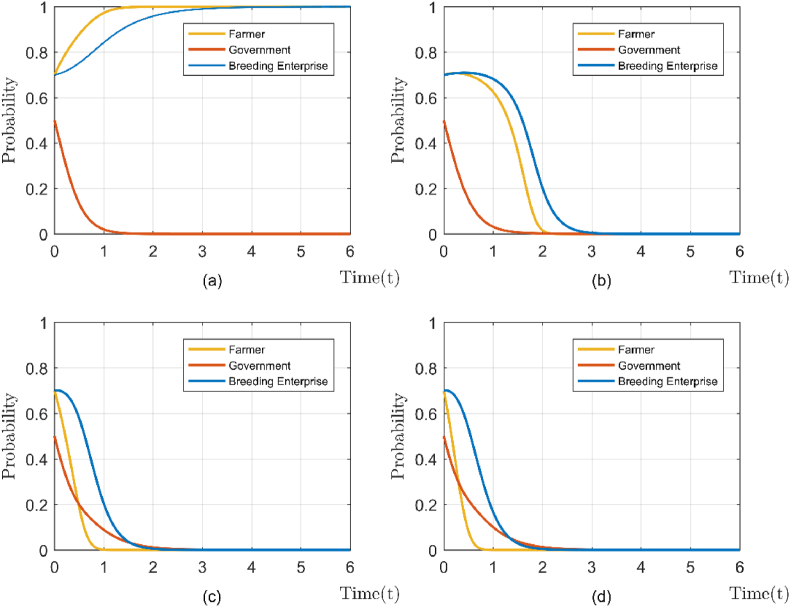
Food security constitutes a foundational cornerstone for social stability, with the achievement of sustainable agricultural production serving as a vital step towards this objective. Currently, the untimely harvesting of unripe wheat by farmers has led to a decline in food production, thereby posing a significant threat to the sustainability of China's food system and exacerbating food insecurity. Although the Chinese government has implemented various measures in response, their effectiveness has been limited. Limited scholarly literature exists on this particular issue. To advance food security in China, this study develops a tripartite evolutionary game model involving farmers, the government, and breeding enterprises. Adopting a systemic perspective, this study examines the interactions and impact mechanisms among these key actors during the wheat harvesting process. The findings indicate that the government should prioritize policies that enforce penalties. By implementing penalties within a reasonable range, the government can mitigate farmers' production costs and enhance the market price of grain. This approach discourages farmers from harvesting immature wheat and contributes to enhancing food security. Based on the research findings, this paper provides practical recommendations to guide the government in addressing food security governance issues.
粮食安全是社会稳定的基石,实现农业可持续生产是迈向这一目标的关键一步。目前,农民过早收割未成熟小麦导致粮食产量下降,对中国粮食系统的可持续性构成重大威胁,并加剧了粮食不安全状况。尽管中国政府已采取各种应对措施,但其效果有限。关于这一特定问题的学术文献有限。为推进中国的粮食安全,本研究构建了一个涉及农民、政府和育种企业的三方演化博弈模型。本研究从系统角度审视了这些关键行为主体在小麦收割过程中的相互作用和影响机制。研究结果表明,政府应优先制定实施惩罚的政策。通过在合理范围内实施惩罚,政府可以降低农民的生产成本,提高粮食市场价格。这种方法可抑制农民过早收割未成熟小麦,有助于加强粮食安全。基于研究结果,本文提出了切实可行的建议,以指导政府解决粮食安全治理问题。