Department of Pathology and Laboratory Medicine, College of Medicine, University of Tennessee Health Science Center, Memphis, Tennessee, USA.
Department of Pharmaceutical Sciences, College of Pharmacy, University of Tennessee Health Science Center, Memphis, Tennessee, USA.
J Cell Mol Med. 2023 Sep;27(18):2770-2781. doi: 10.1111/jcmm.17907. Epub 2023 Aug 18.
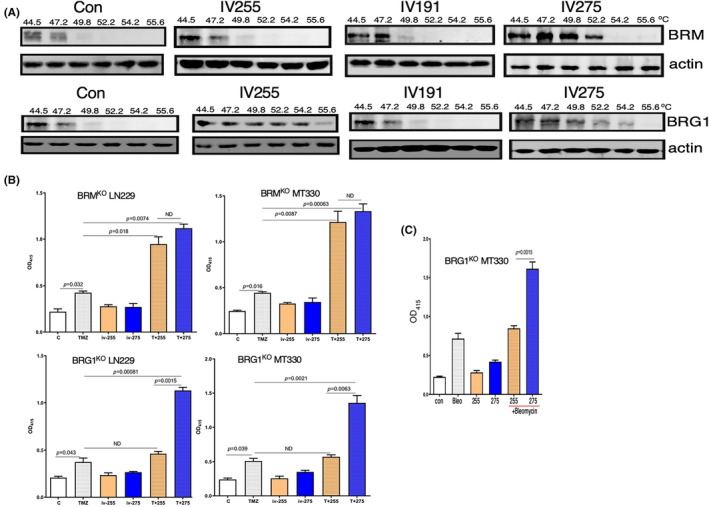
Glioblastoma (GBM) is an aggressive brain cancer with a poor prognosis. While surgical resection is the primary treatment, adjuvant temozolomide (TMZ) chemotherapy and radiotherapy only provide slight improvement in disease course and outcome. Unfortunately, most treated patients experience recurrence of highly aggressive, therapy-resistant tumours and eventually succumb to the disease. To increase chemosensitivity and overcome therapy resistance, we have modified the chemical structure of the PFI-3 bromodomain inhibitor of the BRG1 and BRM catalytic subunits of the SWI/SNF chromatin remodelling complex. Our modifications resulted in compounds that sensitized GBM to the DNA alkylating agent TMZ and the radiomimetic bleomycin. We screened these chemical analogues using a cell death ELISA with GBM cell lines and a cellular thermal shift assay using epitope tagged BRG1 or BRM bromodomains expressed in GBM cells. An active analogue, IV-129, was then identified and further modified, resulting in new generation of bromodomain inhibitors with distinct properties. IV-255 and IV-275 had higher bioactivity than IV-129, with IV-255 selectively binding to the bromodomain of BRG1 and not BRM, while IV-275 bound well to both BRG1 and BRM bromodomains. In contrast, IV-191 did not bind to either bromodomain or alter GBM chemosensitivity. Importantly, both IV-255 and IV-275 markedly increased the extent of DNA damage induced by TMZ and bleomycin as determined by nuclear γH2AX staining. Our results demonstrate that these next-generation inhibitors selectively bind to the bromodomains of catalytic subunits of the SWI/SNF complex and sensitize GBM to the anticancer effects of TMZ and bleomycin. This approach holds promise for improving the treatment of GBM.
胶质母细胞瘤(GBM)是一种侵袭性脑癌,预后不良。虽然手术切除是主要治疗方法,但辅助替莫唑胺(TMZ)化疗和放疗只能略微改善疾病进程和结果。不幸的是,大多数接受治疗的患者都会复发高度侵袭性、治疗耐药的肿瘤,最终死于该疾病。为了提高化疗敏感性并克服治疗耐药性,我们对 BRG1 和 BRM 催化亚基的 SWI/SNF 染色质重塑复合物的 PFI-3 溴结构域抑制剂的化学结构进行了修饰。我们的修饰导致化合物使 GBM 对 DNA 烷化剂 TMZ 和放射模拟物博来霉素敏感。我们使用 GBM 细胞系的细胞死亡 ELISA 和在 GBM 细胞中表达的表位标记的 BRG1 或 BRM 溴结构域的细胞热转移测定法筛选了这些化学类似物。然后鉴定出一种活性类似物 IV-129,并对其进行了进一步修饰,从而产生了具有独特特性的新一代溴结构域抑制剂。IV-255 和 IV-275 的生物活性比 IV-129 更高,IV-255 选择性地与 BRG1 的溴结构域结合,而不与 BRM 结合,而 IV-275 与 BRG1 和 BRM 溴结构域结合良好。相比之下,IV-191 既不与溴结构域结合也不改变 GBM 的化疗敏感性。重要的是,IV-255 和 IV-275 都显著增加了 TMZ 和博来霉素诱导的 DNA 损伤的程度,如核 γH2AX 染色所确定的。我们的结果表明,这些下一代抑制剂选择性地与 SWI/SNF 复合物的催化亚基的溴结构域结合,并使 GBM 对 TMZ 和博来霉素的抗癌作用敏感。这种方法有望改善 GBM 的治疗效果。