Division of Cancer Control and Population Sciences, NCI, Bethesda, Maryland.
Public Health Sciences Division, Fred Hutchinson Cancer Center, Seattle, Washington.
Cancer Epidemiol Biomarkers Prev. 2023 Nov 1;32(11):1591-1598. doi: 10.1158/1055-9965.EPI-23-0066.
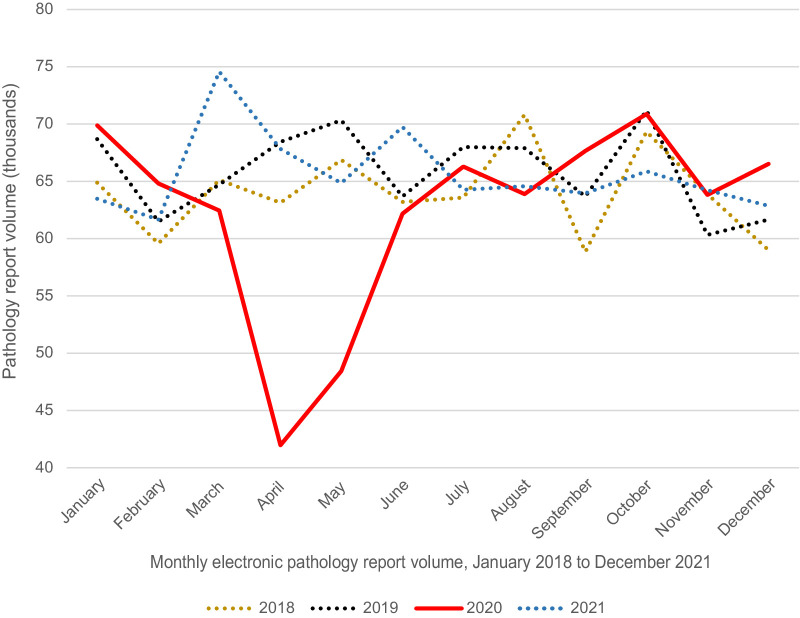
Health care procedures including cancer screening and diagnosis were interrupted due to the COVID-19 pandemic. The extent of this impact on cancer care in the United States is not fully understood. We investigated pathology report volume as a reflection of trends in oncology services pre-pandemic and during the pandemic.
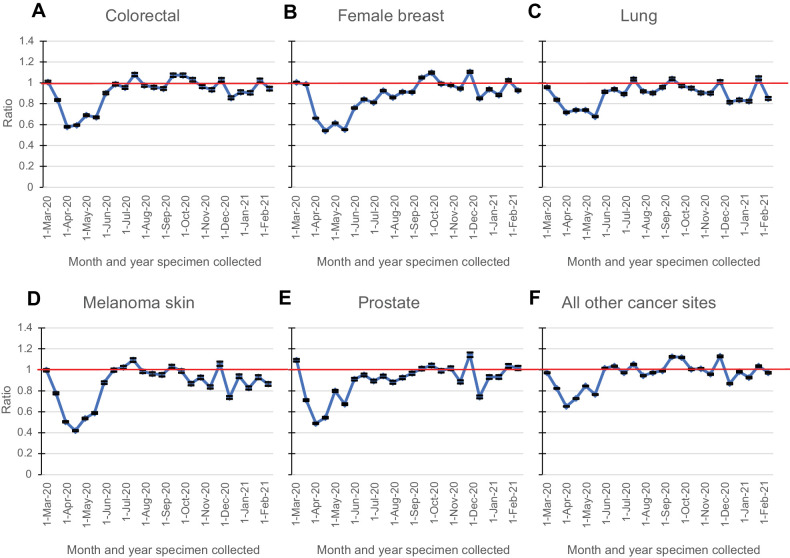
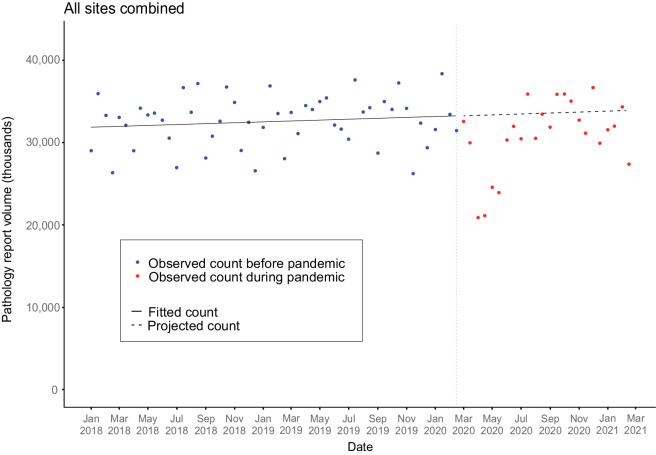
Electronic pathology reports were obtained from 11 U.S. central cancer registries from NCI's SEER Program. The reports were sorted by cancer site and document type using a validated algorithm. Joinpoint regression was used to model temporal trends from January 2018 to February 2020, project expected counts from March 2020 to February 2021 and calculate observed-to-expected ratios. Results were stratified by sex, age, cancer site, and report type.
During the first 3 months of the pandemic, pathology report volume decreased by 25.5% and 17.4% for biopsy and surgery reports, respectively. The 12-month O/E ratio (March 2020-February 2021) was lowest for women (O/E 0.90) and patients 65 years and older (O/E 0.91) and lower for cancers with screening (melanoma skin, O/E 0.86; breast, O/E 0.88; lung O/E 0.89, prostate, O/E 0.90; colorectal, O/E 0.91) when compared with all other cancers combined.
These findings indicate a decrease in cancer diagnosis, likely due to the COVID-19 pandemic. This decrease in the number of pathology reports may result in a stage shift causing a subsequent longer-term impact on survival patterns.
Investigation on the longer-term impact of the pandemic on pathology services is vital to understand if cancer care delivery levels continue to be affected.
由于 COVID-19 大流行,包括癌症筛查和诊断在内的医疗程序被中断。目前尚不完全了解这对美国癌症护理的影响程度。我们调查了病理学报告数量,以反映大流行前和大流行期间肿瘤服务的趋势。
从 NCI 的 SEER 计划中的 11 个美国中央癌症登记处获得电子病理学报告。使用经过验证的算法按癌症部位和文档类型对报告进行分类。使用 Joinpoint 回归模型对 2018 年 1 月至 2020 年 2 月的时间趋势进行建模,预测 2020 年 3 月至 2021 年 2 月的预期计数,并计算观察到的与预期的比值。结果按性别、年龄、癌症部位和报告类型分层。
在大流行的头 3 个月中,活检和手术报告的病理学报告量分别下降了 25.5%和 17.4%。12 个月的 O/E 比值(2020 年 3 月至 2021 年 2 月)对于女性(O/E 0.90)和 65 岁及以上的患者(O/E 0.91)最低,对于具有筛查的癌症(皮肤黑色素瘤、乳腺癌、肺癌 O/E 0.89、前列腺癌、O/E 0.90;结直肠癌、O/E 0.91)也低于所有其他癌症的组合。
这些发现表明癌症诊断减少,可能是由于 COVID-19 大流行。病理学报告数量的减少可能导致分期转移,从而对生存模式产生后续的长期影响。
调查大流行对病理学服务的长期影响对于了解癌症护理提供水平是否继续受到影响至关重要。