Department of Informatics, Technical University of Munich, Boltzmannstraße 3, 85748, Garching, Bavaria, Germany.
Department of Computer Science, Chemnitz University of Technology, Straße der Nationen 62, 09111, Chemnitz, Saxony, Germany.
Biol Cybern. 2023 Oct;117(4-5):275-284. doi: 10.1007/s00422-023-00970-z. Epub 2023 Aug 18.
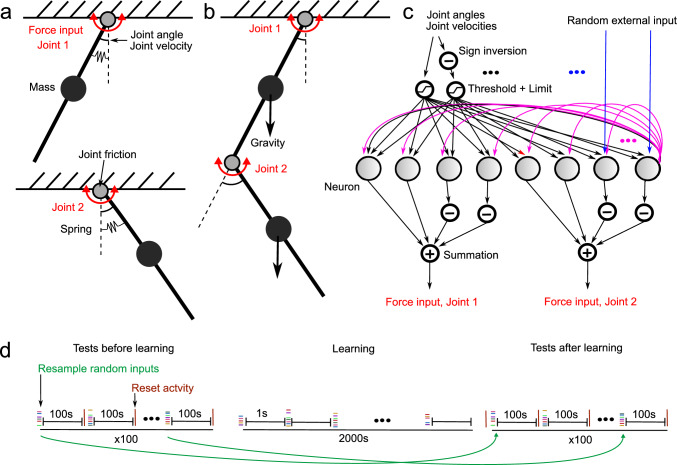
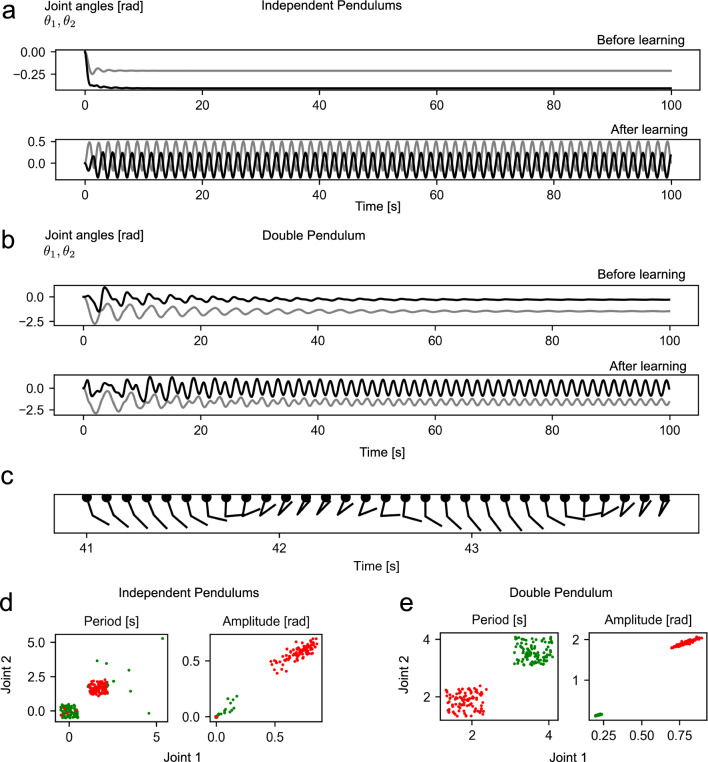
Currently, it is accepted that animal locomotion is controlled by a central pattern generator in the spinal cord. Experiments and models show that rhythm generating neurons and genetically determined network properties could sustain oscillatory output activity suitable for locomotion. However, current central pattern generator models do not explain how a spinal cord circuitry, which has the same basic genetic plan across species, can adapt to control the different biomechanical properties and locomotion patterns existing in these species. Here we demonstrate that rhythmic and alternating movements in pendulum models can be learned by a monolayer spinal cord circuitry model using the Bienenstock-Cooper-Munro learning rule, which has been previously proposed to explain learning in the visual cortex. These results provide an alternative theory to central pattern generator models, because rhythm generating neurons and genetically defined connectivity are not required in our model. Though our results are not in contradiction to current models, as existing neural mechanism and structures, not used in our model, can be expected to facilitate the kind of learning demonstrated here. Therefore, our model could be used to augment existing models.
目前,人们普遍认为动物的运动是由脊髓中的中枢模式发生器控制的。实验和模型表明,产生节律的神经元和由遗传决定的网络特性可以维持适合运动的振荡输出活动。然而,目前的中枢模式发生器模型并不能解释为什么具有相同基本遗传计划的脊髓电路能够适应控制这些物种中存在的不同生物力学特性和运动模式。在这里,我们证明使用以前提出的用于解释视觉皮层学习的 Bienenstock-Cooper-Munro 学习规则,单层脊髓电路模型可以学习摆锤模型中的节奏和交替运动。这些结果为中枢模式发生器模型提供了一种替代理论,因为我们的模型不需要产生节律的神经元和由遗传定义的连接。尽管我们的结果与现有模型并不矛盾,因为预期现有神经机制和结构(未用于我们的模型中)可以促进这里演示的学习类型。因此,我们的模型可以用来增强现有的模型。