Queensland Micro- and Nanotechnology Centre (QMNC), Griffith University, West Creek Road, Nathan, QLD 4111, Australia.
School of Environment and Science, Griffith University, Kessels Road, Nathan, QLD 4111, Australia.
Cardiovasc Res. 2023 Oct 24;119(13):2278-2293. doi: 10.1093/cvr/cvad130.
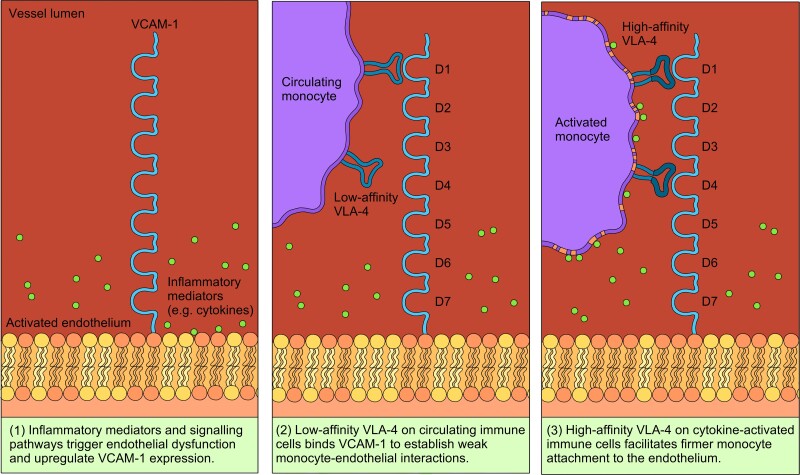
Vascular cell adhesion molecule-1 (VCAM-1) has been well established as a critical contributor to atherosclerosis and consequently as an attractive therapeutic target for anti-atherosclerotic drug candidates. Many publications have demonstrated that disrupting the VCAM-1 function blocks monocyte infiltration into the sub-endothelial space, which effectively prevents macrophage maturation and foam cell transformation necessary for atherosclerotic lesion formation. Currently, most VCAM-1-inhibiting drug candidates in pre-clinical and clinical testing do not directly target VCAM-1 itself but rather down-regulate its expression by inhibiting upstream cytokines and transcriptional regulators. However, the pleiotropic nature of these regulators within innate immunity means that optimizing dosage to a level that suppresses pathological activity while preserving normal physiological function is extremely challenging and oftentimes infeasible. In recent years, highly specific pharmacological strategies that selectively inhibit VCAM-1 function have emerged, particularly peptide- and antibody-based novel therapeutics. Studies in such VCAM-1-directed therapies so far remain scarce and are limited by the constraints of current experimental atherosclerosis models in accurately representing the complex pathophysiology of the disease. This has prompted the need for a comprehensive review that recounts the evolution of VCAM-1-directed pharmaceuticals and addresses the current challenges in novel anti-atherosclerotic drug development.
血管细胞黏附分子-1(VCAM-1)已被充分证实是动脉粥样硬化的关键贡献者,因此也是抗动脉粥样硬化候选药物的有吸引力的治疗靶点。许多出版物已经证明,破坏 VCAM-1 功能可以阻止单核细胞渗透到血管内皮下空间,从而有效阻止巨噬细胞成熟和泡沫细胞转化,这是动脉粥样硬化病变形成所必需的。目前,大多数处于临床前和临床试验阶段的 VCAM-1 抑制候选药物并不是直接针对 VCAM-1 本身,而是通过抑制上游细胞因子和转录调节剂来下调其表达。然而,这些先天免疫中调节因子的多效性意味着,要优化剂量以达到既能抑制病理性活动又能保留正常生理功能的水平,极具挑战性,而且往往是不可行的。近年来,出现了高度特异性的药理学策略,可选择性抑制 VCAM-1 功能,特别是基于肽和抗体的新型治疗方法。到目前为止,此类针对 VCAM-1 的治疗方法的研究仍然很少,并且受到当前实验性动脉粥样硬化模型在准确代表疾病复杂病理生理学方面的限制。这促使人们需要进行全面的综述,回顾 VCAM-1 靶向药物的发展,并解决新型抗动脉粥样硬化药物开发中的当前挑战。