Gultekin Okan, Gonzalez-Molina Jordi, Sarhan Dhifaf, Groes-Kofoed Nina, Hassan Mahmood Ul, Lehti Kaisa, Salehi Sahar
Department of Women's and Children's Health, division of Obstetrics and Gynecology, Karolinska Institutet, Stockholm, Sweden.
Department of Microbiology, Tumor and Cell Biology, Karolinska Institutet, Stockholm, Sweden.
Transl Oncol. 2025 Sep;59:102462. doi: 10.1016/j.tranon.2025.102462. Epub 2025 Jul 12.
Cytoreductive surgery in advanced ovarian cancer presents significant challenges and there is a need for an improved patient selection to surgical treatment. Cytokines and adhesion molecules are key regulators of immune responses, playing crucial roles in tumor cell adhesion, metastasis, and immune evasion. They shape the tumor microenvironment and influence systemic immunity, ultimately affecting cancer progression. Despite their recognized significance in cancer biology, the potential of cytokines as predictive biomarkers for surgical complexity and recurrence in ovarian cancer remains insufficiently characterized. This study aimed to elucidate the correlation between inflammatory cytokines and surgical outcomes, to identify reliable liquid or tissue-based biomarkers that could enhance patient stratification and support preoperative decision-making in ovarian cancer management.
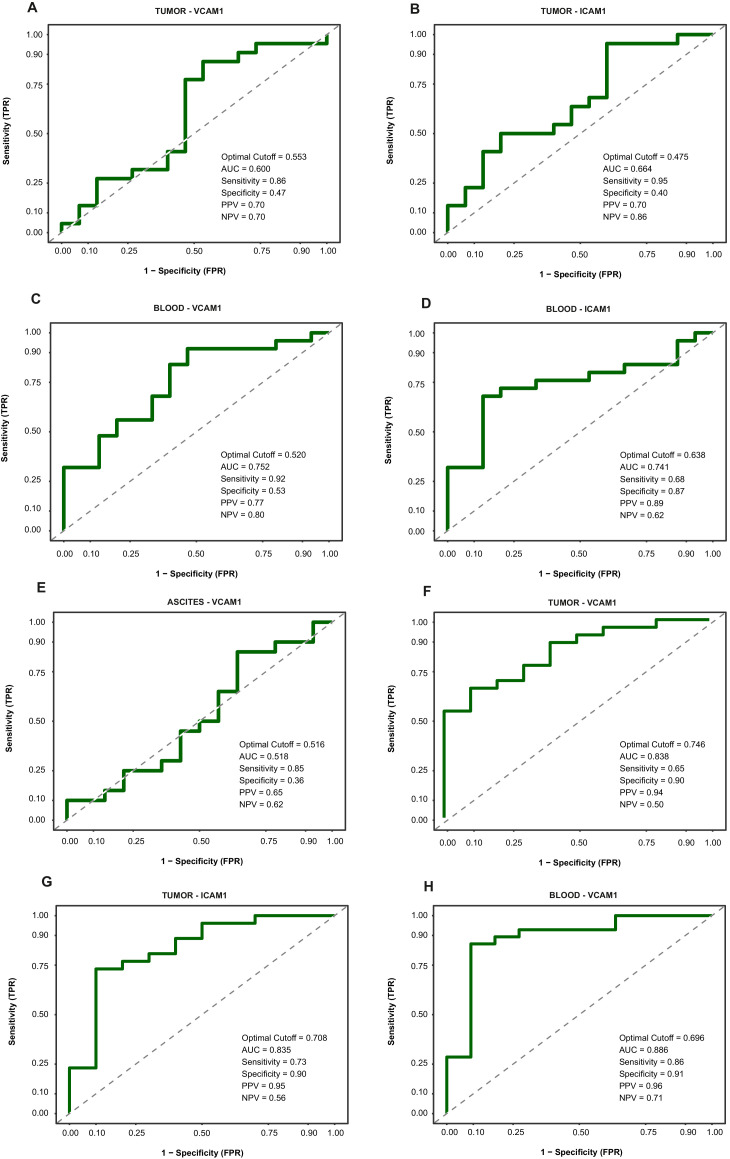
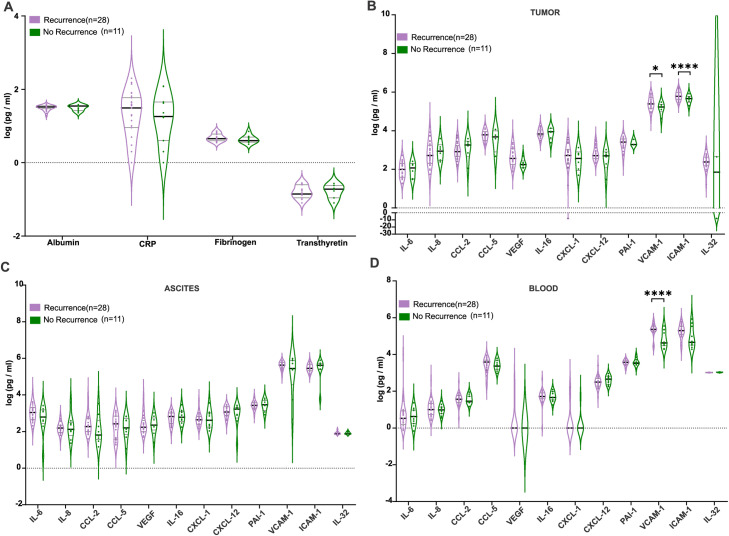
The Concentration of 10 inflammatory cytokines and 2 adhesion molecules concentrations were measured by Luminex based assay in blood, tumor tissue, and ascitic fluid samples from patients with advanced ovarian cancer prior to cytoreductive surgery. Clinical data were prospectively collected. Correlations between cytokines and adhesion molecules levels and surgical complexity, as well as disease/cancer recurrence, were assessed using Pearson two-tail statistical test analyses. The association between adhesion molecules and surgical extent, and recurrence was analysed using logistic regression yielding odds ratios (OR) with 95 % confidence intervals, adjusted for relevant covariates. The diagnostic accuracy of biomarker candidates was evaluated using receiver operating characteristic (ROC) curve analysis RESULTS: In blood, higher VCAM-1 and ICAM-1 levels correlated with lower surgical complexity scores, while ascitic VCAM-1 was linked to longer surgical durations. CXCL-12 in tumor and IL-32 in ascites were positively correlated with increased surgery duration, indicating their role in systemic inflammation. Elevated VCAM-1 and ICAM-1 levels in tumor tissue were strongly associated with increased cancer recurrence risk, suggesting their involvement in metastasis and immune evasion. Traditional preoperative markers, including albumin and CRP, did not correlate significantly with surgical complexity, highlighting the need for novel biomarkers. In the adjusted multivariable regression model, VCAM-1 in blood was associated with recurrence, OR 10.1 (95 % CI, 1.30-77.8; p=0.027). Similarly, VCAM-1 in blood demonstrated exceptional predictive capability, Area Under Curve=0.886 with cutoff point of 0.696.
Inflammatory markers can serve as valuable predictors of surgical complexity and recurrence in advanced ovarian cancer. Particularly the levels of VCAM-1 in blood was identified as a potential predictive marker to be tested in adequately powered clinical studies. Incorporating these markers into preoperative assessments could improve surgical planning and enhance patient stratification. Further validation and mechanistic studies are needed to fully understand their role in ovarian cancer progression.
ClinicalTrials.gov nr: NCT04065009, European Union Clinical Trials Register nr: 2019-003299-38/SE.
晚期卵巢癌的减瘤手术面临重大挑战,需要改进手术治疗的患者选择方法。细胞因子和黏附分子是免疫反应的关键调节因子,在肿瘤细胞黏附、转移和免疫逃逸中发挥着至关重要的作用。它们塑造肿瘤微环境并影响全身免疫,最终影响癌症进展。尽管细胞因子在癌症生物学中的重要性已得到认可,但其作为卵巢癌手术复杂性和复发的预测生物标志物的潜力仍未得到充分表征。本研究旨在阐明炎性细胞因子与手术结果之间的相关性,以确定可靠的基于液体或组织的生物标志物,从而加强患者分层并支持卵巢癌管理中的术前决策。
在晚期卵巢癌患者进行减瘤手术前,通过基于Luminex的检测方法测量血液、肿瘤组织和腹水样本中10种炎性细胞因子的浓度以及2种黏附分子的浓度。前瞻性收集临床数据。使用Pearson双尾统计检验分析评估细胞因子和黏附分子水平与手术复杂性以及疾病/癌症复发之间的相关性。使用逻辑回归分析黏附分子与手术范围和复发之间的关联,得出比值比(OR)及95%置信区间,并对相关协变量进行调整。使用受试者工作特征(ROC)曲线分析评估候选生物标志物的诊断准确性。结果:在血液中,较高的血管细胞黏附分子-1(VCAM-1)和细胞间黏附分子-1(ICAM-1)水平与较低的手术复杂性评分相关,而腹水中的VCAM-1与较长的手术持续时间相关。肿瘤中的CXC趋化因子配体12(CXCL-12)和腹水中的白细胞介素32(IL-32)与手术持续时间增加呈正相关,表明它们在全身炎症中的作用。肿瘤组织中升高的VCAM-1和ICAM-1水平与癌症复发风险增加密切相关,表明它们参与转移和免疫逃逸。包括白蛋白和C反应蛋白(CRP)在内的传统术前标志物与手术复杂性无显著相关性,凸显了新型生物标志物的必要性。在调整后的多变量回归模型中,血液中的VCAM-1与复发相关,OR为10.1(95%CI,1.30 - 77.8;p = 0.027)。同样,血液中的VCAM-1具有出色的预测能力,曲线下面积为0.886,截断点为0.696。
炎性标志物可作为晚期卵巢癌手术复杂性和复发的有价值预测指标。特别是血液中VCAM-1的水平被确定为一种潜在的预测标志物,有待在有足够样本量的临床研究中进行测试。将这些标志物纳入术前评估可改善手术规划并加强患者分层。需要进一步的验证和机制研究以充分了解它们在卵巢癌进展中的作用。
ClinicalTrials.gov编号:NCT04065009,欧盟临床试验注册编号:2019 - 003299 - 38/SE。