Centre for Cluster Headache, Department of Neuroscience, Karolinska Institutet, Stockholm, Sweden.
Department of Clinical Neuroscience, Karolinska Institutet, Stockholm, Sweden.
J Headache Pain. 2023 Aug 18;24(1):114. doi: 10.1186/s10194-023-01650-w.
Cluster headache (CH) is a primary headache disorder which is characterized by circadian timing of headache attacks, usually at nighttime, in around two thirds of patients. Patients with CH often report sleep difficulties, though it is unknown whether this is a cause or a consequence of nightly headache attacks.
In this case-control study we have assessed sleep quality in study participants with CH in cluster bout respectively in remission, compared to a control group of neurologically healthy individuals to investigate the potential connection between sleep and CH.
Fifty study participants with CH and 42 controls were recruited for sleep assessment. Sleep was recorded using MotionWatch 8 actigraphs (CamNTech) for a period of two weeks. Study participants were instructed to wear the unit during rest and sleep and to fill out a sleep diary daily through the two-weeks period.
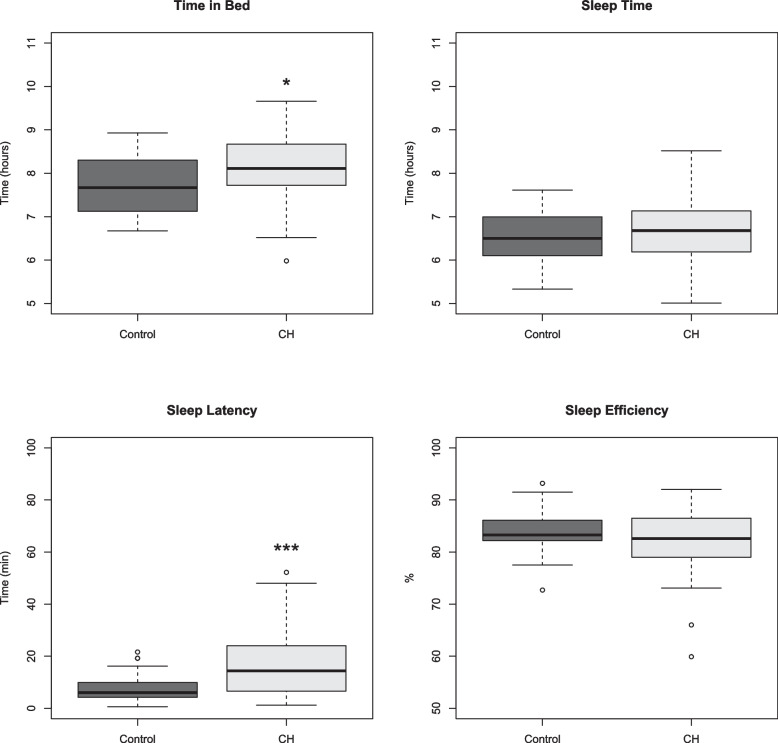
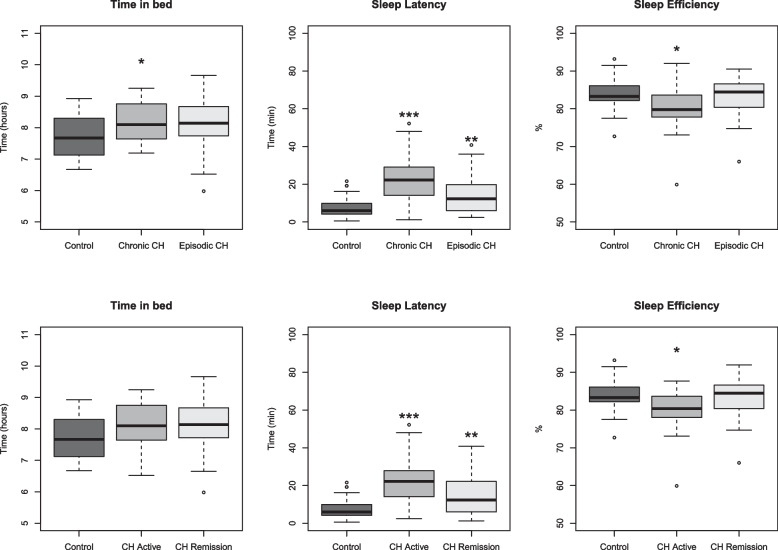
Results from actigraphy recordings and sleep diaries suggested that patients with CH spend longer time in bed than controls (CH 8.1 hours vs. Controls 7.7 hours, p=0.03), but do not sleep more than controls (CH 6.7 hours vs. controls 6.5 hours, p=0.3). In addition, CH patients reported increased sleep latency (p=0.003), particularly during, but not restricted to, cluster bouts. Study participants with CH further reported higher levels of stress at bedtime (p=0.01), and they felt less well rested than controls (p=0.001).
Our analysis suggests that sleep is negatively affected in CH both in cluster bout and in remission, manifesting in symptoms consistent with insomnia such as prolonged sleep latency and increased time in bed.
丛集性头痛(CH)是一种原发性头痛疾病,其特征是头痛发作具有昼夜节律,通常在夜间,约三分之二的患者会出现这种情况。患有 CH 的患者经常报告睡眠困难,尽管尚不清楚这是夜间头痛发作的原因还是后果。
在这项病例对照研究中,我们评估了处于发作期和缓解期的 CH 患者的睡眠质量,与一组神经健康的对照组进行了比较,以调查睡眠与 CH 之间的潜在联系。
招募了 50 名 CH 患者和 42 名对照者进行睡眠评估。使用 MotionWatch 8 活动记录仪(CamNTech)记录睡眠,为期两周。研究参与者被指示在休息和睡眠期间佩戴该设备,并在两周期间每天填写睡眠日记。
活动记录仪记录和睡眠日记的结果表明,CH 患者比对照组在床上的时间更长(CH 8.1 小时比对照组 7.7 小时,p=0.03),但睡眠时间并不比对照组长(CH 6.7 小时比对照组 6.5 小时,p=0.3)。此外,CH 患者报告的入睡潜伏期更长(p=0.003),特别是在发作期,但不限于发作期。CH 患者进一步报告在睡前感到压力更大(p=0.01),并且比对照组感觉休息更差(p=0.001)。
我们的分析表明,CH 患者的睡眠在发作期和缓解期均受到负面影响,表现为与失眠一致的症状,如入睡潜伏期延长和在床上的时间增加。