Department of Entomology, Michigan State University, 578 Wilson Road, East Lansing, MI 48824, USA.
Department of Plant, Soil and Microbial Sciences, Michigan State University Pesticide Analytical Laboratory, Center for Integrated Plant Systems, 578 Wilson Road, East Lansing, MI 48824, USA.
J Econ Entomol. 2023 Oct 10;116(5):1737-1749. doi: 10.1093/jee/toad162.
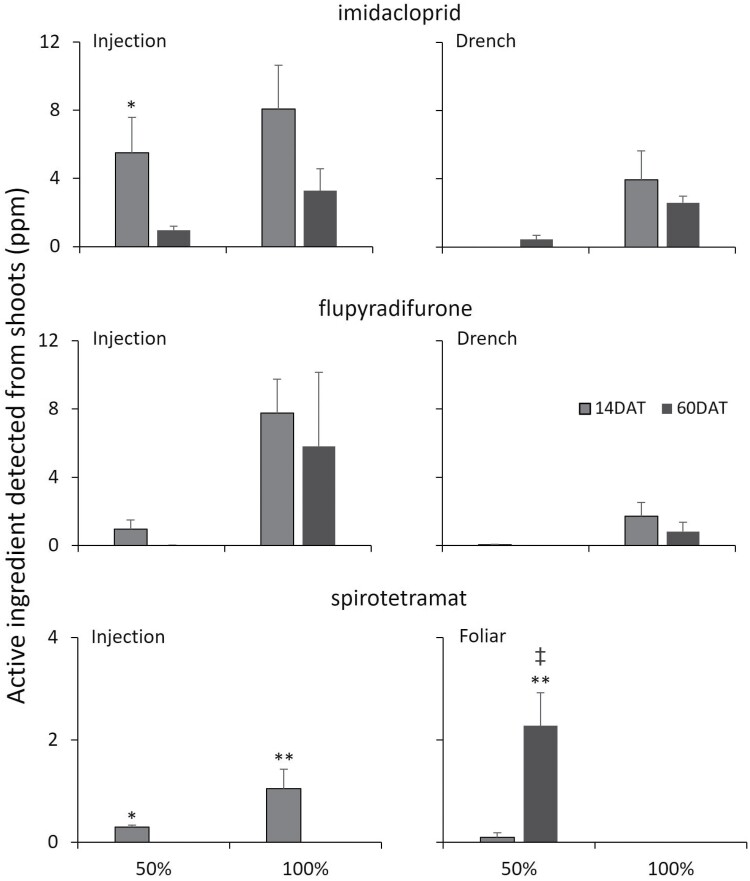
The gall wasp, Hemadas nubilipennis Ashmead, is a pest of highbush and lowbush blueberry and can pose a challenge to control with foliar sprays due to adult activity being during bloom and because larval development is within plant tissues. We hypothesized that systemic insecticides that move within the blueberry vascular system would reach areas where H. nubilipennis eggs are laid, causing larval mortality. Three application methods, crown injection, soil drench, and foliar spray were applied to potted 'Jersey' blueberry bushes at 50% and 100% rates to quantify systemic residue concentrations in shoots and leaves. Additionally, systemic insecticides were evaluated for control of gall wasps using single-shoot bioassays and measuring larval mortality at 0.01%, 0.1%, 1%, and 10% of field rate provided within a floral pick. Systemic insecticides tested in both studies included imidacloprid, flupyradifurone, and spirotetramat. The potted bush residue study determined that insecticides moved from three tested sites of entry: the roots, crown cavity, and foliage. Results from the shoot bioassays found that the mean percent larval survival of H. nubilipennis was negatively correlated with the concentration of AI detected in galls. Imidacloprid and spirotetramat were found to have the greatest potential for control of H. nubilipennis due to mortality in the shoot bioassays and similar residue concentrations in the potted bush studies to shoot bioassays. Future research should evaluate systemic insecticides applied in highbush blueberry plantings for control of H. nubilipennis using the bioassay mortality assessment method developed in this study.
瘿蜂,Hemadas nubilipennis Ashmead,是一种高丛和低丛蓝莓的害虫,由于成虫活动在开花期,并且幼虫在植物组织内发育,因此叶面喷雾可能难以控制。我们假设在蓝莓维管束系统内移动的系统性杀虫剂将到达 H. nubilipennis 卵被放置的区域,导致幼虫死亡。三种施药方法,冠部注射、土壤淋溶和叶面喷雾,以 50%和 100%的浓度应用于盆栽'泽西'蓝莓灌木,以量化枝条和叶片中的系统残留浓度。此外,还通过单枝生物测定评估了系统性杀虫剂对瘿蜂的控制作用,并在花采内以田间施用量的 0.01%、0.1%、1%和 10%测量幼虫死亡率。在这两项研究中测试的系统性杀虫剂包括吡虫啉、氟氯吡啶酯和螺虫乙酯。盆栽灌木残留研究确定,杀虫剂从三个测试的进入点:根部、冠腔和叶片移动。枝条生物测定的结果发现,H. nubilipennis 的幼虫存活率与在瘿中检测到的 AI 浓度呈负相关。由于在枝条生物测定中发现死亡率以及在盆栽灌木研究中与枝条生物测定中相似的残留浓度,吡虫啉和螺虫乙酯被发现对控制 H. nubilipennis 具有最大的潜力。未来的研究应该评估在高丛蓝莓种植中应用系统性杀虫剂,以本研究中开发的生物测定死亡率评估方法控制 H. nubilipennis。