Jegatheeswaran Lavandan, Gokani Shyam Ajay, Luke Louis, Klyvyte Gabija, Espehana Andreas, Garden Elizabeth Mairenn, Tarantino Alessia, Al Omari Basil, Philpott Carl Martin
Department of Ear, Nose and Throat Surgery, James Paget University Hospitals NHS Foundation Trust, Great Yarmouth, United Kingdom.
Rhinology and ENT Research Group, Norwich Medical School, University of East Anglia, Norwich, United Kingdom.
Front Neurosci. 2023 Aug 4;17:1165329. doi: 10.3389/fnins.2023.1165329. eCollection 2023.
To provide a detailed overview of the assessment of COVID-19-related olfactory dysfunction and its association with psychological, neuropsychiatric, and cognitive symptoms.
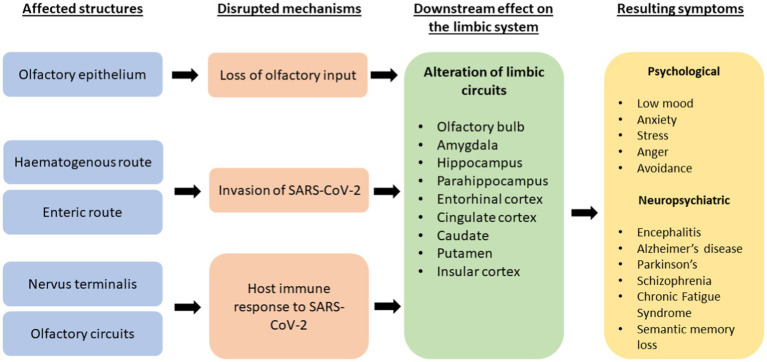
COVID-19-related olfactory dysfunction can have a detrimental impact to the quality of life of patients. Prior to the COVID-19 pandemic, olfactory and taste disorders were a common but under-rated, under-researched and under-treated sensory loss. The pandemic has exacerbated the current unmet need for accessing good healthcare for patients living with olfactory disorders and other symptoms secondary to COVID-19. This review thus explores the associations that COVID-19 has with psychological, neuropsychiatric, and cognitive symptoms, and provide a framework and rationale for the assessment of patients presenting with COVID-19 olfactory dysfunction.
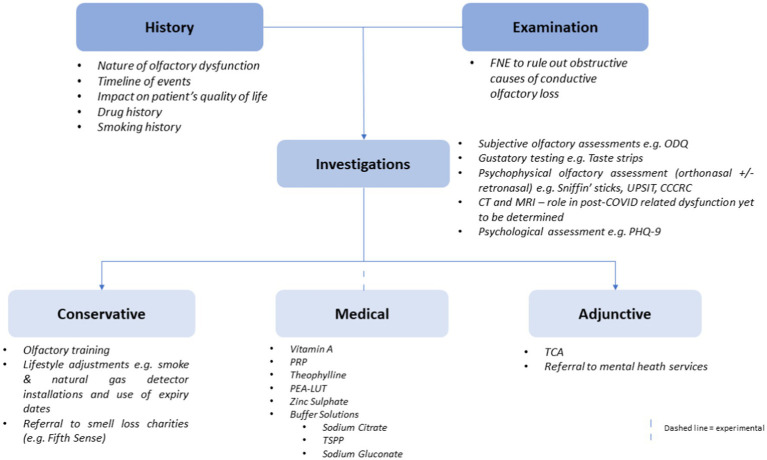
Acute COVID-19 infection and long COVID is not solely a disease of the respiratory and vascular systems. These two conditions have strong associations with psychological, neuropsychiatric, and cognitive symptoms. A systematic approach with history taking and examination particularly with nasal endoscopy can determine the impact that this has on the patient. Specific olfactory disorder questionnaires can demonstrate the impact on quality of life, while psychophysical testing can objectively assess and monitor olfaction over time. The role of cross-sectional imaging is not yet described for COVID-19-related olfactory dysfunction. Management options are limited to conservative adjunctive measures, with some medical therapies described.
详细概述新型冠状病毒肺炎(COVID-19)相关嗅觉功能障碍的评估及其与心理、神经精神和认知症状的关联。
COVID-19相关嗅觉功能障碍会对患者的生活质量产生不利影响。在COVID-19大流行之前,嗅觉和味觉障碍是一种常见但未得到充分重视、研究不足且治疗不足的感觉丧失。这场大流行加剧了目前嗅觉障碍患者以及继发于COVID-19的其他症状患者在获得优质医疗保健方面未得到满足的需求。因此,本综述探讨了COVID-19与心理、神经精神和认知症状的关联,并为评估出现COVID-19嗅觉功能障碍的患者提供了一个框架和理论依据。
急性COVID-19感染和新冠后综合征并非仅仅是呼吸系统和血管系统的疾病。这两种情况与心理、神经精神和认知症状密切相关。通过病史采集和检查,特别是鼻内镜检查的系统方法,可以确定其对患者的影响。特定的嗅觉障碍问卷可以显示对生活质量的影响,而心理物理学测试可以客观地评估和监测随时间变化的嗅觉。横断面成像在COVID-19相关嗅觉功能障碍中的作用尚未描述。管理选择仅限于保守的辅助措施,文中描述了一些药物治疗方法。