Lu Xikui, Zhang Lu, Huang Hangxing, Wu Xiangping, Wang Zhenting, Huang Ling, Li Jingyang, Yu Huimin, Zhang Hongyan, Xiao Jian
Department of Pharmacy, Xiangya Hospital, Central South University, Changsha, China.
National Clinical Research Center for Geriatric Disorders, Xiangya Hospital, Central South University, Changsha, China.
Front Pharmacol. 2023 Aug 4;14:1073939. doi: 10.3389/fphar.2023.1073939. eCollection 2023.
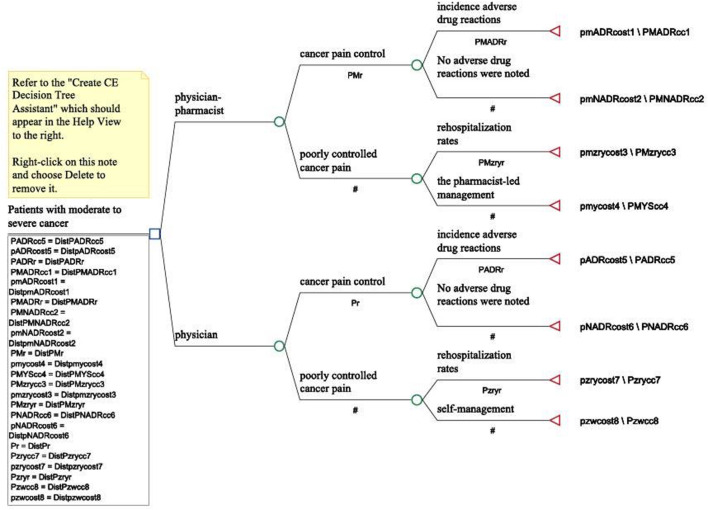
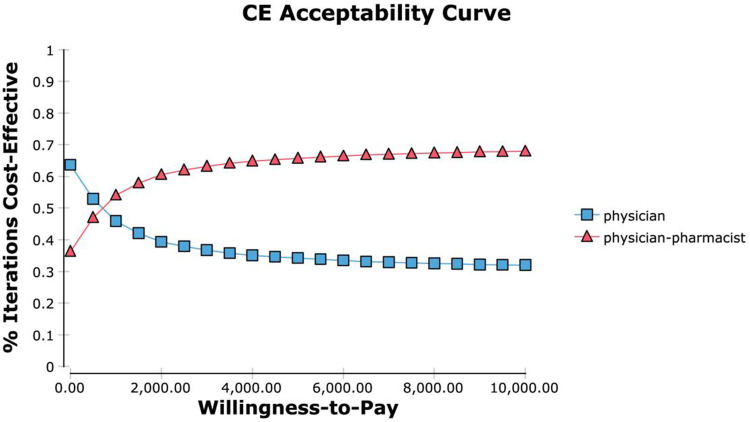
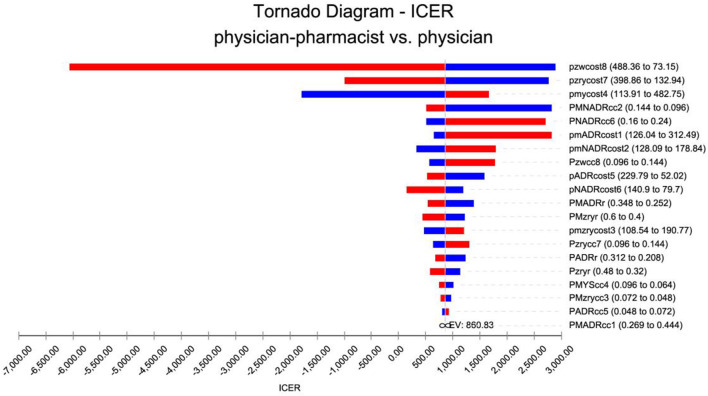
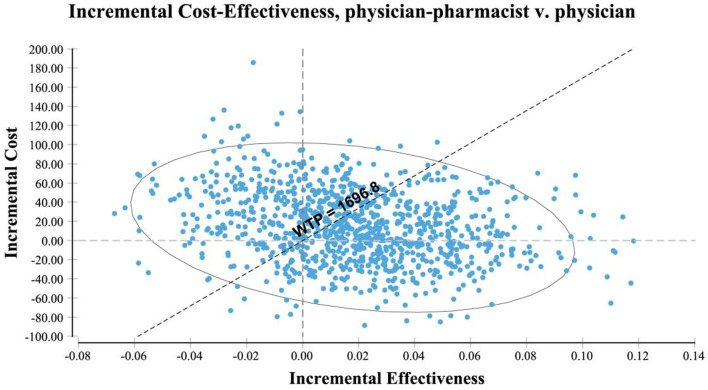
To examine whether joint management of cancer pain by physicians and pharmacists in clinics provides economic advantages from the perspective of the Chinese healthcare system. From February 2018 to March 2020, 100 patients who visited the joint cancer pain clinic at the Xiangya Hospital of Central South University were included. These patients were randomly assigned to either the control or intervention groups. The control group received regular outpatient services from a physician, while the intervention group received regular outpatient services from a physician and medication education provided by a pharmacist. The study considered various direct costs, including drug expenses, physician-pharmacist outpatient services, adverse event management, consultations, examinations, and readmissions. The outcome indicators considered were the cancer pain control rate and the reduction in pain scores. Decision tree modeling, single-factor sensitivity analysis, and probabilistic sensitivity analysis were performed to evaluate the cost-effectiveness of joint physician-pharmacist outpatient services compared to physician-alone outpatient services. The intervention group showed a significantly higher cancer pain control rate than the control group (0.69 vs. 0.39, = 0.03). In the decision tree model, the intervention group had a significantly lower pain score than the control group (0.23 vs. 0.14). The cost per person in the intervention group was $165.39, while it was $191.1 per person in the control group. The univariate sensitivity analysis showed that the cost of self-management for patients in the control group was identified as the primary sensitivity factor. Probabilistic sensitivity analysis indicated that the joint clinic group had a favorable incremental cost-effectiveness compared to the physician clinic group. In addition, the probabilistic sensitivity analysis demonstrated an absolute advantage in the incremental cost-effectiveness of the joint clinic group over the outpatient physician group. The participation of pharmacists in joint cancer pain clinic services led to improved pain management for patients, demonstrating a clear advantage in terms of cost-effectiveness.
从中国医疗体系的角度研究临床中医师和药剂师联合管理癌症疼痛是否具有经济优势。2018年2月至2020年3月,纳入了100名到中南大学湘雅医院联合癌症疼痛门诊就诊的患者。这些患者被随机分为对照组或干预组。对照组接受医师的常规门诊服务,而干预组接受医师的常规门诊服务以及药剂师提供的用药教育。该研究考虑了各种直接成本,包括药物费用、医师 - 药剂师门诊服务、不良事件管理、会诊、检查和再入院费用。所考虑的结果指标为癌症疼痛控制率和疼痛评分的降低。进行决策树建模、单因素敏感性分析和概率敏感性分析,以评估与仅由医师提供门诊服务相比,医师 - 药剂师联合门诊服务的成本效益。干预组的癌症疼痛控制率显著高于对照组(0.69对0.39, = 0.03)。在决策树模型中,干预组的疼痛评分显著低于对照组(0.23对0.14)。干预组人均成本为165.39美元,而对照组人均成本为191.1美元。单因素敏感性分析表明,对照组患者自我管理的成本被确定为主要敏感性因素。概率敏感性分析表明,联合门诊组与医师门诊组相比具有良好的增量成本效益。此外,概率敏感性分析表明联合门诊组在增量成本效益方面相对于门诊医师组具有绝对优势。药剂师参与联合癌症疼痛门诊服务可改善患者的疼痛管理,在成本效益方面显示出明显优势。