Entrepreneurship Section, Utrecht University School of Economics, Utrecht University, Utrecht, Netherlands.
Front Public Health. 2023 Aug 3;11:1209965. doi: 10.3389/fpubh.2023.1209965. eCollection 2023.
Nurses frequently innovate in response to operational failures, regulations, procedures, and/or other workflow barriers that prevent them from delivering high-quality patient care. Unfortunately, most nurse innovations do not diffuse to a broader audience, depriving other nurses from taking advantage of solutions that have already been developed elsewhere. This under-diffusion is problematic from a societal and welfare point of view. The goal of this paper is to understand how diffusion shortage of nurse innovations can be reduced.
We develop a qualitative case study of a medical makerspace at the largest academic hospital in the Netherlands. This medical makerspace reported unusually high rates of nurse innovation diffusion. Our data collection includes on-site observations, archival data, secondary data, and fifteen in-depth interviews with key informants. Qualitative coding procedures and a combination of deductive and inductive reasoning are used to analyze the data.
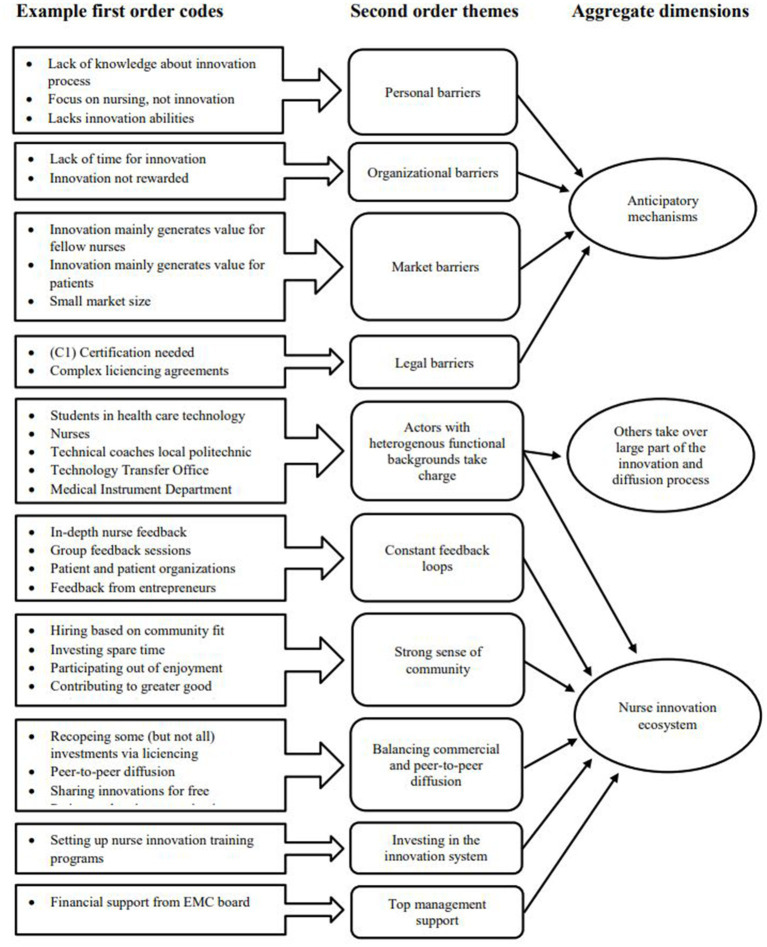
Our data show that personal, organizational, regulatory, and market barriers prevent nurses from further developing and diffusion their innovations in an anticipatory manner. That is, because nurses expect that transforming an initial solution into an innovation that can be shared with others will be too time consuming and difficult they do not proceed with the further development. The medical makerspace that we investigated adequately addresses this problem by developing an innovation ecosystem that largely takes over the innovation and diffusion process.
We provide a concrete example of how a medical makerspace, and innovation support systems in a broader sense, can be designed to more adequately address the nurse innovation-diffusion gap. The two main elements of the practical solution that we identified are: (1) Support systems should facilitate that others may lead the development and diffusion of innovations and (2) The support system should promote that actors integrate their functional specializations within an innovation ecosystem. We make two theoretical contributions. First, we contribute to understanding barriers in the nurse innovation-diffusion process from a psychological point. Second, we identified that an ecosystem perspective is beneficial to develop innovation support systems in which diffusion occurs more often.
护士经常创新,以应对操作失败、法规、程序和/或其他工作流程障碍,这些障碍会妨碍他们提供高质量的患者护理。不幸的是,大多数护士创新并没有扩散到更广泛的受众,使其他护士无法利用已经在其他地方开发的解决方案。从社会和福利的角度来看,这种扩散不足是有问题的。本文的目的是了解如何减少护士创新扩散不足的问题。
我们对荷兰最大的学术医院的一个医疗制造者空间进行了定性案例研究。这个医疗制造者空间报告了异常高的护士创新扩散率。我们的数据收集包括现场观察、档案数据、二手数据和对 15 名关键信息员的 15 次深入访谈。使用定性编码程序和演绎推理与归纳推理的结合来分析数据。
我们的数据表明,个人、组织、监管和市场障碍阻止护士以预期的方式进一步开发和传播他们的创新。也就是说,由于护士预计将最初的解决方案转化为可以与他人共享的创新将过于耗时和困难,他们不会进一步开发。我们调查的医疗制造者空间通过开发一个创新生态系统来解决这个问题,该生态系统在很大程度上接管了创新和传播过程。
我们提供了一个具体的例子,说明医疗制造者空间以及更广泛意义上的创新支持系统如何被设计来更充分地解决护士创新扩散差距的问题。我们确定的实际解决方案的两个主要要素是:(1)支持系统应便于他人领导创新的开发和传播;(2)支持系统应促进参与者在创新生态系统中整合其职能专业化。我们做出了两个理论贡献。首先,我们从心理学的角度对护士创新扩散过程中的障碍做出了贡献。其次,我们发现生态系统视角有利于开发创新支持系统,从而更频繁地发生扩散。