Department of Community Health, Faculty of Medicine and Health Sciences, Universiti Putra Malaysia, Serdang, Malaysia.
Front Public Health. 2023 Aug 3;11:1217052. doi: 10.3389/fpubh.2023.1217052. eCollection 2023.
Malaria health education intervention is a community-directed approach that has long been considered important in preventing malaria in sub-Saharan Africa. However, its effectiveness is being questioned due to a lack of strong evidence. We aim to synthesize the evidence of the impact of health education on malaria knowledge and insecticide-treated nets (ITN) usage. Specifically, we analyzed the odds of correctly answering malaria-related questions and the odds of using ITN between the intervention and control groups.
Experimental and observational studies conducted in sub-Saharan Africa between 2000 and 2021 which had quantitatively evaluated the impact of health education interventions on malaria knowledge and ITN usage were included in the review.
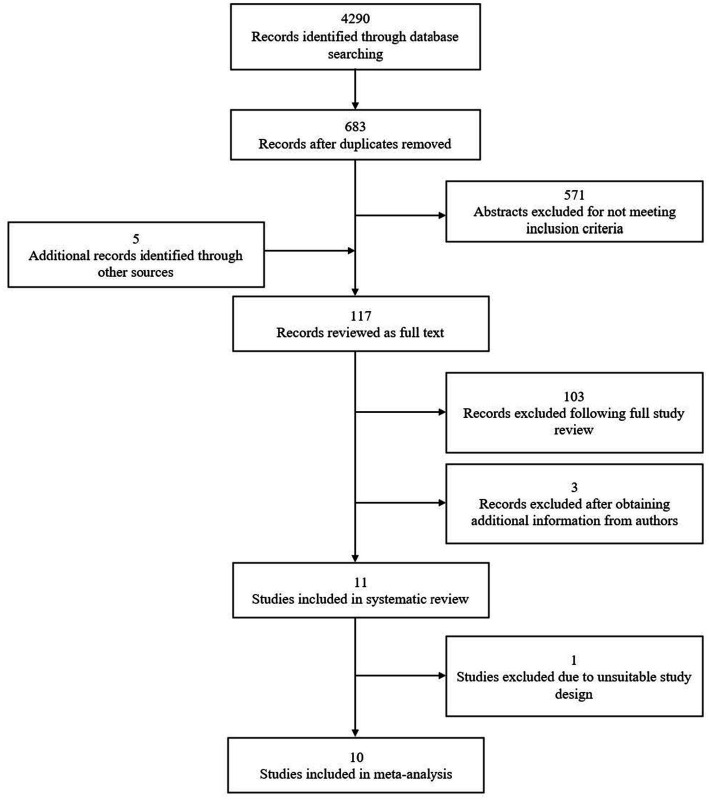
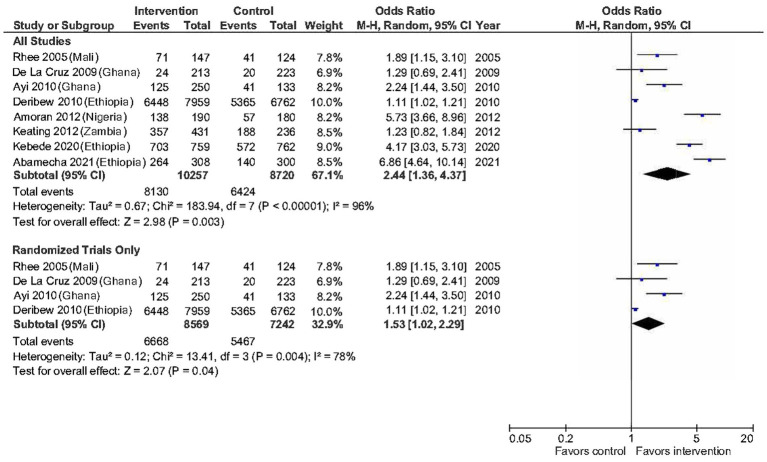
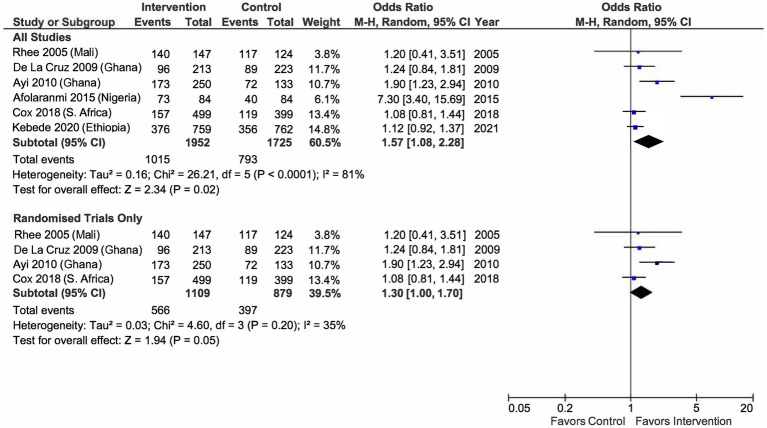
A total of 11 studies (20,523 participants) were included. Four studies used educational interventions to teach appropriate ITN strategies and promote ITN usage. Two others focused on improving knowledge of malaria transmission, prevention, treatment, and its signs and symptoms. The remaining five studies assessed both ITN use and malaria knowledge. Of these, 10 were eligible for meta-analysis. On average, the odds of a person in the intervention group reporting better malaria knowledge (odds ratio 1.30, 95% CI: 1.00 to 1.70, = 0.05) and higher ITN usage (odds ratio 1.53, 95% CI: 1.02 to 2.29, = 0.004) increased significantly after receiving health education interventions compared to those in the control group. The odds of ITN usage also substantially increased when the interventions were based on a theory or model (odds ratio 5.27, 95% CI: 3.24 to 8.58, = 0.05).
Our review highlights sub-Saharan Africa's various health education strategies to curb malaria over the past two decades. Meta-analysis findings show that health education interventions are moderately effective in improving malaria knowledge and ITN usage and have contributed to the effort of global malaria strategy.
疟疾健康教育干预是一种以社区为导向的方法,长期以来被认为在撒哈拉以南非洲预防疟疾方面非常重要。然而,由于缺乏强有力的证据,其有效性受到了质疑。我们旨在综合健康教育对疟疾知识和驱虫蚊帐(ITN)使用影响的证据。具体来说,我们分析了干预组和对照组之间正确回答疟疾相关问题的可能性和使用 ITN 的可能性。
纳入了 2000 年至 2021 年间在撒哈拉以南非洲进行的、定量评估健康教育干预对疟疾知识和 ITN 使用影响的实验和观察研究。
共纳入 11 项研究(20523 名参与者)。四项研究使用教育干预措施来教授适当的 ITN 策略并促进 ITN 使用。另外两项研究侧重于提高对疟疾传播、预防、治疗及其症状和体征的认识。其余五项研究评估了 ITN 使用和疟疾知识。其中 10 项研究适合进行荟萃分析。平均而言,与对照组相比,接受健康教育干预的人报告更好的疟疾知识(优势比 1.30,95%可信区间:1.00 至 1.70, = 0.05)和更高的 ITN 使用(优势比 1.53,95%可信区间:1.02 至 2.29, = 0.004)的可能性显著增加。当干预措施基于理论或模型时,ITN 使用的可能性也大大增加(优势比 5.27,95%可信区间:3.24 至 8.58, = 0.05)。
我们的综述强调了过去二十年撒哈拉以南非洲为遏制疟疾而采取的各种健康教育策略。荟萃分析结果表明,健康教育干预在提高疟疾知识和 ITN 使用方面具有中等效果,并为全球疟疾战略做出了贡献。