Md Hanif Shahrul Azhar, Hassan Mohd Rohaizat, Safian Nazarudin, Sutan Rosnah, Alabed Alabed Ali A, Rafi'i Muhammad Ridzwan, Md Asari Siti Najiha, Naserrudin Nurul Athirah, Dapari Rahmat
Department of Public Health Medicine, Faculty of Medicine, Universiti Kebangsaan Malaysia, Jalan Yaacob Latif, Cheras, Kuala Lumpur, Malaysia.
University of Cyberjaya, Persiaran Bestari, Cyber 11, 63000, Cyberjaya, Selangor, Malaysia.
Trop Med Health. 2025 Aug 4;53(1):105. doi: 10.1186/s41182-025-00784-8.
Malaria continues to pose a considerable public health challenge in Southeast Asia, necessitating control efforts that consider region-specific vulnerabilities. Although global risk factors are well-documented, the interplay of social determinants of health in shaping malaria vulnerability within SEA populations is less thoroughly explored.
This scoping review aims to determine elements influencing vulnerabilities towards malaria in SEA populations. In addition, this study seeks to explore how various social determinants of health contribute to the increased malaria vulnerabilities in this region.
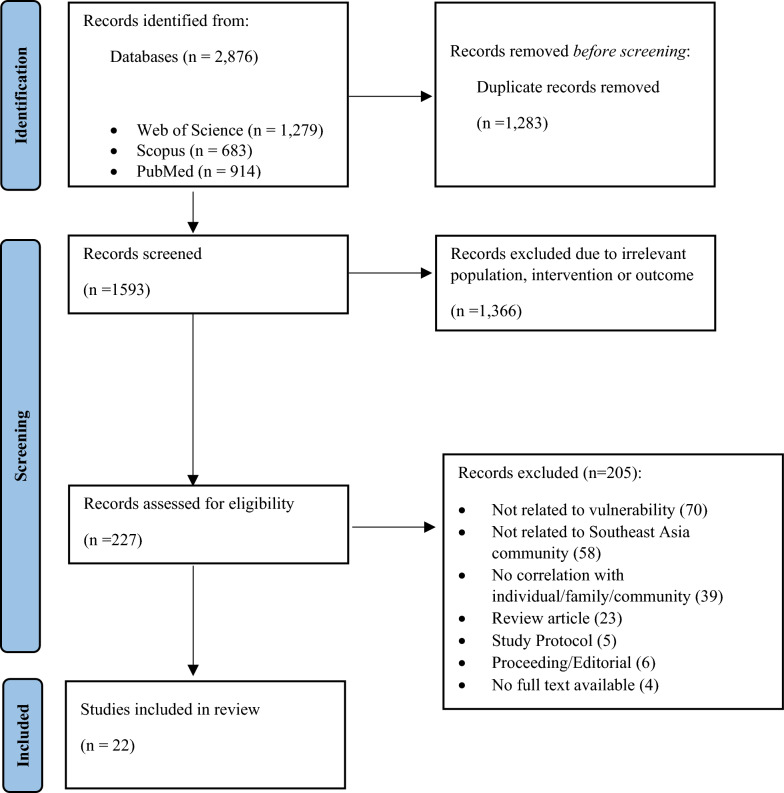
This review adhered to the PRISMA-ScR guidelines. A systematic literature search was performed in PubMed, Scopus, and Web of Science from October to November 2024, focusing on peer-reviewed, open-access quantitative studies published from 2014 to 2024. Studies that addressed the risk or vulnerability of malaria in SEA populations were included. Multiple reviewers independently conducted screening, data charting, and thematic synthesis.
Twenty-two studies met the inclusion criteria, encompassing various malaria-endemic settings in SEA, including cross-border regions and migrant populations. The findings were synthesized using a social determinants of health lens, resulting in five thematic domains: biological influences, demographic and socioeconomic parameters, built and lived environments, behaviour and practices, and access to healthcare services and information.
The vulnerability of SEA population to malaria is multifaceted and deeply entrenched in a web of complex, interrelated factors. Effective control requires region-specific, multi-sectoral strategies that address these vulnerabilities through targeted interventions, strengthened health systems, and equitable public health policies.
疟疾在东南亚地区仍然是一项重大的公共卫生挑战,因此需要开展考虑到该地区特定脆弱性的防控工作。尽管全球风险因素已有充分记录,但健康的社会决定因素在塑造东南亚人群疟疾脆弱性方面的相互作用尚未得到充分探讨。
本范围综述旨在确定影响东南亚人群疟疾脆弱性的因素。此外,本研究还试图探讨各种健康的社会决定因素如何导致该地区疟疾脆弱性增加。
本综述遵循PRISMA-ScR指南。2024年10月至11月在PubMed、Scopus和Web of Science上进行了系统的文献检索,重点关注2014年至2024年发表的经同行评审的开放获取定量研究。纳入了涉及东南亚人群疟疾风险或脆弱性的研究。多名评审员独立进行筛选、数据图表绘制和主题综合。
22项研究符合纳入标准,涵盖东南亚地区各种疟疾流行地区,包括跨境地区和流动人口。研究结果从健康的社会决定因素角度进行了综合,形成了五个主题领域:生物学影响、人口和社会经济参数、建成环境和生活环境、行为和实践,以及获得医疗服务和信息的机会。
东南亚人群对疟疾的脆弱性是多方面的,并且深深植根于一系列复杂的相互关联的因素之中。有效的防控需要针对该地区的多部门战略,通过有针对性的干预措施、加强卫生系统和公平的公共卫生政策来应对这些脆弱性。