Jo Su In, Park Yoon Sun, Chang Yeeun, Moon Jai-Hee, Lee Slee, Lee Hyejin, Kim MiYeon, Kim Do Yeon, Bae SangMun, Park Se Yeong, Yun Hyeseon, You Ji-Eun, Im Minju, Han Hae-Jung, Kim Sang-Yeob, Jin Dong-Hoon
Asan Institute for Life Science, Asan Medical Center, Seoul, Republic of Korea.
Department of Medical Science, AMIST, Asan Medical Center, University of Ulsan College of Medicine, Seoul, Republic of Korea.
Biochem Biophys Rep. 2023 Aug 14;35:101525. doi: 10.1016/j.bbrep.2023.101525. eCollection 2023 Sep.
Sarcopenia and muscular dystrophy are two muscle diseases. In cancer patients, cancer cachexia induces continuous weight loss and muscle loss due to the disease itself or the use of anticancer drugs. Cachexia occurs in up to 80% of cancer patients. It is recognized as a direct cause of reduced quality of life, contributing to at least 20% of cancer-associated deaths and limiting therapeutic options for cancer patients. Cancer cachexia is associated with multiple chronic or end-stage conditions and develops similarly. There are various options for the treatment of cancer cachexia, but there are still many issues to be solved. Hence, to determine its potential to overcome the muscle wasting during cancer cachexia, we studied the effect of BST204, a refined dry ginseng extract, on muscle fiber regeneration.
We checked the muscle regeneration efficacy of BST204. First, BaCl and freeze injury models were selected to investigate muscle regeneration after BST204 administration. In addition, after inducing muscle differentiation of C2C12 cells, the efficacy of BST204 was analyzed. In this model, we analyzed the expression of the signal pathway (PI3K-AKT signal) by Western blot and imaging methods.
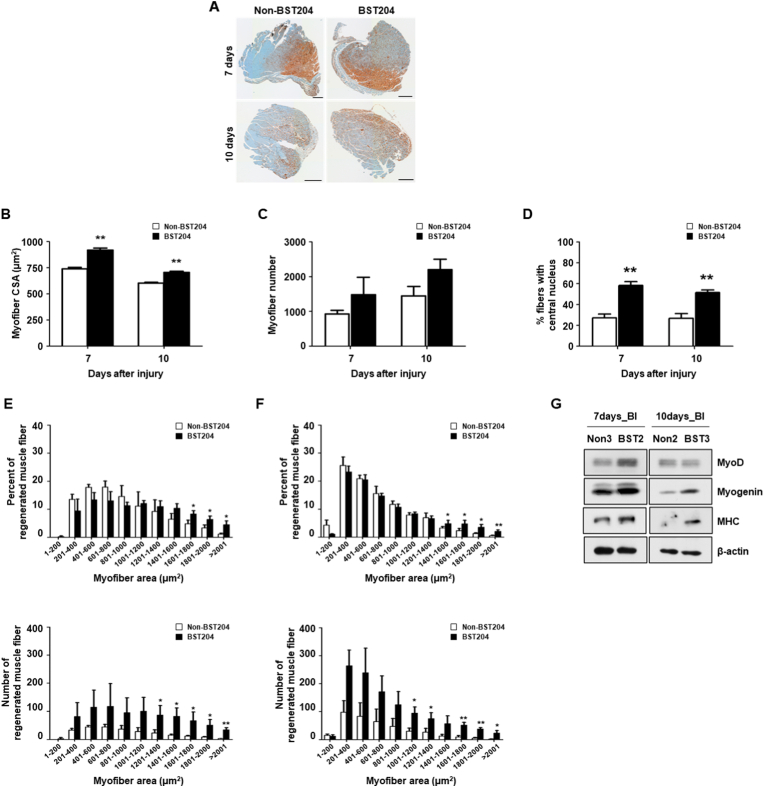
These results showed that BST204 induced muscle fiber regeneration in BaCl and freeze injury models. Also, we confirmed that BST204 could regulate the PI3K/AKT signaling pathway and regulate the differentiation of C2C12 cells. These results indicate that BST204 has the potential to facilitate the skeletal muscle regeneration during muscle wasting induced by various factors including cancer cachexia.
肌肉减少症和肌肉萎缩症是两种肌肉疾病。在癌症患者中,癌症恶病质会由于疾病本身或抗癌药物的使用导致持续体重减轻和肌肉流失。高达80%的癌症患者会出现恶病质。它被认为是生活质量下降的直接原因,至少导致20%的癌症相关死亡,并限制了癌症患者的治疗选择。癌症恶病质与多种慢性或终末期疾病相关,且发展情况相似。癌症恶病质的治疗有多种选择,但仍有许多问题有待解决。因此,为了确定其克服癌症恶病质期间肌肉萎缩的潜力,我们研究了精制干人参提取物BST204对肌纤维再生的影响。
我们检测了BST204的肌肉再生功效。首先,选择氯化钡和冷冻损伤模型来研究给予BST204后的肌肉再生情况。此外,在诱导C2C12细胞发生肌肉分化后,分析BST204的功效。在该模型中,我们通过蛋白质印迹法和成像方法分析信号通路(PI3K-AKT信号)的表达。
这些结果表明,BST204在氯化钡和冷冻损伤模型中诱导了肌纤维再生。此外,我们证实BST204可以调节PI3K/AKT信号通路并调节C2C12细胞的分化。这些结果表明,BST204具有促进包括癌症恶病质在内的各种因素诱导的肌肉萎缩期间骨骼肌再生的潜力。