Forcina Laura, Miano Carmen, Pelosi Laura, Musarò Antonio
DAHFMO-Unit of Histology and Medical Embryology, Sapienza University of Rome, Laboratory Affiliated to Istituto Pasteur Italia - Fondazione Cenci Bolognetti, Via A. Scarpa, 14 Rome 00161, Italy.
Curr Genomics. 2019 Jan;20(1):24-37. doi: 10.2174/1389202920666190116094736.
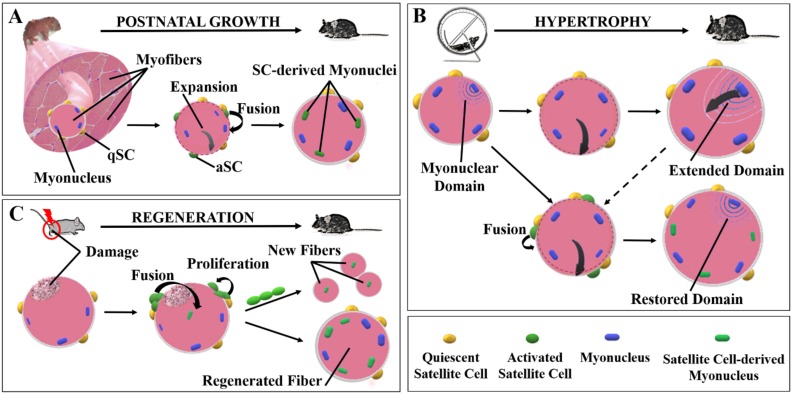
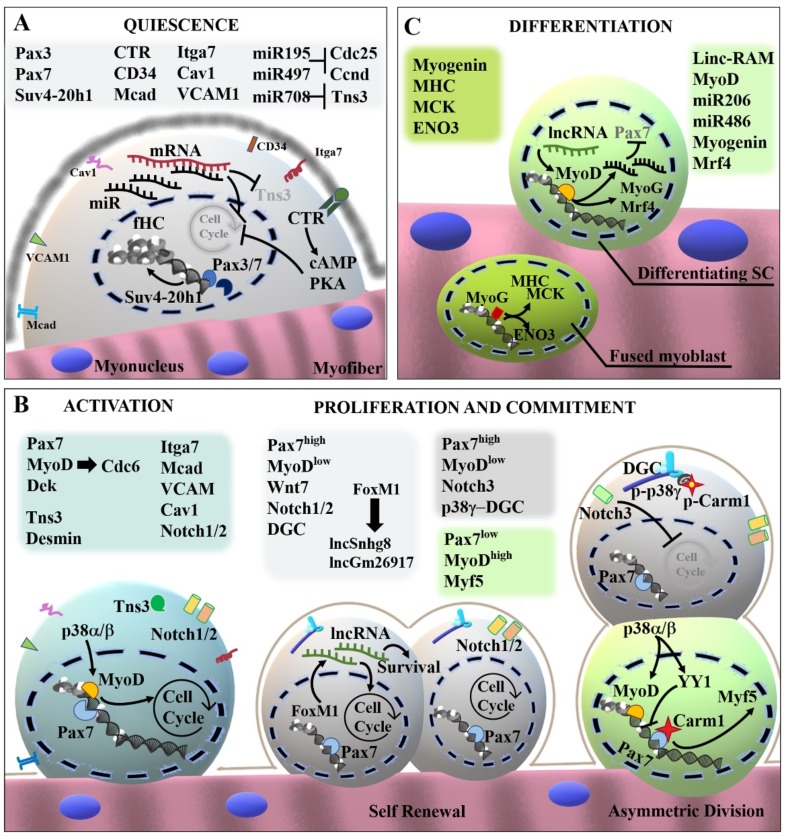
The peculiar ability of skeletal muscle tissue to operate adaptive changes during post-natal de-velopment and adulthood has been associated with the existence of adult somatic stem cells. Satellite cells, occupying an exclusive niche within the adult muscle tissue, are considered bona fide stem cells with both stem-like properties and myogenic activities. Indeed, satellite cells retain the capability to both maintain the quiescence in uninjured muscles and to be promptly activated in response to growth or re-generative signals, re-engaging the cell cycle. Activated cells can undergo myogenic differentiation or self-renewal moving back to the quiescent state. Satellite cells behavior and their fate decision are finely controlled by mechanisms involving both cell-autonomous and external stimuli. Alterations in these regu-latory networks profoundly affect muscle homeostasis and the dynamic response to tissue damage, con-tributing to the decline of skeletal muscle that occurs under physio-pathologic conditions. Although the clear myogenic activity of satellite cells has been described and their pivotal role in muscle growth and regeneration has been reported, a comprehensive picture of inter-related mechanisms guiding muscle stem cell activity has still to be defined. Here, we reviewed the main regulatory networks determining satellite cell behavior. In particular, we focused on genetic and epigenetic mechanisms underlining satel-lite cell maintenance and commitment. Besides intrinsic regulations, we reported current evidences about the influence of environmental stimuli, derived from other cell populations within muscle tissue, on satel-lite cell biology.
骨骼肌组织在出生后发育和成年期进行适应性变化的特殊能力与成体体细胞干细胞的存在有关。卫星细胞在成年肌肉组织中占据独特的微环境,被认为是具有干细胞样特性和生肌活性的真正干细胞。事实上,卫星细胞既保留了在未受损肌肉中维持静止状态的能力,又能在响应生长或再生信号时迅速被激活,重新进入细胞周期。激活的细胞可以进行生肌分化或自我更新,回到静止状态。卫星细胞的行为及其命运决定受到涉及细胞自主和外部刺激的机制的精细控制。这些调节网络的改变会深刻影响肌肉稳态和对组织损伤的动态反应,导致在生理病理条件下发生的骨骼肌衰退。尽管卫星细胞明显的生肌活性已被描述,并且它们在肌肉生长和再生中的关键作用也有报道,但指导肌肉干细胞活性的相互关联机制的全貌仍有待确定。在这里,我们综述了决定卫星细胞行为的主要调节网络。特别是,我们重点关注了卫星细胞维持和定向分化的遗传和表观遗传机制。除了内在调节外,我们还报告了当前关于肌肉组织中其他细胞群体产生的环境刺激对卫星细胞生物学影响的证据。