Key Laboratory of Freshwater Fish Reproduction and Development (Ministry of Education), Key Laboratory of Aquatic Science of Chongqing, School of Life Sciences, Southwest University, Chongqing, 400715, China.
Biology, The Life Science Center, School of Science and Technology, Örebrorebro University, 70182, Örebro, Sweden.
Biol Sex Differ. 2023 Aug 21;14(1):53. doi: 10.1186/s13293-023-00534-7.
Sexually dimorphic mating behaviors differ between sexes and involve gonadal hormones and possibly sexually dimorphic gene expression in the brain. However, the associations among the brain, gonad, and sexual behavior in teleosts are still unclear. Here, we utilized germ cells-free tdrd12 knockout (KO) zebrafish, and steroid synthesis enzyme cyp17a1-deficient zebrafish to investigate the differences and interplays in the brain-gonad-behavior axis, and the molecular control of brain dimorphism and male mating behaviors.
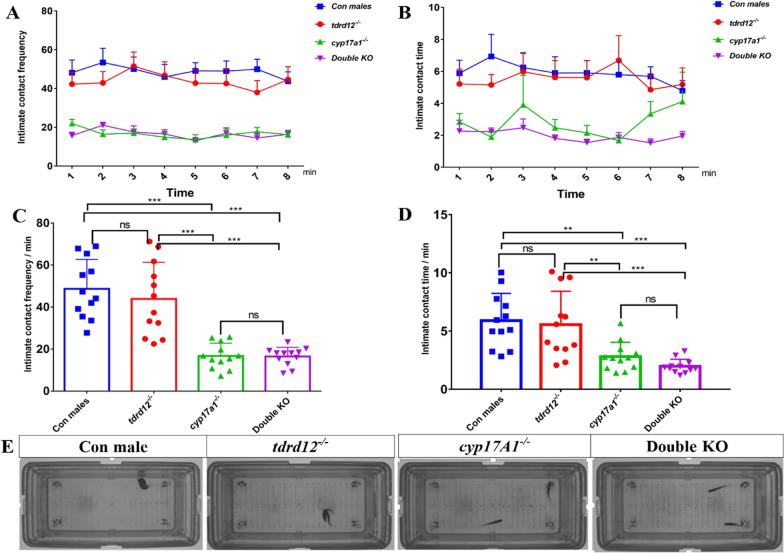
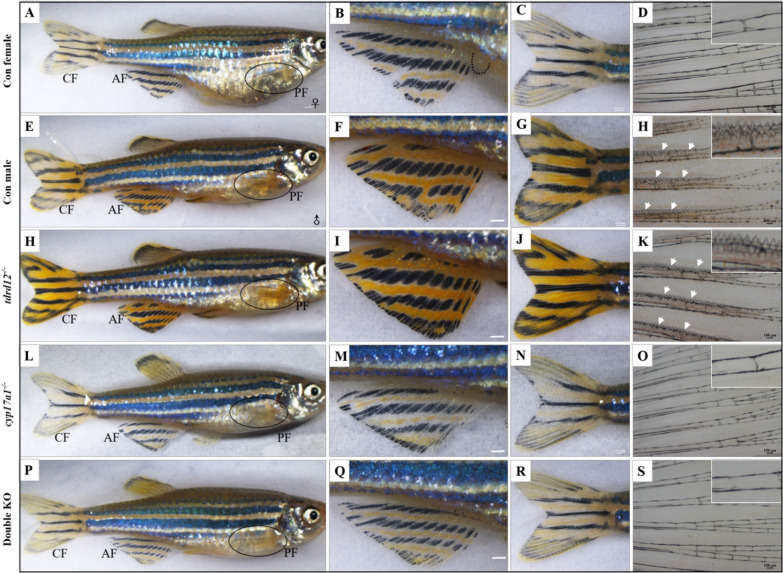
Tdrd12; cyp17a1 double heterozygous parents were crossed to obtain tdrd12; cyp17a1 (tdrd12 KO), tdrd12; cyp17a1 (cyp17a1 KO), and tdrd12; cyp17a1 (double KO) homozygous progenies. Comparative analysis of mating behaviors were evaluated using Viewpoint zebrafish tracking software and sexual traits were thoroughly characterized based on anatomical and histological experiments in these KOs and wild types. The steroid hormone levels (testosterone, 11-ketotestosterone and 17β-estradiol) in the brains, gonads, and serum were measured using ELISA kits. To achieve a higher resolution view of the differences in region-specific expression patterns of the brain, the brains of these KOs, and control male and female fish were dissected into three regions: the forebrain, midbrain, and hindbrain for transcriptomic analysis.
Qualitative analysis of mating behaviors demonstrated that tdrd12 fish behaved in the same manner as wild-type males to trigger oviposition behavior, while cyp17a1 and double knockout (KO) fish did not exhibit these behaviors. Based on the observation of sex characteristics, mating behaviors and hormone levels in these mutants, we found that the maintenance of secondary sex characteristics and male mating behavior did not depend on the presence of germ cells; rather, they depended mainly on the 11-ketotestosterone and testosterone levels secreted into the brain-gonad regulatory axis. RNA-seq analysis of different brain regions revealed that the brain transcript profile of tdrd12 fish was similar to that of wild-type males, especially in the forebrain and midbrain. However, the brain transcript profiles of cyp17a1 and double KO fish were distinct from those of wild-type males and were partially biased towards the expression pattern of the female brain. Our results revealed important candidate genes and signaling pathways, such as synaptic signaling/neurotransmission, MAPK signaling, and steroid hormone pathways, that shape brain dimorphism and modulate male mating behavior in zebrafish.
Our results provide comprehensive analyses and new insights regarding the endogenous interactions in the brain-gonad-behavior axis. Moreover, this study revealed the crucial candidate genes and neural signaling pathways of different brain regions that are involved in modulating brain dimorphism and male mating behavior in zebrafish, which would significantly light up the understanding the neuroendocrine and molecular mechanisms modulating brain dimorphism and male mating behavior in zebrafish and other teleost fish.
性二态交配行为在两性之间存在差异,涉及性腺激素和可能在大脑中的性二态基因表达。然而,在硬骨鱼中,大脑、性腺和性行为之间的联系仍不清楚。在这里,我们利用精细胞缺失的 tdrd12 敲除(KO)斑马鱼和类固醇合成酶 cyp17a1 缺陷型斑马鱼,研究了大脑-性腺-行为轴的差异和相互作用,以及大脑二态性和雄性交配行为的分子控制。
tdrd12;cyp17a1 双杂合父母交配获得 tdrd12;cyp17a1(tdrd12 KO)、tdrd12;cyp17a1(cyp17a1 KO)和 tdrd12;cyp17a1(双 KO)纯合后代。利用 Viewpoint 斑马鱼跟踪软件对交配行为进行比较分析,并根据解剖学和组织学实验对这些 KO 和野生型的性特征进行了全面的描述。使用 ELISA 试剂盒测量大脑、性腺和血清中的类固醇激素水平(睾酮、11-酮睾酮和 17β-雌二醇)。为了更详细地观察大脑中特定区域表达模式的差异,对这些 KO 和对照雄性和雌性鱼的大脑进行了三个区域的分离:前脑、中脑和后脑进行转录组分析。
交配行为的定性分析表明,tdrd12 鱼的行为与野生型雄性相同,可触发产卵行为,而 cyp17a1 和双 KO 鱼则没有表现出这些行为。根据对性特征、交配行为和这些突变体中的激素水平的观察,我们发现,二级性特征的维持和雄性交配行为的维持不依赖于生殖细胞的存在;相反,它们主要依赖于 11-酮睾酮和睾酮进入脑-性腺调节轴的分泌。对不同脑区的 RNA-seq 分析表明,tdrd12 鱼的大脑转录谱与野生型雄性相似,尤其是在前脑和中脑。然而,cyp17a1 和双 KO 鱼的大脑转录谱与野生型雄性不同,部分偏向于雌性大脑的表达模式。我们的研究结果揭示了重要的候选基因和信号通路,如突触信号转导/神经传递、MAPK 信号转导和类固醇激素通路,这些基因和信号通路塑造了斑马鱼的大脑二态性和调节雄性交配行为。
我们的研究提供了关于大脑-性腺-行为轴的内源性相互作用的全面分析和新的见解。此外,这项研究揭示了不同脑区调节大脑二态性和雄性交配行为的关键候选基因和神经信号通路,这将极大地阐明调节大脑二态性和雄性交配行为的神经内分泌和分子机制,不仅在斑马鱼中,而且在其他硬骨鱼中也是如此。