Centre Hospitalier Universitaire de Nice, Laboratoire d'immunologie, Nice, France.
Université Côte d'Azur - Centre Hospitalier Universitaire de Nice, UR2CA, Nice, France.
J Clin Immunol. 2023 Nov;43(8):1724-1739. doi: 10.1007/s10875-023-01558-9. Epub 2023 Aug 22.
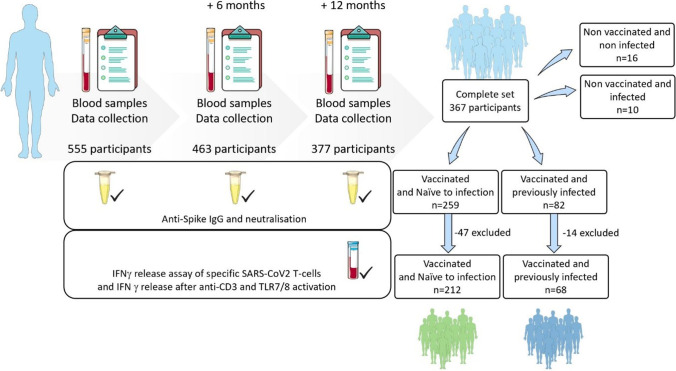
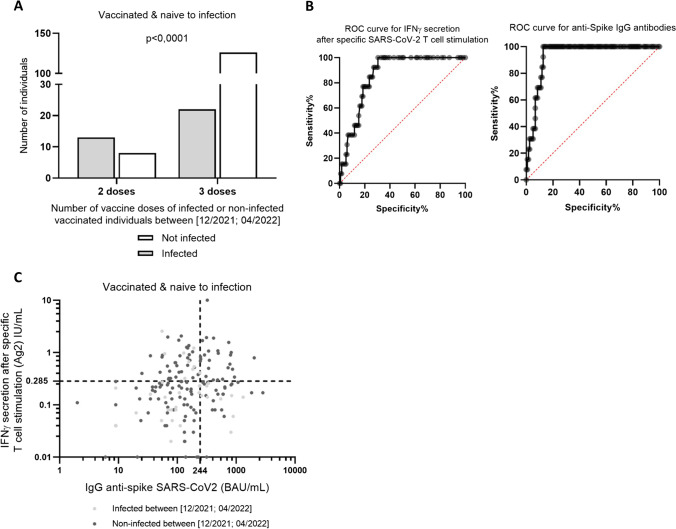
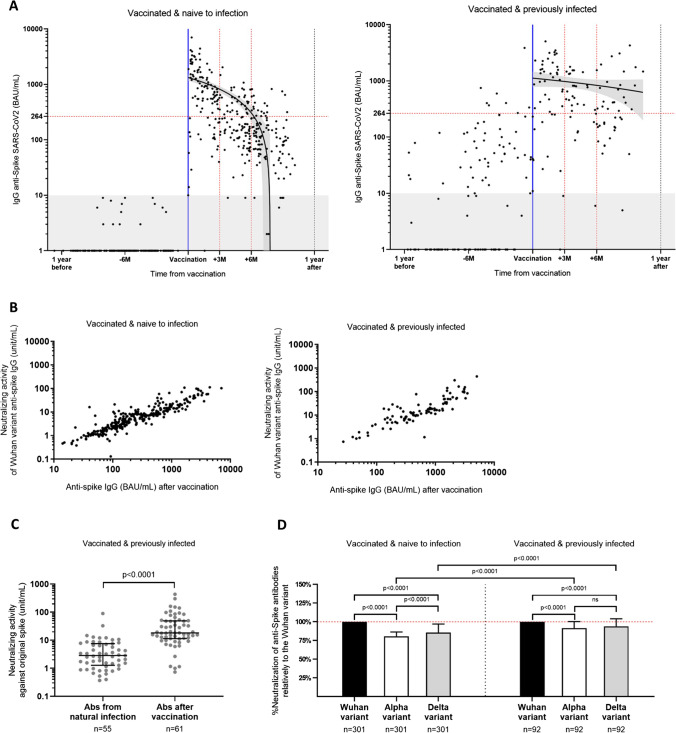
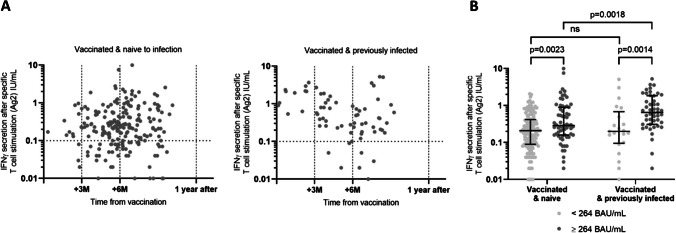
COVID-19 vaccines have significantly decreased the number of severe cases of the disease, but the virus circulation remains important, and questions about the need of new vaccination campaigns remain unanswered. The individual's protection against SARS-CoV-2 infection is most commonly measured by the level and the neutralizing capacity of antibodies produced against SARS-CoV-2. T cell response is a major contributor in viral infection, and several studies have shown that cellular T cell response is crucial in fighting off SARS-CoV-2 infection. Actually, no threshold of protective immune response against SARS-CoV2 infection has been identified. To better understand SARS-CoV-2-mediated immunity, we assessed both B cell (measuring anti-Spike IgG titer and neutralization capacity) and T cell (measuring IFNγ release assay after specific SARS-CoV2 stimulation) responses to SARS-CoV-2 vaccination with or without virus encounter in a cohort of 367 working volunteers. Vaccinated individuals who had previously been infected had a stronger and more lasting immunity in comparison to vaccinated individuals naive to infection whose immunity started to decline 3 months after vaccination. IFNγ release ≥ 0.285 IU/mL and anti-Spike IgG antibodies ≥ 244 BAU/mL were associated with a sufficient immune response following vaccination preventing future infections. Individuals with comorbidities had a lower chance of reaching the protective thresholds of T cell and B cell responses as identified in multivariate analysis. A combined B cell and T cell analysis of immune responses to determine protective thresholds after SARS-CoV-2 vaccination will allow us to identify individuals in need of a booster vaccine dose, particularly in comorbid subjects.
COVID-19 疫苗显著降低了疾病的重症病例数量,但病毒传播仍然很重要,关于是否需要开展新的疫苗接种运动的问题仍未得到解答。个体对 SARS-CoV-2 感染的保护作用通常通过针对 SARS-CoV-2 产生的抗体水平和中和能力来衡量。T 细胞反应是病毒感染的主要贡献者,多项研究表明,细胞 T 细胞反应对于对抗 SARS-CoV-2 感染至关重要。实际上,尚未确定针对 SARS-CoV2 感染的保护性免疫反应的阈值。为了更好地了解 SARS-CoV-2 介导的免疫,我们在 367 名工作志愿者的队列中评估了 SARS-CoV-2 疫苗接种后的 B 细胞(测量抗刺突 IgG 滴度和中和能力)和 T 细胞(测量特异性 SARS-CoV2 刺激后的 IFNγ 释放试验)反应,无论是否有病毒接触。与未感染的接种个体相比,先前感染过的接种个体具有更强且更持久的免疫力,后者的免疫力在接种后 3 个月开始下降。IFNγ 释放≥0.285 IU/mL 和抗刺突 IgG 抗体≥244 BAU/mL 与接种后预防未来感染的充足免疫反应相关。在多变量分析中,患有合并症的个体达到 T 细胞和 B 细胞反应保护阈值的机会较低。对 SARS-CoV-2 疫苗接种后免疫反应进行 B 细胞和 T 细胞联合分析,将有助于我们确定需要加强疫苗剂量的个体,特别是合并症患者。