AlAmeel Turki, AlMutairdi Abdulelah, Al-Bawardy Badr
Department of Medicine, King Fahad Specialist Hospital, Dammam, Saudi Arabia.
Department of Internal Medicine, Division of Gastroenterology and Hepatology, King Faisal Specialist Hospital and Research Center, Riyadh, Saudi Arabia.
Clin Exp Gastroenterol. 2023 Aug 17;16:147-167. doi: 10.2147/CEG.S375969. eCollection 2023.
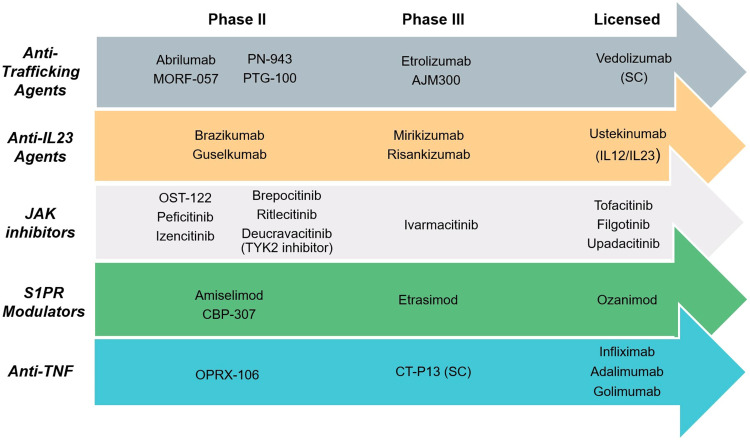
Ulcerative colitis (UC) is a chronic and progressive inflammatory disorder that affects the colon. The advent of advanced therapies such as biologic agents and small molecules has revolutionized the management of UC. Despite the expanding therapeutic armamentarium of advanced therapies to treat UC, the overall net remission rates and durability of currently available agents are relatively low. This highlights the need for further drug development and more innovative clinical trial design. There are currently multiple emerging agents in the pipeline for the management of UC. This includes agents with alternative routes of administration such as oral or subcutaneous tumor necrosis factor inhibitors or novel mechanisms of action such as toll-like receptor 9 (TLR9) agonist cobitolimod and phosphodiesterase 4 inhibitor apremilast. In this review, we will highlight novel and emerging advanced therapies currently in the pipeline for the management of UC.
溃疡性结肠炎(UC)是一种影响结肠的慢性进行性炎症性疾病。生物制剂和小分子等先进疗法的出现彻底改变了UC的治疗方式。尽管用于治疗UC的先进疗法的治疗手段不断增加,但目前可用药物的总体净缓解率和持久性相对较低。这凸显了进一步药物研发和更具创新性的临床试验设计的必要性。目前有多种新兴药物正在研发用于UC的治疗。这包括具有口服或皮下肿瘤坏死因子抑制剂等替代给药途径的药物,或具有如Toll样受体9(TLR9)激动剂科比特莫德和磷酸二酯酶4抑制剂阿普斯特等新型作用机制的药物。在本综述中,我们将重点介绍目前正在研发用于UC治疗的新型和新兴先进疗法。