UCL School of Pharmacy, London, UK.
Cancer Division, University College London Hospitals NHS Foundation Trust, London, UK.
Cancer Med. 2023 Sep;12(17):17856-17865. doi: 10.1002/cam4.6418. Epub 2023 Aug 23.
In those receiving chemotherapy, renal and hepatic dysfunction can increase the risk of toxicity and should therefore be monitored. We aimed to develop a machine learning model to identify those patients that need closer monitoring, enabling a safer and more efficient service.
We used retrospective data from a large academic hospital, for patients treated with chemotherapy for breast cancer, colorectal cancer and diffuse-large B-cell lymphoma, to train and validate a Multi-Layer Perceptrons (MLP) model to predict the outcomes of unacceptable rises in bilirubin or creatinine. To assess the performance of the model, validation was performed using patient data from a separate, independent hospital using the same variables. Using this dataset, we evaluated the sensitivity and specificity of the model.
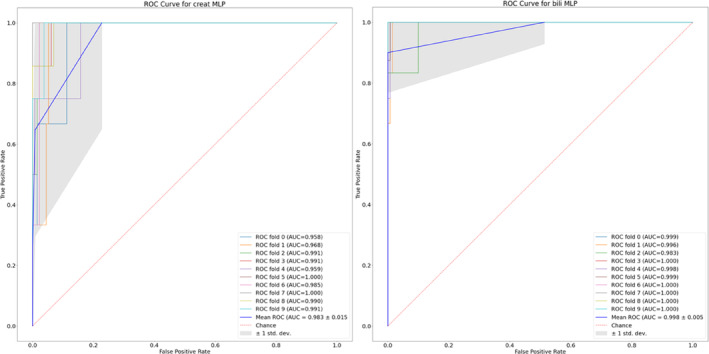
1214 patients in total were identified. The training set had almost perfect sensitivity and specificity of >0.95; the area under the curve (AUC) was 0.99 (95% CI 0.98-1.00) for creatinine and 0.97 (95% CI: 0.95-0.99) for bilirubin. The validation set had good sensitivity (creatinine: 0.60, 95% CI: 0.55-0.64, bilirubin: 0.54, 95% CI: 0.52-0.56), and specificity (creatinine 0.98, 95% CI: 0.96-0.99, bilirubin 0.90, 95% CI: 0.87-0.94) and area under the curve (creatinine: 0.76, 95% CI: 0.70, 0.82, bilirubin 0.72, 95% CI: 0.68-0.76).
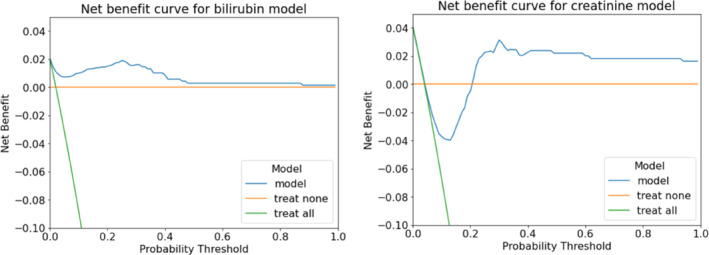
We have demonstrated that a MLP model can be used to reduce the number of blood tests required for some patients at low risk of organ dysfunction, whilst improving safety for others at high risk.
在接受化疗的患者中,肾功能和肝功能障碍会增加毒性风险,因此应进行监测。我们旨在开发一种机器学习模型,以识别需要更密切监测的患者,从而提供更安全、更有效的服务。
我们使用来自一家大型学术医院的回顾性数据,对接受乳腺癌、结直肠癌和弥漫性大 B 细胞淋巴瘤化疗的患者进行训练和验证,以建立多层感知器(MLP)模型来预测胆红素或肌酐不可接受升高的结果。为了评估模型的性能,我们使用来自另一家独立医院的相同变量的数据进行了验证。使用该数据集,我们评估了模型的敏感性和特异性。
共确定了 1214 例患者。训练集的敏感性和特异性均接近完美,>0.95;曲线下面积(AUC)为 0.99(95%CI 0.98-1.00)用于肌酐,0.97(95%CI:0.95-0.99)用于胆红素。验证集的敏感性较高(肌酐:0.60,95%CI:0.55-0.64,胆红素:0.54,95%CI:0.52-0.56),特异性也较高(肌酐 0.98,95%CI:0.96-0.99,胆红素 0.90,95%CI:0.87-0.94),AUC 也较高(肌酐:0.76,95%CI:0.70-0.82,胆红素:0.72,95%CI:0.68-0.76)。
我们已经证明,MLP 模型可用于减少某些低器官功能障碍风险患者所需的血液检查数量,同时提高高风险患者的安全性。