Faculty of Medicine, Wroclaw Medical University, Wroclaw, Poland.
Department of Family Medicine and Infectious Diseases, University of Warmia and Mazury, Olsztyn, Poland.
J Headache Pain. 2023 Aug 23;24(1):116. doi: 10.1186/s10194-023-01653-7.
Headache is one of the most common neurological symptoms. Many previous studies have indicated a relationship between primary headaches and alcohol. Drinking has been associated with increased risk of tension-type headache (TTH) and migraine. However, recently published studies have not confirmed this relationship. The existing literature is inconclusive; however, migraine patients avoid alcohol. Therefore, the primary objective was to provide a reliable assessment of alcohol intake in people with primary headaches; the secondary objective was to identify any potential relationship between alcohol consumption and headache risk.
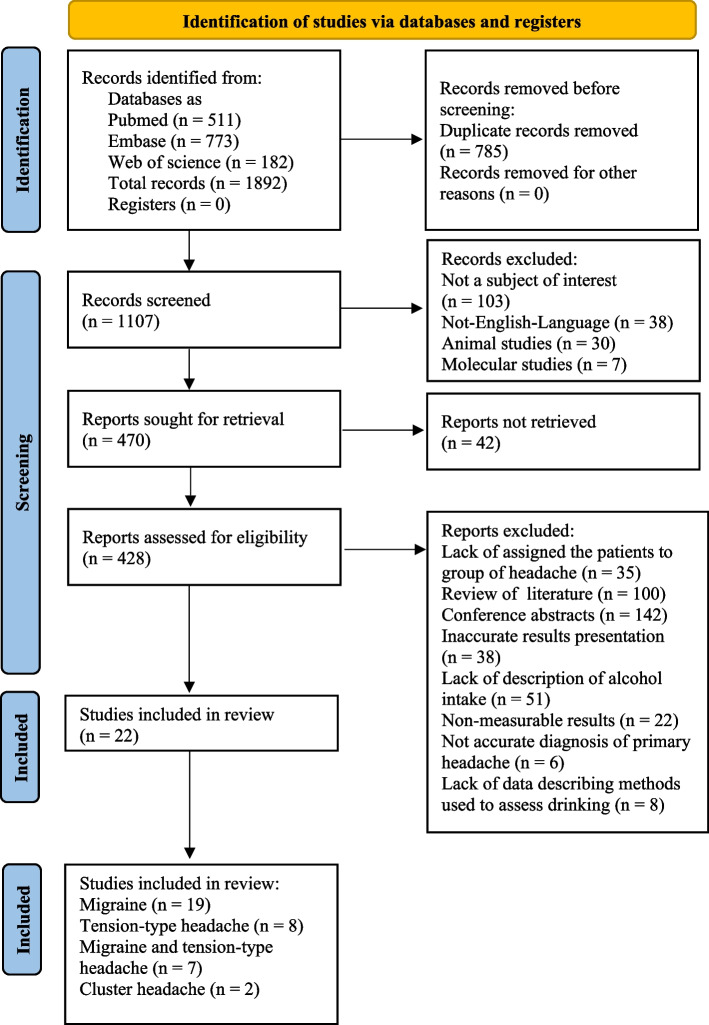
This study was based on PubMed, Embase and Web of Science database searches performed on 11 July 2023. This systematic review was registered in PROSPERO (CRD42023412926). Risk of bias for the included studies was assessed using the Joanna Briggs Institute critical appraisal tools. Meta-analyses were performed using Statistica software. The Risk Ratio (RR) was adopted as the measure of the final effect. Analyses were based on a dichotomous division of the respondents into "non-drinkers" and "drinkers" for headache patients and matched non-headache groups.
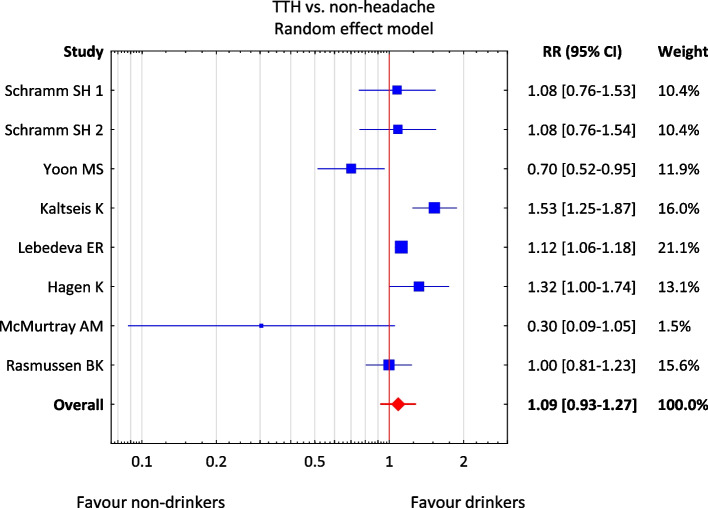
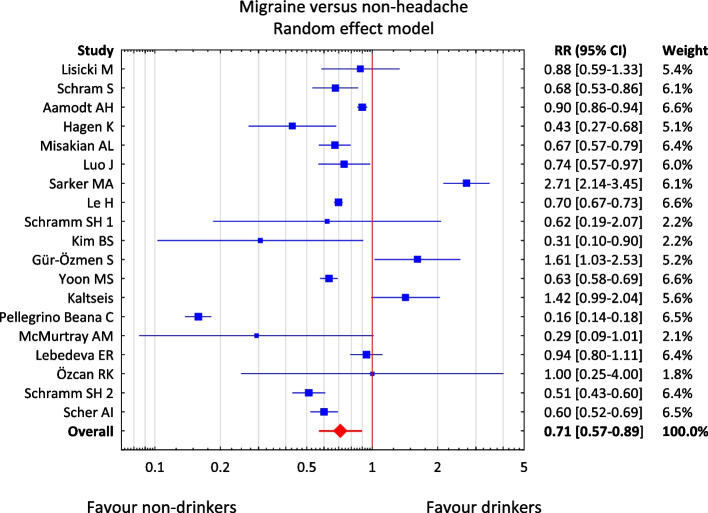
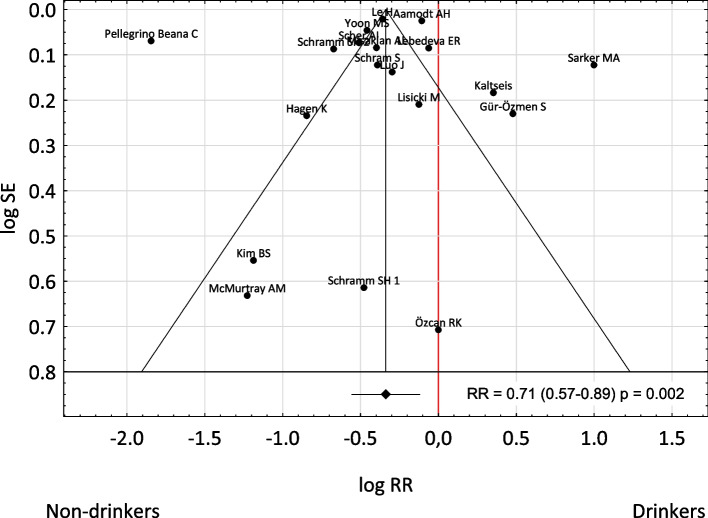
From a total of 1892 articles, 22 were included in the meta-analysis. The majority demonstrated a moderate or high risk of bias. The first part of the meta-analysis was performed on data obtained from 19 migraine studies with 126 173 participants. The risk of migraine in alcohol drinkers is approximately 1.5 times lower than in the group of non-drinkers (RR = 0.71; 95% CI: 0.57-0.89). The second part involved 9 TTH studies with 28 715 participants. No relationship was found between TTH diagnosis and alcohol consumption (RR = 1.09; 95% CI: 0.93-1.27). Two of the included cluster-headache articles had inconclusive results.
Alcohol consumption and migraine are inversely correlated. The exact mechanism behind this observation may indicate that migraine leads to alcohol-avoidance, rather than alcohol having any protective role against migraine. There was no relationship between TTH and drinking. However, further studies related to primary headaches and alcohol consumption with low risk of bias are required. Additionally, patients and physicians should consider the latest medical data, in order to avoid the myths about alcohol consumption and primary headaches.
头痛是最常见的神经症状之一。许多先前的研究表明原发性头痛与酒精之间存在关系。饮酒与紧张型头痛(TTH)和偏头痛的风险增加有关。然而,最近发表的研究并未证实这种关系。现有文献尚无定论;然而,偏头痛患者会避免饮酒。因此,主要目的是可靠地评估原发性头痛患者的饮酒量;次要目的是确定饮酒与头痛风险之间是否存在任何潜在关系。
本研究基于 2023 年 7 月 11 日在 PubMed、Embase 和 Web of Science 数据库中进行的搜索。本系统评价已在 PROSPERO(CRD42023412926)中注册。使用 Joanna Briggs 研究所的批判性评估工具评估纳入研究的偏倚风险。使用 Statistica 软件进行荟萃分析。采用风险比(RR)作为最终效应的度量。分析基于将应答者分为头痛患者的“不饮酒者”和“饮酒者”以及匹配的非头痛组的二分法。
从总共 1892 篇文章中,有 22 篇被纳入荟萃分析。大多数研究显示出中度或高度偏倚风险。荟萃分析的第一部分是基于来自 19 项偏头痛研究的数据,这些研究共纳入了 126173 名参与者。饮酒者患偏头痛的风险比非饮酒者低约 1.5 倍(RR=0.71;95%CI:0.57-0.89)。第二部分涉及 9 项 TTH 研究,共纳入 28715 名参与者。未发现 TTH 诊断与饮酒之间存在关系(RR=1.09;95%CI:0.93-1.27)。纳入的两项丛集性头痛文章的结果不确定。
饮酒与偏头痛呈负相关。这种观察结果背后的确切机制可能表明偏头痛导致戒酒,而不是饮酒对偏头痛有任何保护作用。TTH 与饮酒无关。然而,需要进行进一步的、与原发性头痛和饮酒相关的研究,且这些研究的偏倚风险要低。此外,患者和医生应考虑最新的医学数据,以避免有关饮酒和原发性头痛的误解。