Błaszczyk Bartłomiej, Waliszewska-Prosół Marta, Smardz Joanna, Więckiewicz Mieszko, Wojakowska Anna, Martynowicz Helena
Department and Clinic of Internal Medicine, Occupational Diseases, Hypertension and Clinical Oncology, Wroclaw Medical University, Wroclaw, Poland.
Department of Neurology, Wroclaw Medical University, Wroclaw, Poland.
Headache. 2025 Feb;65(2):242-257. doi: 10.1111/head.14892. Epub 2024 Dec 30.
Migraine is the most common disabling headache disorder in the world. Temporomandibular disorders (TMDs) are a group of conditions characterized by pain/dysfunction of masticatory muscles or their associated structures. There is a lack of studies concerning the association between sleep disorders such as sleep bruxism (SB), obstructive sleep apnea (OSA), migraine, and TMD, despite the increased prevalence of these conditions in TMD patients.
Our case-control study assesses the potential relationship among SB, OSA, and migraine using polysomnography (PSG) among the group with TMD.
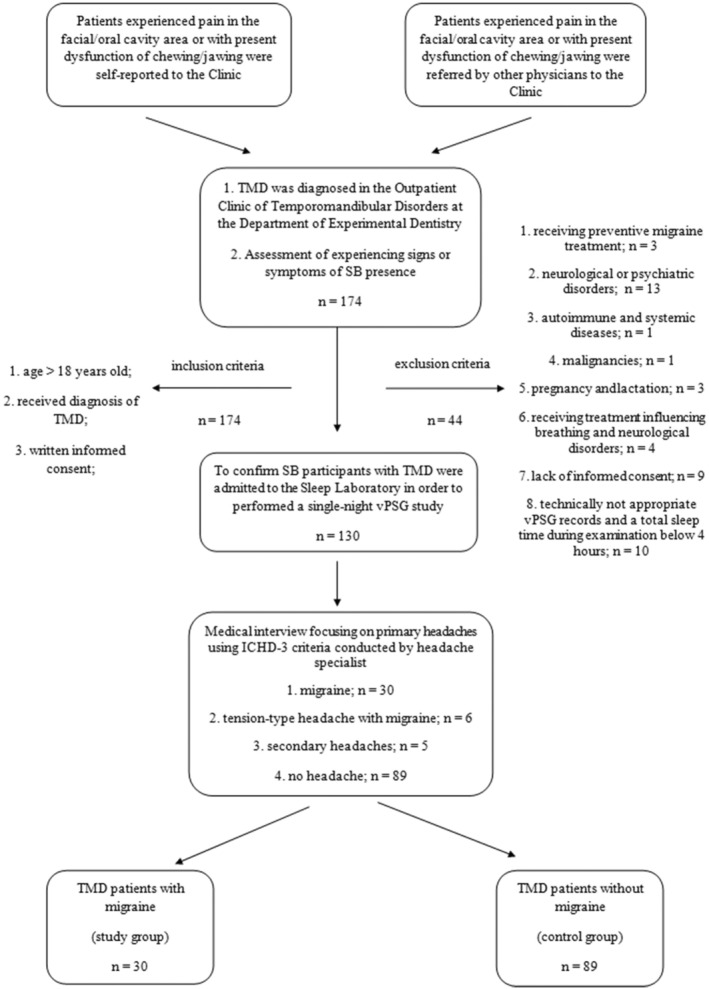
One hundred nineteen patients with TMD were recruited and hospitalized in the Department and Clinic of Internal Medicine, Occupational Diseases, Hypertension, and Clinical Oncology at Wroclaw Medical University. Their sleep parameters were assessed by PSG according to American Academy of Sleep Medicine guidelines. Migraine diagnosis was based on the third edition of the International Classification of Headache Disorders. The group of 30 patients with median age 35.0 years (interquartile range [IQR]: 26.0, 41.0) were diagnosed with migraine and this group consisted of 17 without aura (MwoA) and 13 with aura (MwA). Thirty patients with migraine were compared to 89 patients with TMD without migraine (controls) with median age 37.0 years (IQR: 26.0, 44.0).
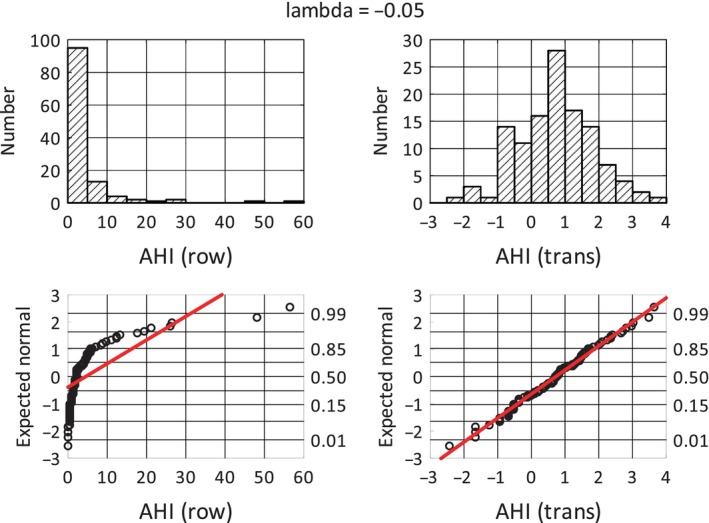
Sleep bruxism was detected in 86% of the migraine group and 71.9% of control participants. The median bruxism episode index (BEI) among patients with migraine was 3.8 n/h (IQR: 2.7, 5.8) and 3.5 n/h (IQR: 1.8, 6.0) in the control group. SB and severe SB (respectively, BEI > 2 and BEI > 4) were not associated with migraine (odds ratio [OR] = 2.68, 95% confidence interval [CI]: 0.84-8.55, p = 0.095; OR = 0.98, 95% CI: 0.42-2.32, p = 0.966). However, mixed bruxism episodes were more frequent in the migraine group compared to study participants not experiencing migraine (median 0.7 n/h [IQR: 0.4, 1.6] vs. median 0.5 n/h [IQR: 0.2, 0.9], p = 0.044; OR = 1.96 with 95% CI: 1.16-3.32, p = 0.013). The median average duration of SB episodes in the migraine group was longer than in the controls (7.0 s [IQR: 5.5, 8.4] vs. 5.9 s [IQR: 5.1, 6.6], p = 0.005). The apnea-hypopnea index (AHI) value was not associated with migraine compared to controls (OR = 1.01, 95% CI: 0.96-1.06, p = 0.605), but MwoA had significantly increased AHI values compared to MwA (mean AHI = -0.1, standard deviation [SD] = 1.5 for MwA vs. mean AHI = 0.9 with SD = 1.3 for MwoA, p = 0.049).
Sleep bruxism may not be associated with migraine among patients with TMD; however, mixed bruxism episodes were more frequent in the migraine group. The increased duration of SB episodes in patients with migraine may suggest the common background of these conditions. OSA is also not associated with migraine; however, MwoA might increase the odds of OSA. There is a need to further explore sleep disturbances and migraine, especially in groups with their increased prevalence, such as patients with TMD.
偏头痛是全球最常见的致残性头痛疾病。颞下颌关节紊乱病(TMDs)是一组以咀嚼肌或其相关结构疼痛/功能障碍为特征的病症。尽管TMD患者中这些病症的患病率有所增加,但关于睡眠磨牙症(SB)、阻塞性睡眠呼吸暂停(OSA)、偏头痛和TMD之间关联的研究仍很缺乏。
我们的病例对照研究使用多导睡眠图(PSG)评估TMD患者群体中SB、OSA和偏头痛之间的潜在关系。
招募了119例TMD患者并在弗罗茨瓦夫医科大学内科、职业病科、高血压科和临床肿瘤科住院。根据美国睡眠医学会指南,通过PSG评估他们的睡眠参数。偏头痛诊断基于《头痛疾病国际分类》第三版。30例年龄中位数为35.0岁(四分位间距[IQR]:26.0,41.0)的患者被诊断为偏头痛,该组包括17例无先兆偏头痛(MwoA)和13例有先兆偏头痛(MwA)。将30例偏头痛患者与89例无偏头痛的TMD患者(对照组)进行比较,对照组年龄中位数为37.0岁(IQR:26.