Bell Caitlin F, Lei Xiudong, Haas Allen, Baylis Richard A, Gao Hua, Luo Lingfeng, Giordano Sharon H, Wehner Mackenzie R, Nead Kevin T, Leeper Nicholas J
Department of Medicine, Division of Cardiovascular Medicine, Stanford University School of Medicine, Stanford, California, USA.
Department of Surgery, Division of Vascular Surgery, Stanford University School of Medicine, Stanford, California, USA.
JACC CardioOncol. 2023 Apr 11;5(4):431-440. doi: 10.1016/j.jaccao.2023.01.010. eCollection 2023 Aug.
Cardiovascular disease (CVD) and cancer share several risk factors. Although preclinical models show that various types of CVD can accelerate cancer progression, clinical studies have not determined the impact of atherosclerosis on cancer risk.
The objective of this study was to determine whether CVD, especially atherosclerotic CVD, is independently associated with incident cancer.
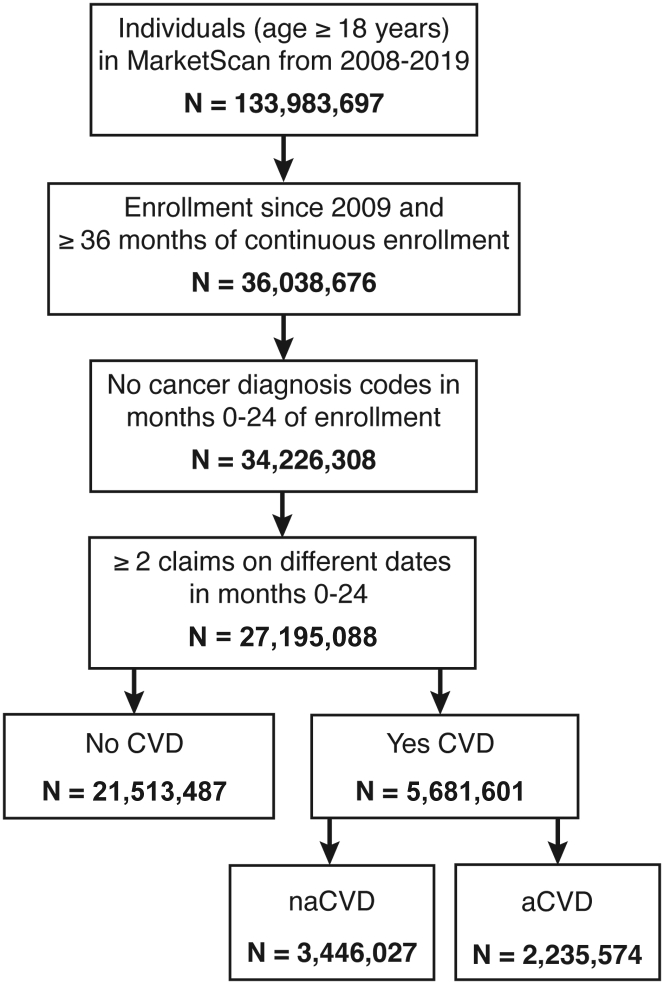
Using IBM MarketScan claims data from over 130 million individuals, 27 million cancer-free subjects with a minimum of 36 months of follow-up data were identified. Individuals were stratified by presence or absence of CVD, time-varying analysis with multivariable adjustment for cardiovascular risk factors was performed, and cumulative risk of cancer was calculated. Additional analyses were performed according to CVD type (atherosclerotic vs nonatherosclerotic) and cancer subtype.
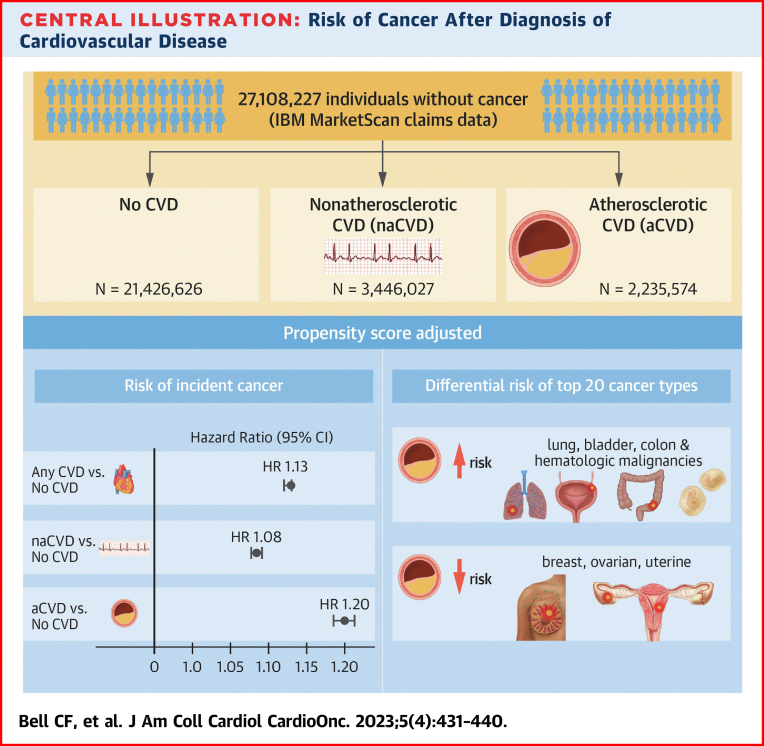
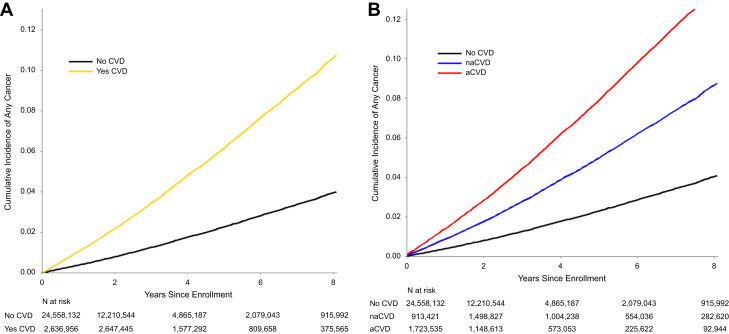
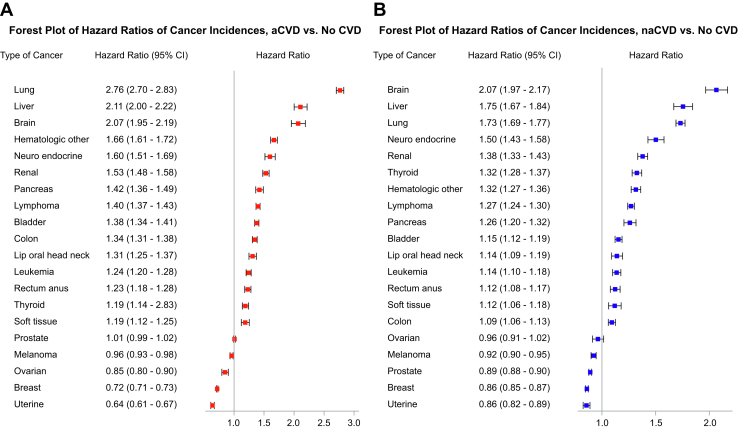
Among 27,195,088 individuals, those with CVD were 13% more likely to develop cancer than those without CVD (HR: 1.13; 95% CI: 1.12-1.13). Results were more pronounced for individuals with atherosclerotic CVD (aCVD), who had a higher risk of cancer than those without CVD (HR: 1.20; 95% CI: 1.19-1.21). aCVD also conferred a higher risk of cancer compared with those with nonatherosclerotic CVD (HR: 1.11; 95% CI: 1.11-1.12). Cancer subtype analyses showed specific associations of aCVD with several malignancies, including lung, bladder, liver, colon, and other hematologic cancers.
Individuals with CVD have an increased risk of developing cancer compared with those without CVD. This association may be driven in part by the relationship of atherosclerosis with specific cancer subtypes, which persists after controlling for conventional risk factors.
心血管疾病(CVD)和癌症有若干共同的风险因素。尽管临床前模型显示,各类心血管疾病可加速癌症进展,但临床研究尚未确定动脉粥样硬化对癌症风险的影响。
本研究旨在确定心血管疾病,尤其是动脉粥样硬化性心血管疾病,是否与新发癌症独立相关。
利用IBM MarketScan数据库中超过1.3亿人的理赔数据,识别出2700万无癌症且有至少36个月随访数据的受试者。根据是否存在心血管疾病对个体进行分层,对心血管风险因素进行多变量调整的时变分析,并计算癌症累积风险。根据心血管疾病类型(动脉粥样硬化性与非动脉粥样硬化性)和癌症亚型进行了额外分析。
在27195088名个体中,患有心血管疾病的个体患癌症的可能性比未患心血管疾病的个体高13%(风险比:1.13;95%置信区间:1.12 - 1.13)。这一结果在患有动脉粥样硬化性心血管疾病(aCVD)的个体中更为明显,他们患癌症的风险高于未患心血管疾病的个体(风险比:1.20;95%置信区间:1.19 - 1.21)。与患有非动脉粥样硬化性心血管疾病的个体相比,aCVD也使患癌症的风险更高(风险比:1.11;95%置信区间:1.11 - 1.12)。癌症亚型分析显示,aCVD与几种恶性肿瘤存在特定关联,包括肺癌、膀胱癌、肝癌、结肠癌和其他血液系统癌症。
与未患心血管疾病的个体相比,患有心血管疾病的个体患癌症的风险增加。这种关联可能部分是由动脉粥样硬化与特定癌症亚型的关系所驱动的,在控制传统风险因素后这种关系依然存在。