Shah Ashish S, Sobolewski Brad, Chon Sabina, Cruse Bradly, Glisson Mike D, Zackoff Matthew W, Davis David, Zhang Yin, Schumacher Daniel J, Geis Gary L
Department of Pediatrics, University of California - San Diego, San Diego, CA, USA.
Division of Emergency Medicine, Rady Children's Hospital, San Diego, CA, USA.
Adv Med Educ Pract. 2023 Aug 18;14:901-911. doi: 10.2147/AMEP.S414022. eCollection 2023.
Early identification of shock is vital in decreasing morbidity and mortality in the pediatric population. Although residents are taught the perfusion portion of the rapid cardiopulmonary assessment at our institution, they perform it at the bedside with 8.4% completing 1 part of the assessment and 9.7% verbalizing their findings. Newer technologies, including virtual reality (VR), offer immersive training to close this clinical gap.
To assess senior pediatric residents' performance of a perfusion exam and verbalization of their perfusion assessment following VR-based Just-in-Time/Just-in-Place (JITP) training compared to video-based JITP training. We hypothesized that JITP media training was feasible, and VR JITP was more effective than video-based training.
Residents were randomized to VR or video-based training during shifts in the emergency department. Clinical performance was assessed by review of a video-recorded patient encounter using a standardized assessment tool and by an in-person, two question shock assessment. Residents completed a survey assessing attitudes toward their intervention at the time of training.
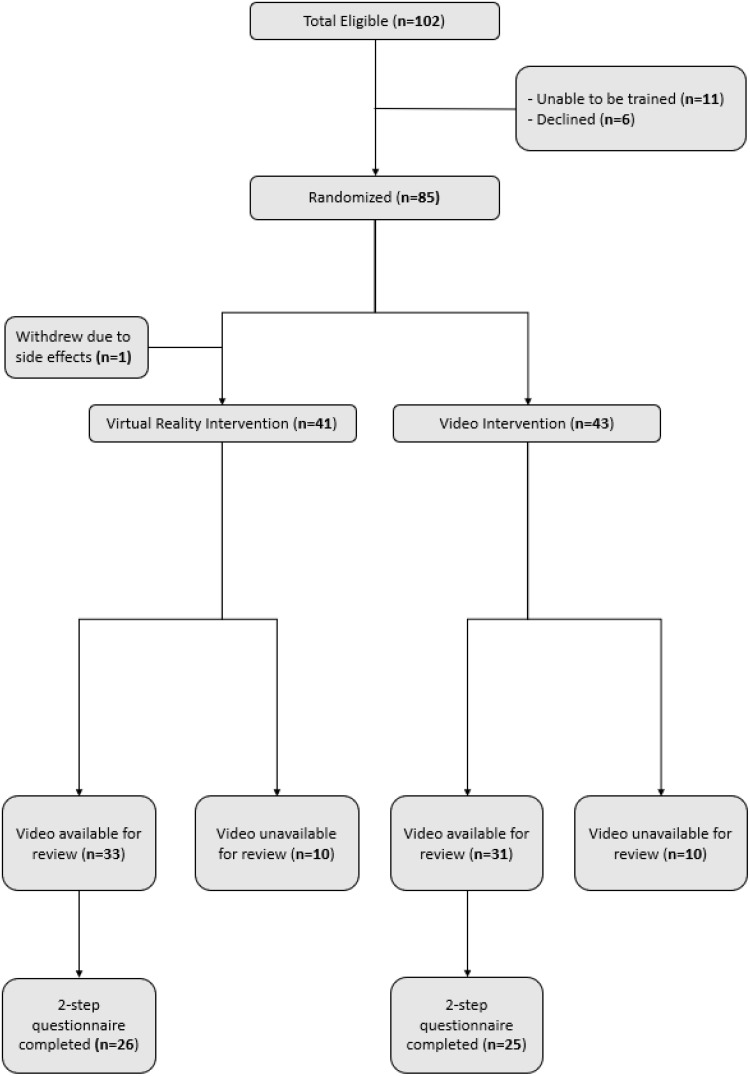
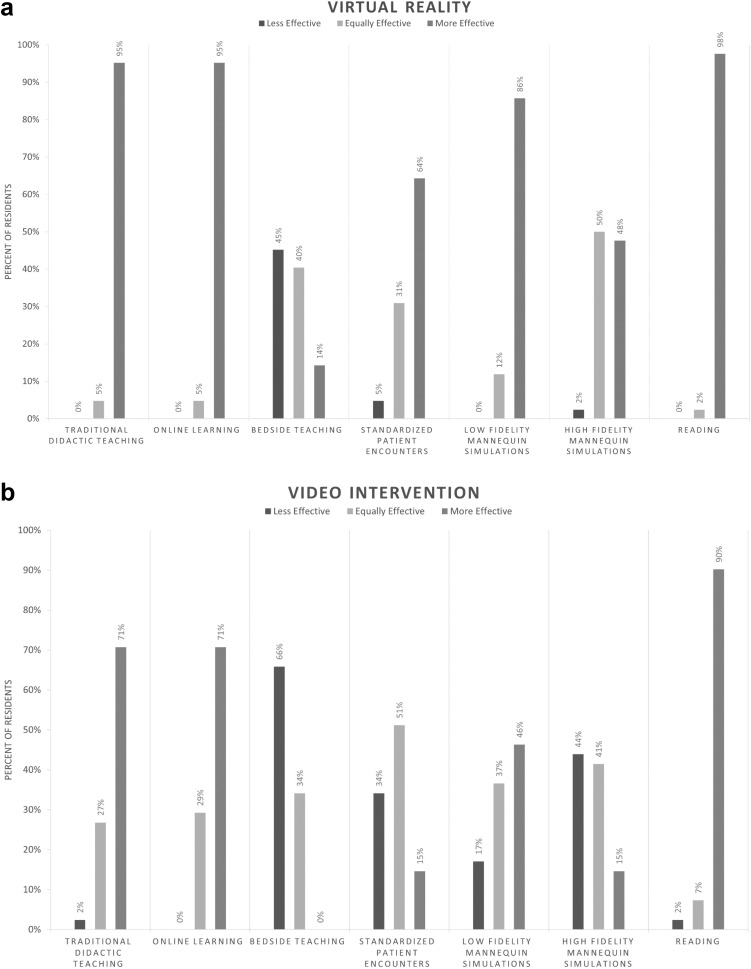
Eighty-five senior pediatric residents were enrolled; 84 completed training. Sixty-four (76%) residents had a patient encounter available for video review (VR 33; Video 31). Fourteen residents in the VR group (42.4%, 95% CI 25.5% to 60.8%) and 13 residents in the video group (41.9%, 95% CI 24.6% to 60.9%) completed a perfusion exam AND verbalized an assessment during their next clinical encounter (X p-value 1.00). Fifty-one of 64 residents (79.7%) completed the two-step shock assessment; 50 (98%) agreed with supervising physician's assessment. VR was rated more effective than reading, low-fidelity manikin, standardized patient encounters, traditional didactic teaching, and online learning. Video was rated more effective than online learning, traditional didactic teaching, and reading.
Novel video and VR JITP perfusion exam and assessment trainings are impactful and well-received by senior pediatric residents.
早期识别休克对于降低儿科患者的发病率和死亡率至关重要。尽管在我们机构住院医师接受了快速心肺评估中灌注部分的培训,但他们在床边进行该评估时,只有8.4%的人完成了评估的一部分,9.7%的人说出了他们的评估结果。包括虚拟现实(VR)在内的新技术提供沉浸式培训以弥合这一临床差距。
评估与基于视频的即时/就地(JITP)培训相比,高级儿科住院医师在基于VR的JITP培训后进行灌注检查的表现以及对其灌注评估的表述。我们假设JITP媒体培训是可行的,并且VR JITP比基于视频的培训更有效。
住院医师在急诊科轮班期间被随机分配到VR或基于视频的培训。通过使用标准化评估工具回顾视频记录的患者会诊以及进行面对面的两个问题的休克评估来评估临床表现。住院医师在培训时完成一项调查,评估他们对干预措施的态度。
招募了85名高级儿科住院医师;84人完成了培训。64名(76%)住院医师有可供视频回顾的患者会诊(VR组33人;视频组31人)。VR组的14名住院医师(42.4%,95%置信区间25.5%至60.8%)和视频组的13名住院医师(41.9%,95%置信区间24.6%至60.9%)在他们的下一次临床会诊中完成了灌注检查并说出了评估结果(X p值1.00)。64名住院医师中有51名(79.7%)完成了两步休克评估;50名(98%)同意指导医师的评估。VR被评为比阅读、低保真人体模型、标准化患者会诊、传统说教式教学和在线学习更有效。视频被评为比在线学习、传统说教式教学和阅读更有效。
新颖的视频和VR JITP灌注检查及评估培训很有影响力,并且受到高级儿科住院医师的好评。