Li Yifan, Zhang Xiaomei, Liu Haimei, Li Guomin, Guan Wanzhen, Zhang Tao, Zeng Qiaoqian, Gong Yinv, Xu Hong, Sun Li
Department of Rheumatology, Children's Hospital of Fudan University, National Center for Children's Health, Shanghai, China.
Department of Nephrology, Children's Hospital of Fudan University, National Center for Children's Health, Shanghai, China.
Front Pediatr. 2023 Aug 8;11:1194214. doi: 10.3389/fped.2023.1194214. eCollection 2023.
The study aimed to describe the characteristics of gastrointestinal (GI) involvement in a cohort of hospitalized children with IgA vasculitis (IgAV) in China.
We reviewed the records of hospitalized IgAV patients from January 2014 to December 2020 at one tertiary medical center. The patients were divided into the severe GI group and the non-severe GI group according to the presence of massive GI bleeding and complications. The clinical manifestations, laboratory factors, and treatment were analyzed between the two groups.
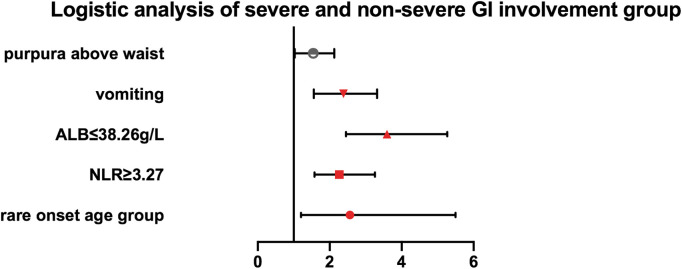
A total of 1,179 patients were hospitalized due to IgAV. GI involvement was noted in 50% (589) of the patients, of whom 288 (48.9%) had severe GI involvement. GI complications were observed in 34 patients with IgAV with GI involvement. Rare onset age (<3 years or within 13-17 years), purpura above the waist, vomiting, high neutrophil-to-lymphocyte ratio, and decreased serum albumin were factors associated with severe GI involvement. Frequencies of renal involvement and biopsy-proven nephritis were higher in the severe GI group. The most commonly used medications were corticosteroids (100.0%) in the severe GI group. The maximum corticosteroid dose was higher (2.9 vs. 2.0 mg/kg), and more second-line therapies were needed (30.9% vs. 16.94%) in the severe GI group.
Severe GI involvement in children is common in our center. Rare onset age, purpura above the waist, vomiting, high neutrophil-to-lymphocyte ratio, and decreased serum albumin are associated with severe GI involvement. Patients with severe GI involvement need higher doses of corticosteroids and second-line therapy.
本研究旨在描述中国一组住院的免疫球蛋白A血管炎(IgAV)患儿胃肠道(GI)受累的特征。
我们回顾了一家三级医疗中心2014年1月至2020年12月期间住院的IgAV患者的记录。根据是否存在大量胃肠道出血及并发症,将患者分为严重胃肠道组和非严重胃肠道组。分析两组之间的临床表现、实验室指标及治疗情况。
共有1179例患者因IgAV住院。50%(589例)的患者出现胃肠道受累,其中288例(48.9%)有严重胃肠道受累。在34例有胃肠道受累的IgAV患者中观察到胃肠道并发症。发病年龄罕见(<3岁或13 - 17岁之间)、腰部以上紫癜、呕吐、高中性粒细胞与淋巴细胞比值及血清白蛋白降低是与严重胃肠道受累相关的因素。严重胃肠道组肾脏受累及活检证实的肾炎的发生率更高。严重胃肠道组最常用的药物是皮质类固醇(100.0%)。严重胃肠道组皮质类固醇的最大剂量更高(2.9 vs. 2.0 mg/kg),且需要更多二线治疗(30.9% vs. 16.94%)。
儿童严重胃肠道受累在我们中心很常见。发病年龄罕见、腰部以上紫癜、呕吐、高中性粒细胞与淋巴细胞比值及血清白蛋白降低与严重胃肠道受累相关。严重胃肠道受累的患者需要更高剂量的皮质类固醇及二线治疗。