Li Jing, Xu Yupei, Sun Tianhao, Zhang Xiaotian, Liang Huimin, Lin Wei, Yu Hangxing, Yang Bo, Yang Hongtao
Department of Nephrology, First Teaching Hospital of Tianjin University of Traditional Chinese Medicine, National Clinical Research Center for Chinese Medicine Acupuncture and Moxibustion, Tianjin, China.
Department of Nephrology, Traditional Chinese Hospital of Xiamen, Xiamen, China.
Front Immunol. 2024 Dec 9;15:1430356. doi: 10.3389/fimmu.2024.1430356. eCollection 2024.
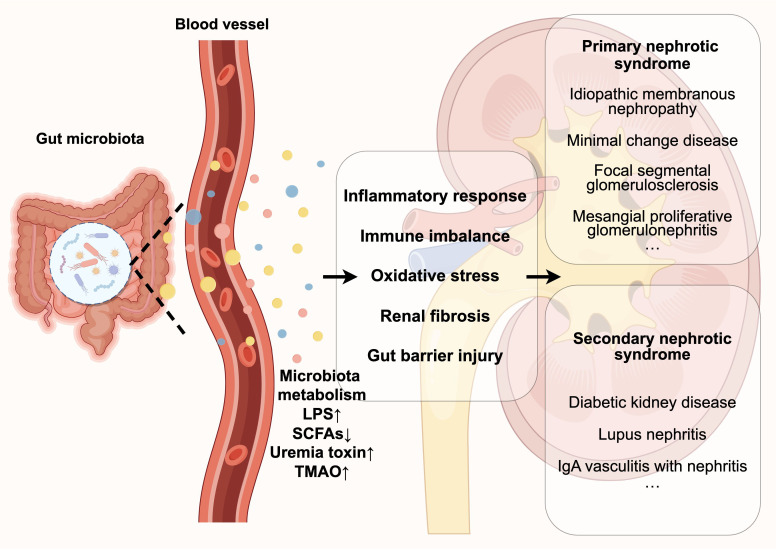
Nephrotic syndrome (NS) represents a prevalent syndrome among various chronic kidney disease pathologies and is known for its higher severity and worse prognosis compared with chronic glomerulonephritis. Understanding its pathogenesis and identifying more effective treatment modalities have long been a concern of kidney specialists. With the introduction of the gut-kidney axis concept and the progress in omics technologies, alterations in the gut microbiota have been observed in primary and secondary NS. This link has been extensively researched in conditions such as diabetic nephropathy and immunoglobulin A (IgA) nephropathy. Thus, dysbiosis of the gut microbiota is seen as a crucial contributing factor in NS; however, there is a lack of comprehensive reviews that elucidate the changes in the gut microbiota across different NS conditions and that describe its mechanistic role in the disease. Moreover, serving as an innate regulator of the gut microbiota, traditional Chinese medicine (TCM) has the potential to exert a profound impact on the expression of inflammation-promoting agents, decreasing the levels of endotoxins and uremic toxins. In addition, it strengthens the stability of the intestinal barrier while controlling the metabolic function of the body through its efficient modulation of the gut microbiota. This intricate process yields far-reaching consequences for NS.
肾病综合征(NS)是各种慢性肾脏疾病中常见的综合征,与慢性肾小球肾炎相比,其严重程度更高,预后更差。长期以来,了解其发病机制并确定更有效的治疗方法一直是肾脏专家关注的问题。随着肠-肾轴概念的引入和组学技术的进步,在原发性和继发性NS中均观察到肠道微生物群的改变。这种联系在糖尿病肾病和免疫球蛋白A(IgA)肾病等疾病中已得到广泛研究。因此,肠道微生物群失调被视为NS的一个关键促成因素;然而,缺乏全面的综述来阐明不同NS情况下肠道微生物群的变化及其在疾病中的作用机制。此外,作为肠道微生物群的天然调节剂,中药有可能对促炎因子的表达产生深远影响,降低内毒素和尿毒症毒素水平。此外,它还能增强肠道屏障的稳定性,同时通过有效调节肠道微生物群来控制身体的代谢功能。这一复杂过程对NS产生了深远影响。