Université de Paris, INSERM, CEA, Stabilité Génétique Cellules Souches et Radiations, F-92260 Fontenay-aux-Roses, France.
Université Paris-Saclay, INSERM, CEA, Stabilité Génétique Cellules Souches et Radiations, F-92260 Fontenay-aux-Roses, France.
Stem Cells Transl Med. 2023 Oct 5;12(10):676-688. doi: 10.1093/stcltm/szad049.
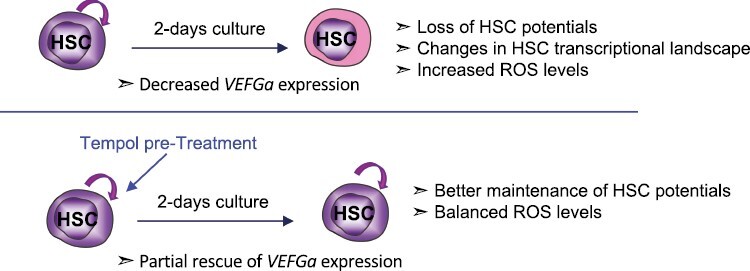
In a steady state, hematopoietic stem cells (HSC) exhibit very low levels of reactive oxygen species (ROS). Upon stress, HSC get activated and enter into proliferation and differentiation process to ensure blood cell regeneration. Once activated, their levels of ROS increase, as messengers to mediate their proliferation and differentiation programs. However, at the end of the stress episode, ROS levels need to return to normal to avoid HSC exhaustion. It was shown that antioxidants can prevent loss of HSC self-renewal potential in several contexts such as aging or after exposure to low doses of irradiation suggesting that antioxidants can be used to maintain HSC functional properties upon culture-induced stress. Indeed, in humans, HSC are increasingly used for cell and gene therapy approaches, requiring them to be cultured for several days. As expected, we show that a short culture period leads to drastic defects in HSC functional properties. Moreover, a switch of HSC transcriptional program from stemness to differentiation was evidenced in cultured HSC. Interestingly, cultured-HSC treated with 4-hydroxy-2,2,6,6-tetramethylpiperidin-1-oxyl (4-hydroxy-TEMPO or Tempol) exhibited a higher clonogenic potential in secondary colony forming unit cell (CFU-C) assay and higher reconstitution potential in xenograft model, compared to untreated cultured-HSC. By transcriptomic analyses combined with serial CFU-C assays, we show that Tempol, which mimics superoxide dismutase, protects HSC from culture-induced stress partly through VEGFα signaling. Thus, we demonstrate that adding Tempol leads to the protection of HSC functional properties during ex vivo culture.
在稳定状态下,造血干细胞 (HSC) 表现出非常低水平的活性氧 (ROS)。在应激下,HSC 被激活并进入增殖和分化过程,以确保血细胞再生。一旦被激活,它们的 ROS 水平会增加,作为介导其增殖和分化程序的信使。然而,在应激事件结束时,ROS 水平需要恢复正常,以避免 HSC 衰竭。研究表明,抗氧化剂可以防止几种情况下 HSC 自我更新能力的丧失,如衰老或暴露于低剂量辐射后,这表明抗氧化剂可以用于维持 HSC 在培养诱导的应激下的功能特性。事实上,在人类中,HSC 越来越多地用于细胞和基因治疗方法,需要对其进行几天的培养。正如预期的那样,我们表明,短期培养会导致 HSC 功能特性的严重缺陷。此外,在培养的 HSC 中,HSC 的转录程序从干性向分化转变的转变得到了证实。有趣的是,用 4-羟基-2,2,6,6-四甲基哌啶-1-氧自由基 (4-羟基-TEMPO 或 Tempol) 处理的培养的 HSC 在二次集落形成单位细胞 (CFU-C) 测定中表现出更高的克隆形成潜力,并且在异种移植模型中表现出更高的重建潜力,与未经处理的培养的 HSC 相比。通过转录组分析结合连续 CFU-C 测定,我们表明,Tempol 模拟超氧化物歧化酶,通过 VEGFα 信号部分保护 HSC 免受培养诱导的应激。因此,我们证明在体外培养期间添加 Tempol 可保护 HSC 的功能特性。