Beviere Marion, Reissier Sophie, Penven Malo, Dejoies Loren, Guerin François, Cattoir Vincent, Piau Caroline
Service de Bactériologie-Hygiène Hospitalière, CHU de Rennes, F-35043 Rennes, France.
Inserm U1230, Université de Rennes 1, F-35043 Rennes, France.
Pathogens. 2023 Jul 26;12(8):978. doi: 10.3390/pathogens12080978.
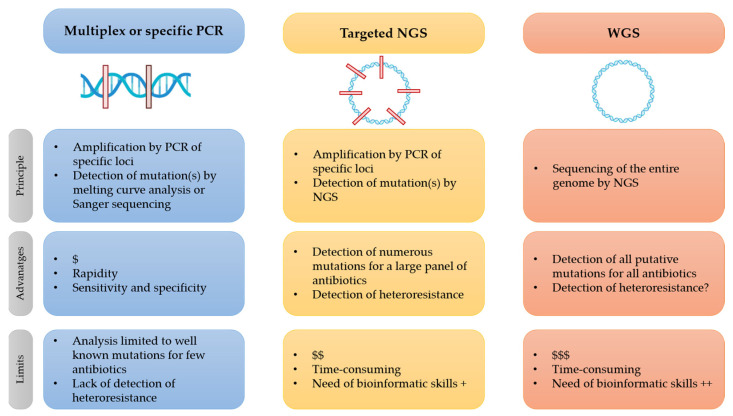
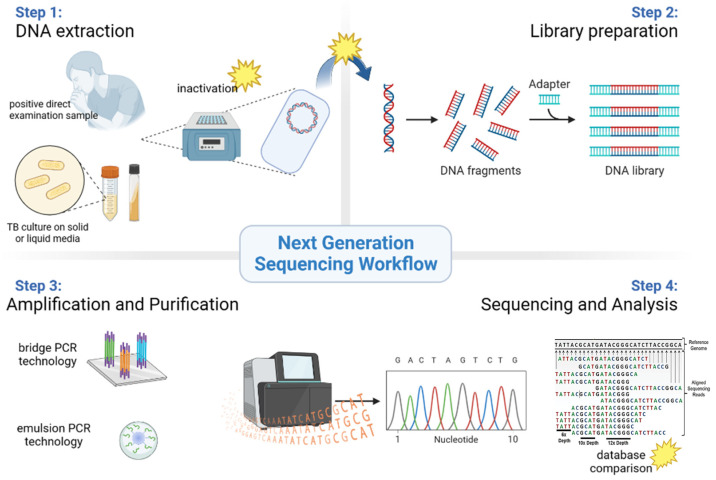
Next-generation sequencing (NGS) has modernized the field of tuberculosis (TB) research by enabling high-throughput sequencing of the entire genome of (MTB), which is the causative agent of TB. NGS has provided insights into the genetic diversity of MTB, which are crucial for understanding the evolution and transmission of the disease, and it has facilitated the identification of drug-resistant strains, enabling rapid and accurate tailoring of treatment. However, the high cost and the technical complexities of NGS currently limit its widespread use in clinical settings. International recommendations are thus necessary to facilitate the interpretation of polymorphisms, and an experimental approach is still necessary to correlate them to phenotypic data. This review aims to present a comparative, step-by-step, and up-to-date review of the techniques available for the implementation of this approach in routine laboratory workflow. Ongoing research on NGS for TB holds promise for improving our understanding of the disease and for developing more efficacious treatments.
下一代测序(NGS)通过对结核分枝杆菌(MTB)的全基因组进行高通量测序,使结核病(TB)研究领域实现了现代化,MTB是结核病的病原体。NGS为了解MTB的遗传多样性提供了见解,这对于理解该疾病的演变和传播至关重要,并且它有助于鉴定耐药菌株,从而能够快速准确地制定个性化治疗方案。然而,NGS的高成本和技术复杂性目前限制了其在临床环境中的广泛应用。因此,需要国际建议来促进对多态性的解释,并且仍然需要一种实验方法将它们与表型数据相关联。本综述旨在对在常规实验室工作流程中实施该方法可用的技术进行比较、逐步且最新的综述。关于结核病的NGS的正在进行的研究有望增进我们对该疾病的理解并开发出更有效的治疗方法。