Department of Psychology, Behavioral Neuroscience, Michigan State University (MSU), Interdisciplinary Science and Technology Building, West Rm. 4010, 766 Service Rd., East Lansing, MI, 48824, USA.
Sci Rep. 2023 Aug 25;13(1):13936. doi: 10.1038/s41598-023-39949-y.
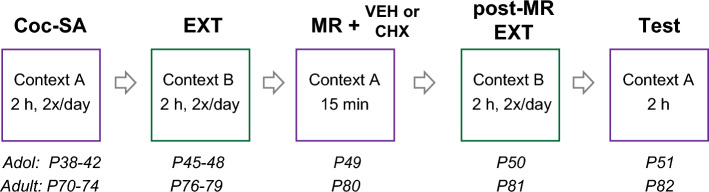
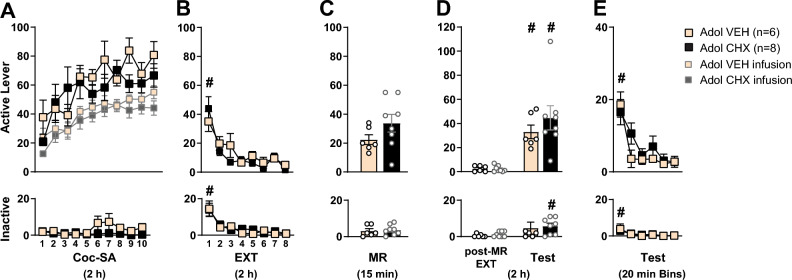
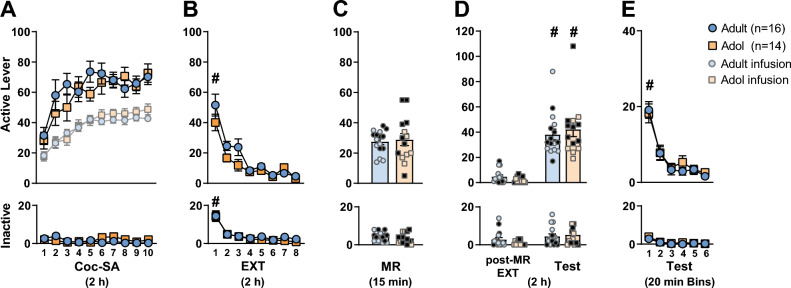
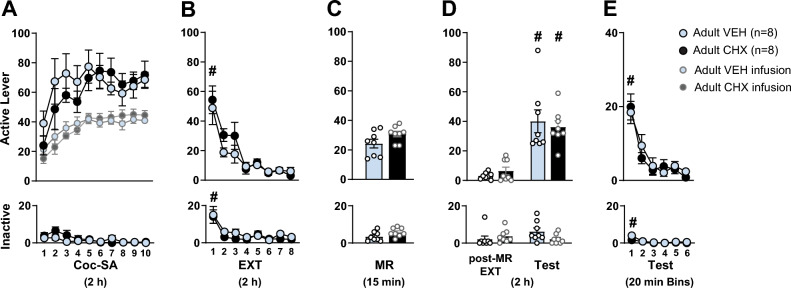
Adolescents are at increased risk to develop substance use disorders and suffer from relapse throughout life. Targeted weakening of drug-associated memories has been shown to reduce relapse-like behavior in adult rats, however this process has been understudied in adolescents. We aimed to examine whether adolescent-formed, cocaine-associated memories could be manipulated via reconsolidation mechanisms. To accomplish this objective, we used an abbreviated operant cocaine self-administration paradigm (ABRV Coc-SA). Adult and adolescent rats received jugular catheterization surgery followed by ABRV Coc-SA in a distinct context for 2 h, 2×/day over 5 days. Extinction training (EXT) occurred in a second context for 2 h, 2×/day over 4 days. To retrieve cocaine-context memories, rats were exposed to the cocaine-paired context for 15 min, followed by subcutaneous injection of vehicle or the protein synthesis inhibitor cycloheximide (2.5 mg/kg). Two additional EXT sessions were conducted before a 2 h reinstatement test in the cocaine-paired context to assess cocaine-seeking behavior. We find that both adult and adolescent cocaine-exposed rats show similar levels of cocaine-seeking behavior regardless of post-reactivation treatment. Our results suggest that systemic treatment with the protein synthesis inhibitor cycloheximide does not impair reconsolidation of cocaine-context memories and subsequent relapse during adulthood or adolescence.
青少年有更高的风险发展物质使用障碍,并在整个生命周期中遭受复发。靶向削弱与药物相关的记忆已被证明可以减少成年大鼠的类似复发行为,但这一过程在青少年中研究较少。我们旨在研究青少年形成的可卡因相关记忆是否可以通过再巩固机制进行操纵。为了实现这一目标,我们使用了简化的操作性可卡因自我给药范式(ABRV Coc-SA)。成年和青少年大鼠接受颈静脉导管插入术,然后在不同的环境中进行 ABRV Coc-SA,每天 2 次,每次 2 小时,共 5 天。在第二个环境中进行 4 天的消退训练(EXT),每天 2 次,每次 2 小时。为了检索可卡因相关记忆,大鼠在可卡因配对的环境中暴露 15 分钟,然后皮下注射载体或蛋白质合成抑制剂环己酰亚胺(2.5mg/kg)。在可卡因配对环境中进行另外两个 EXT 疗程,以评估可卡因寻求行为。我们发现,无论是在再激活后接受治疗还是不接受治疗,暴露于可卡因的成年和青少年大鼠都表现出类似水平的可卡因寻求行为。我们的结果表明,系统给予蛋白质合成抑制剂环己酰亚胺不会损害成年期或青春期可卡因相关记忆的再巩固和随后的复发。