
使用聚焦冲击波治疗跑步者骨应力损伤的疗效
Outcomes Using Focused Shockwave for Treatment of Bone Stress Injury in Runners.
作者信息
Beling Alexandra, Saxena Amol, Hollander Karsten, Tenforde Adam S
机构信息
Spaulding Rehabilitation Hospital, 300 First Avenue, Charlestown, MA 02129, USA.
Palo Alto Medical Foundation, Palo Alto, CA 94301, USA.
出版信息
Bioengineering (Basel). 2023 Jul 25;10(8):885. doi: 10.3390/bioengineering10080885.
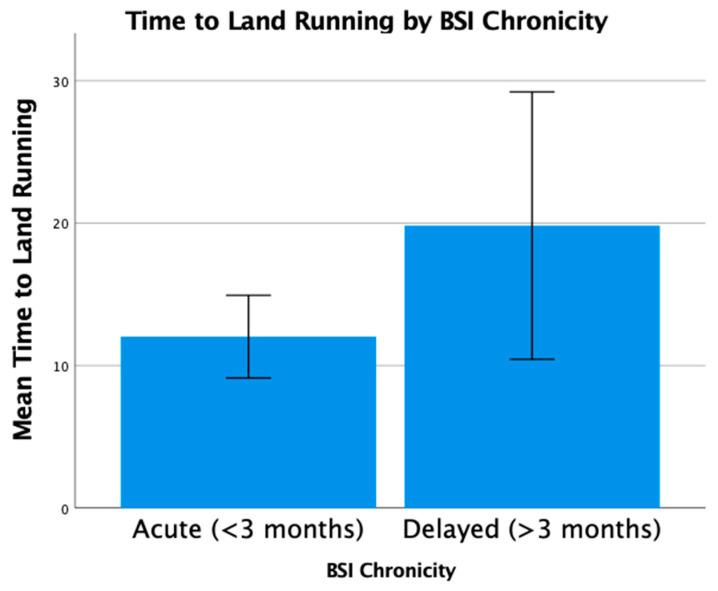
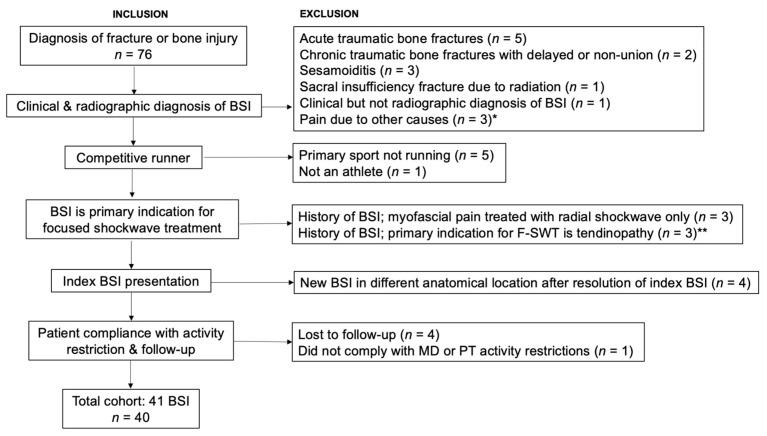
Bone stress injury (BSI) is a common overuse injury that can result in prolonged time away from sport. Limited studies have characterized the use of extracorporeal shockwave therapy (ESWT) for the treatment of BSI. The purpose of this study was to describe the use of ESWT for the management of BSI in runners. A retrospective chart review was performed to identify eligible patients in a single physician's clinic from 1 August 2018 to 30 September 2022. BSI was identified in 40 runners with 41 injuries (28 females; average age and standard deviation: 30 ± 13 years; average pre-injury training 72 ± 40 km per week). Overall, 63% ( = 26) met the criteria for moderate- or high-risk Female or Male Athlete Triad categories. Runners started ESWT at a median of 36 days (IQR 11 to 95 days; range 3 days to 8 years) from BSI diagnosis. On average, each received 5 ± 2 total focused ESWT treatments. Those with acute BSI (ESWT started <3 months from BSI diagnosis) had an average return to run at 12.0 ± 7.5 weeks, while patients with delayed union (>3 months, = 3) or non-union (>6 months, = 9) had longer time for return to running (19.8 ± 14.8 weeks, = 0.032). All runners returned to pain-free running after ESWT except one runner with non-union of grade 4 navicular BSI who opted for surgery. No complications were observed with ESWT. These findings suggest that focused ESWT may be a safe treatment for the management of BSI in runners.
骨应力损伤(BSI)是一种常见的过度使用性损伤,可能导致运动员长期无法参加运动。关于体外冲击波疗法(ESWT)用于治疗BSI的研究有限。本研究的目的是描述ESWT在跑步运动员BSI治疗中的应用。进行了一项回顾性病历审查,以确定2018年8月1日至2022年9月30日在单一医生诊所符合条件的患者。在40名跑步运动员中发现了41处损伤(28名女性;平均年龄和标准差:30±13岁;受伤前平均每周训练72±40公里)。总体而言,63%(n = 26)符合中度或高风险女性或男性运动员三联征类别标准。跑步运动员在BSI诊断后中位36天(四分位间距11至95天;范围3天至8年)开始接受ESWT治疗。平均每人总共接受了5±2次聚焦ESWT治疗。急性BSI患者(ESWT在BSI诊断后<3个月开始)平均在12.0±7.5周恢复跑步,而延迟愈合(>3个月,n = 3)或不愈合(>6个月,n = 9)的患者恢复跑步的时间更长(19.8±14.8周,P = 0.032)。除一名4级舟骨BSI不愈合的跑步运动员选择手术外,所有跑步运动员在ESWT治疗后均恢复无痛跑步。未观察到ESWT的并发症。这些发现表明,聚焦ESWT可能是治疗跑步运动员BSI的一种安全方法。
 Zotero 插件