Palacin Florent, Poinsard Luc, Pycke Jean Renaud, Billat Véronique
Laboratory of Neurophysiology and Movement Biomechanics, Université Libre de Bruxelles Neuroscience Institut, 1070 Bruxelles, Belgium.
Billatraining SAS, 91840 Soisy-sur-École, France.
Entropy (Basel). 2023 Jul 26;25(8):1119. doi: 10.3390/e25081119.
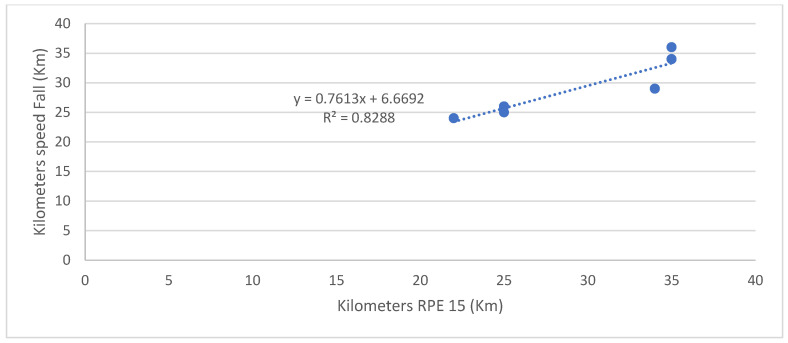
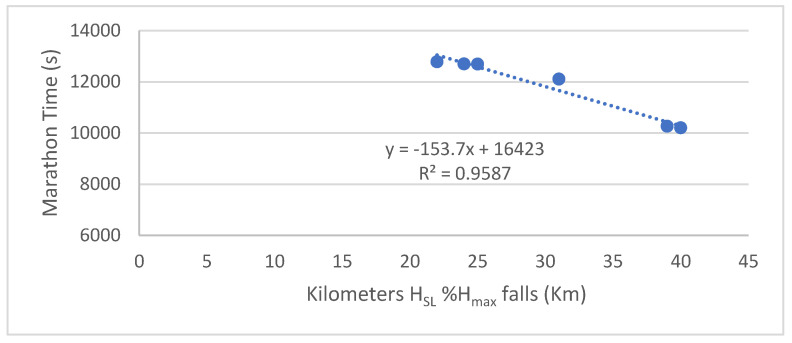
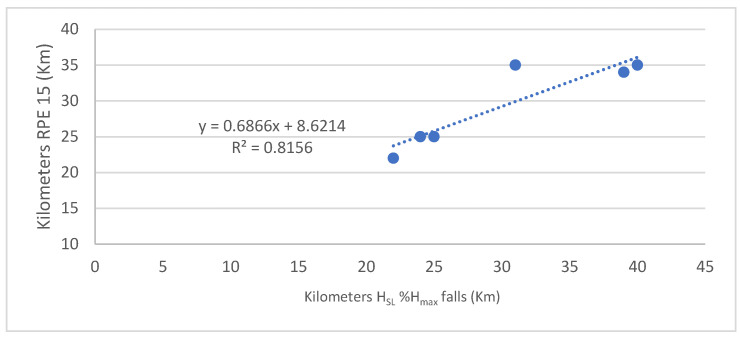
A new group of marathon participants with minimal prior experience encounters the phenomenon known as "hitting the wall," characterized by a notable decline in velocity accompanied by the heightened perception of fatigue (rate of perceived exertion, RPE). Previous research has suggested that successfully completing a marathon requires self-pacing according to RPE rather than attempting to maintain a constant speed or heart rate. However, it remains unclear how runners can self-pace their races based on the signals received from their physiological and mechanical running parameters. This study aims to investigate the relationship between the amount of information conveyed in a message or signal, RPE, and performance. It is hypothesized that a reduction in physiological or mechanical information (quantified by Shannon Entropy) affects performance. The entropy of heart rate, speed, and stride length was calculated for each kilometer of the race. The results showed that stride length had the highest entropy among the variables, and a reduction in its entropy to less than 50% of its maximum value (H = 3.3) was strongly associated with the distance (between 22 and 40) at which participants reported "hard exertion" (as indicated by an RPE of 15) and their performance ( < 0.001). These findings suggest that integrating stride length's Entropy feedback into new cardioGPS watches could improve marathon runners' performance.
一群此前几乎没有经验的马拉松新参与者遭遇了被称为“撞墙”的现象,其特征是速度显著下降,同时疲劳感加剧(主观用力程度,RPE)。先前的研究表明,成功完成马拉松需要根据主观用力程度进行自我配速,而不是试图保持恒定的速度或心率。然而,尚不清楚跑步者如何根据从其生理和机械跑步参数接收到的信号来自我配速比赛。本研究旨在调查信息或信号中传达的信息量、主观用力程度和表现之间的关系。据推测,生理或机械信息的减少(由香农熵量化)会影响表现。计算了比赛每一公里的心率、速度和步幅的熵。结果表明,步幅在这些变量中具有最高的熵,其熵降至最大值(H = 3.3)的50%以下与参与者报告“用力”(主观用力程度为15表示)的距离(22至40公里之间)及其表现密切相关(< 0.001)。这些发现表明,将步幅的熵反馈整合到新型心肺GPS手表中可以提高马拉松跑步者的表现。