Palacin Florent, Poinsard Luc, Billat Véronique
EA 4445-Movement, Balance, Performance, and Health Laboratory, Université de Pau et des Pays de l'Adour, 65000 Tarbes, France.
Faculty of Sport Science, Université Évry Paris-Saclay, 23 Bd François Mitterrand, 91000 Évry-Courcouronnes, France.
Sports (Basel). 2024 Sep 12;12(9):252. doi: 10.3390/sports12090252.
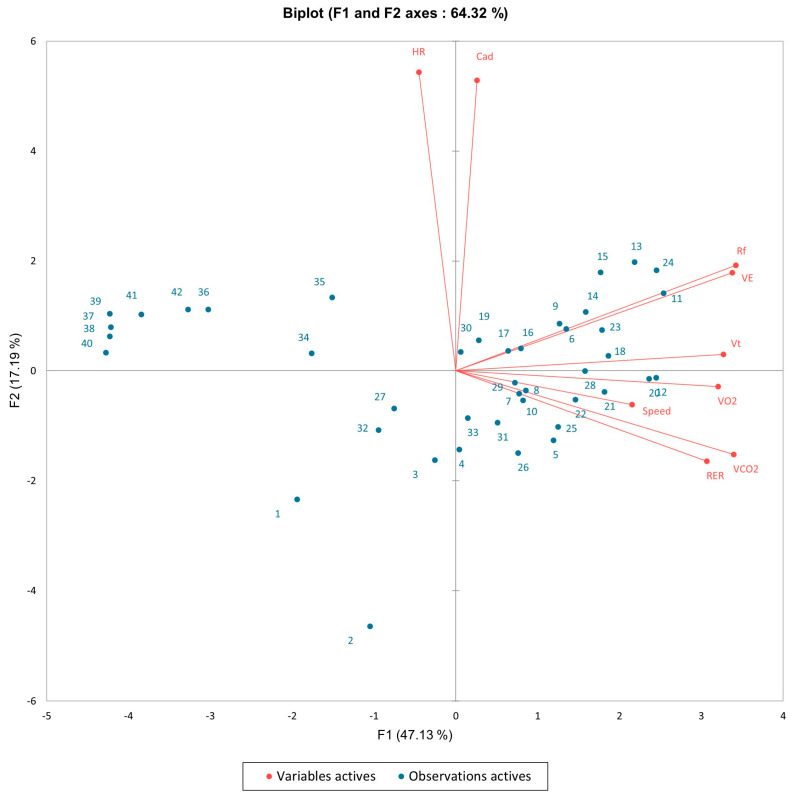
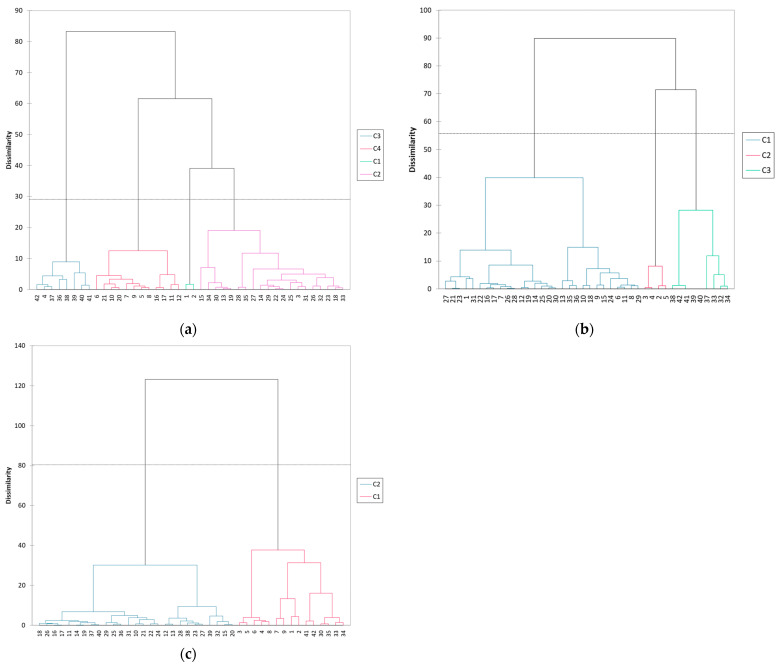
The pacing of a marathon is arguably the most challenging aspect for runners, particularly in avoiding a sudden decline in speed, or what is colloquially termed a "wall", occurring at approximately the 30 km mark. To gain further insight into the potential for optimizing self-paced marathon performance through the coding of comprehensive physiological data, this study investigates the complex physiological responses and pacing strategies during a marathon, with a focus on the application of Shannon entropy and principal component analysis (PCA) to quantify the variability and unpredictability of key cardiorespiratory measures. Nine recreational marathon runners were monitored throughout the marathon race, with continuous measurements of oxygen uptake (V˙O), carbon dioxide output (V˙CO), tidal volume (Vt), heart rate, respiratory frequency (Rf), and running speed. The PCA revealed that the entropy variance of V˙O, V˙CO, and Vt were captured along the F1 axis, while cadence and heart rate variances were primarily captured along the F2 axis. Notably, when distance and physiological responses were projected simultaneously on the PCA correlation circle, the first 26 km of the race were positioned on the same side of the F1 axis as the metabolic responses, whereas the final kilometers were distributed on the opposite side, indicating a shift in physiological state as fatigue set in. The separation of heart rate and cadence entropy variances from the metabolic parameters suggests that these responses are independent of distance, contrasting with the linear increase in heart rate and decrease in cadence typically observed. Additionally, Agglomerative Hierarchical Clustering further categorized runners' physiological responses, revealing distinct clusters of entropy profiles. The analysis identified two to four classes of responses, representing different phases of the marathon for individual runners, with some clusters clearly distinguishing the beginning, middle, and end of the race. This variability emphasizes the personalized nature of physiological responses and pacing strategies, reinforcing the need for individualized approaches. These findings offer practical applications for optimizing pacing strategies, suggesting that real-time monitoring of entropy could enhance marathon performance by providing insights into a runner's physiological state and helping to prevent the onset of hitting the wall.
马拉松的配速可以说是跑步者面临的最具挑战性的方面,尤其是要避免速度突然下降,也就是俗称的在大约30公里处出现的“撞墙”。为了进一步深入了解通过对综合生理数据进行编码来优化自主配速马拉松表现的潜力,本研究调查了马拉松期间复杂的生理反应和配速策略,重点是应用香农熵和主成分分析(PCA)来量化关键心肺指标的变异性和不可预测性。在整个马拉松比赛过程中对九名业余马拉松跑者进行了监测,持续测量摄氧量(V˙O)、二氧化碳排出量(V˙CO)、潮气量(Vt)、心率、呼吸频率(Rf)和跑步速度。主成分分析显示,V˙O、V˙CO和Vt的熵方差沿F1轴捕获,而步频和心率方差主要沿F2轴捕获。值得注意的是,当距离和生理反应同时投影到主成分分析相关圆上时,比赛的前26公里与代谢反应位于F1轴的同一侧,而最后几公里分布在另一侧,这表明随着疲劳的出现生理状态发生了变化。心率和步频熵方差与代谢参数的分离表明,这些反应与距离无关,这与通常观察到的心率线性增加和步频降低形成对比。此外,凝聚层次聚类进一步对跑者的生理反应进行了分类,揭示了不同的熵谱簇。分析确定了两到四类反应,代表了个体跑者马拉松的不同阶段,一些簇清楚地区分了比赛的开始、中间和结束。这种变异性强调了生理反应和配速策略的个性化性质,强化了采用个性化方法的必要性。这些发现为优化配速策略提供了实际应用,表明对熵的实时监测可以通过深入了解跑者的生理状态并帮助预防撞墙的发生来提高马拉松表现。