Department of Gastroenterology, Justus Liebig University Giessen, Klinikstr. 33, 35392 Giessen, Germany.
Int J Mol Sci. 2023 Aug 17;24(16):12884. doi: 10.3390/ijms241612884.
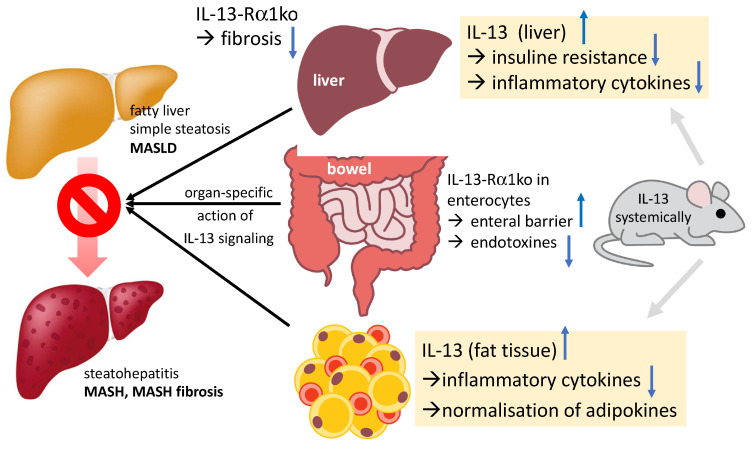
The liver, as a central metabolic organ, is systemically linked to metabolic-inflammatory diseases. In the pathogenesis of the metabolic syndrome, inflammatory and metabolic interactions between the intestine, liver, and adipose tissue lead to the progression of hepatic steatosis to metabolic-dysfunction-associated steatohepatitis (MASH) and consecutive MASH-induced fibrosis. Clinical and animal studies revealed that IL-13 might be protective in the development of MASH through both the preservation of metabolic functions and Th2-polarized inflammation in the liver and the adipose tissue. In contrast, IL-13-associated loss of mucosal gut barrier function and IL-13-associated enhanced hepatic fibrosis may contribute to the progression of MASH. However, there are only a few publications on the effect of IL-13 on metabolic diseases and possible therapies to influence them. In this review article, different aspects of IL-13-associated effects on the liver and metabolic liver diseases, which are partly contradictory, are summarized and discussed on the basis of the recent literature.
肝脏作为一个中央代谢器官,与代谢炎症性疾病有着系统的联系。在代谢综合征的发病机制中,肠道、肝脏和脂肪组织之间的炎症和代谢相互作用导致肝脂肪变性进展为代谢功能相关脂肪性肝炎(MASH)和随后的 MASH 诱导的纤维化。临床和动物研究表明,IL-13 可能通过在肝脏和脂肪组织中保留代谢功能和 Th2 极化炎症而对 MASH 的发展具有保护作用。相比之下,IL-13 相关的黏膜肠道屏障功能丧失和 IL-13 相关的增强的肝纤维化可能导致 MASH 的进展。然而,关于 IL-13 对代谢性疾病的影响及其可能的治疗方法的影响,目前只有少数出版物。在这篇综述文章中,根据最近的文献,总结并讨论了 IL-13 对肝脏和代谢性肝病的影响的不同方面,这些方面在部分上是相互矛盾的。