Kassim Mustafa Ali Kassim, Pantazi Alexandru Cosmin, Nori Wassan, Tuta Liliana Ana, Balasa Adriana Luminita, Mihai Cristina Maria, Mihai Larisia, Frecus Corina Elena, Lupu Vasile Valeriu, Lupu Ancuta, Andrusca Antonio, Iorga Andra Maria, Litrin Radu Mihai, Ion Irina, Ciciu Elena, Chirila Sergiu Ioachim, Chisnoiu Tatiana
Faculty of Medicine, "Ovidius" University of Constanta, 900470 Constanta, Romania.
College of Medicine, Mustansiriyah University, Baghdad 10052, Iraq.
J Clin Med. 2023 Aug 19;12(16):5390. doi: 10.3390/jcm12165390.
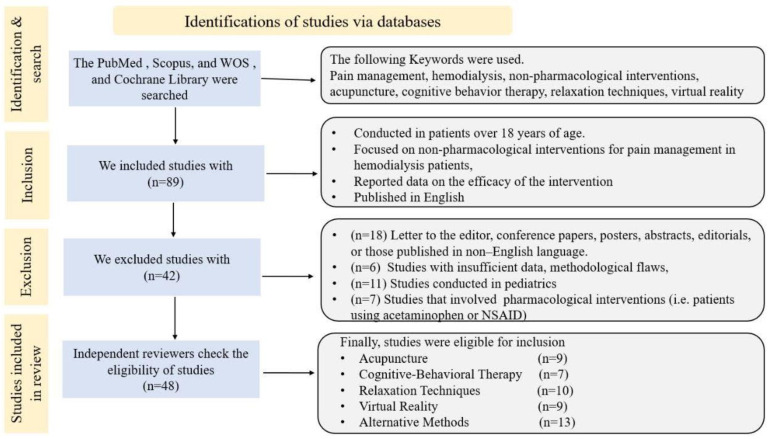
This narrative review aims to summarize non-pharmacological interventions for pain management in hemodialysis patients, assessing their potential benefits and limitations in enhancing patient well-being and quality of life. We reviewed the current literature on five primary non-pharmacological interventions: acupuncture, cognitive behavioral therapy, relaxation techniques, virtual reality, and alternative methods such as transcutaneous electrical nerve stimulation, music therapy, and aromatherapy. We analyzed the evidence regarding their effectiveness, feasibility, and optimal implementation strategies. The existing evidence supports the potential benefits of these interventions in managing pain and improving the well-being of hemodialysis patients. However, further high-quality research is needed to confirm their effectiveness, establish implementation best practices, and assess their long-term impact on patient outcomes. Non-pharmacological interventions hold promise for pain management in hemodialysis patients. Additional research is required to optimize these interventions and validate their effectiveness, contributing to comprehensive pain management strategies for this vulnerable patient population.
本叙述性综述旨在总结血液透析患者疼痛管理的非药物干预措施,评估其在提高患者幸福感和生活质量方面的潜在益处和局限性。我们回顾了关于五种主要非药物干预措施的现有文献:针灸、认知行为疗法、放松技巧、虚拟现实以及经皮电刺激神经疗法、音乐疗法和芳香疗法等替代方法。我们分析了有关其有效性、可行性和最佳实施策略的证据。现有证据支持这些干预措施在管理疼痛和改善血液透析患者幸福感方面的潜在益处。然而,需要进一步的高质量研究来证实其有效性,确立最佳实施方法,并评估其对患者结局的长期影响。非药物干预措施在血液透析患者的疼痛管理方面具有前景。需要更多研究来优化这些干预措施并验证其有效性,为这一脆弱患者群体的综合疼痛管理策略做出贡献。