Mihai Ioana Ruxandra, Burlui Alexandra Maria, Rezus Ioana Irina, Mihai Cătălina, Macovei Luana Andreea, Cardoneanu Anca, Gavrilescu Otilia, Dranga Mihaela, Rezus Elena
Department of Rheumatology and Rehabilitation, Faculty of Medicine, "Grigore T. Popa" University of Medicine and Pharmacy, 700115 Iasi, Romania.
Department of Dermatovenerology, Faculty of Medicine, "Grigore T. Popa" University of Medicine and Pharmacy, 700115 Iasi, Romania.
Life (Basel). 2023 Aug 20;13(8):1779. doi: 10.3390/life13081779.
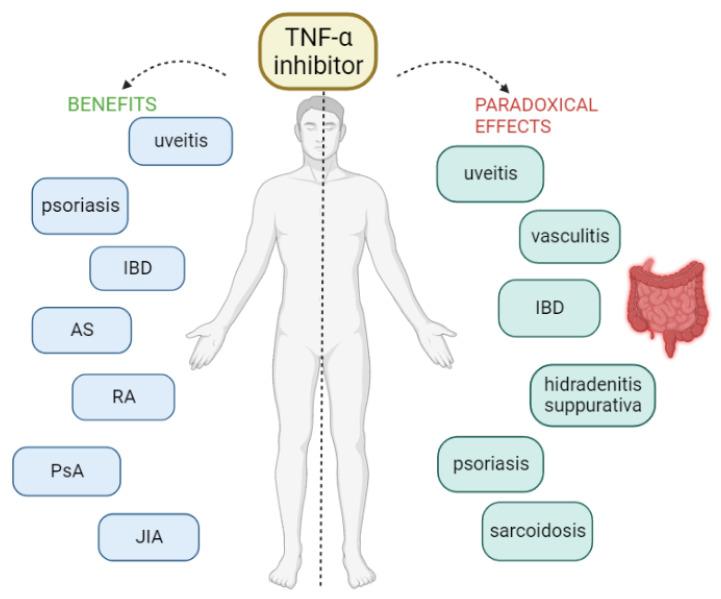
TNF-α inhibitors (TNFis) have revolutionized the treatment of certain chronic immune-mediated diseases, being widely and successfully used in rheumatic inflammatory diseases, and have also proved their efficacy in the treatment of inflammatory bowel disease (IBD). However, among the side effects of these agents are the so-called paradoxical effects. They can be defined as the appearance or exacerbation of a pathological condition that usually responds to this class of drug while treating a patient for another condition. A wide range of paradoxical effects have been reported including dermatological, intestinal and ophthalmic conditions. The causal mechanism of occurrence may implicate an imbalance of cytokines, but is still not fully understood, and remains a matter of debate. These paradoxical reactions often show improvement on discontinuation of the medication or on switching to another TNFi, but in some cases it is a class effect that could lead to the withdrawal of all anti-TNF agents. Close monitoring of patients treated with TNFis is necessary in order to detect paradoxical reactions. In this study we focus on reviewing IBD occurrence as a paradoxical effect of TNFi therapy in patients with rheumatological diseases (rheumatoid arthritis, psoriatic arthritis, ankylosing spondylitis, and juvenile idiopathic arthritis).
肿瘤坏死因子-α抑制剂(TNFis)彻底改变了某些慢性免疫介导疾病的治疗方式,在风湿性炎症性疾病中得到广泛且成功的应用,并且在治疗炎症性肠病(IBD)方面也证明了其疗效。然而,这些药物的副作用中有所谓的矛盾效应。它们可被定义为在治疗患者的另一种病症时,通常对这类药物有反应的病理状况出现或加重。已经报道了广泛的矛盾效应,包括皮肤病学、肠道和眼科病症。其发生的因果机制可能与细胞因子失衡有关,但仍未完全理解,仍是一个有争议的问题。这些矛盾反应通常在停药或换用另一种TNFis时有所改善,但在某些情况下,这是一种类效应,可能导致所有抗TNF药物停用。对接受TNFis治疗的患者进行密切监测以检测矛盾反应是必要的。在本研究中,我们重点回顾炎症性肠病作为TNFis治疗风湿性疾病(类风湿性关节炎、银屑病关节炎、强直性脊柱炎和幼年特发性关节炎)患者的矛盾效应的发生情况。