AO Research Institute Davos, Clavadelerstrasse 8, 7270 Davos, Switzerland.
Department of Trauma, University Hospital Zurich, Raemistrasse 100, 8091 Zurich, Switzerland.
Medicina (Kaunas). 2023 Jul 28;59(8):1379. doi: 10.3390/medicina59081379.
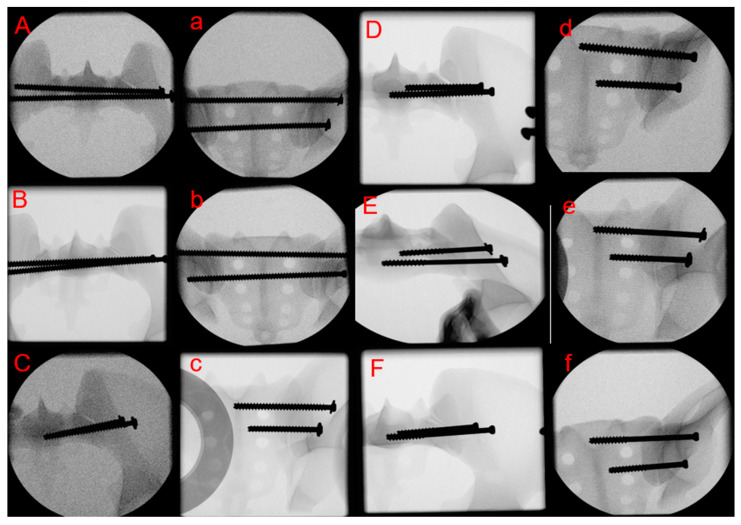
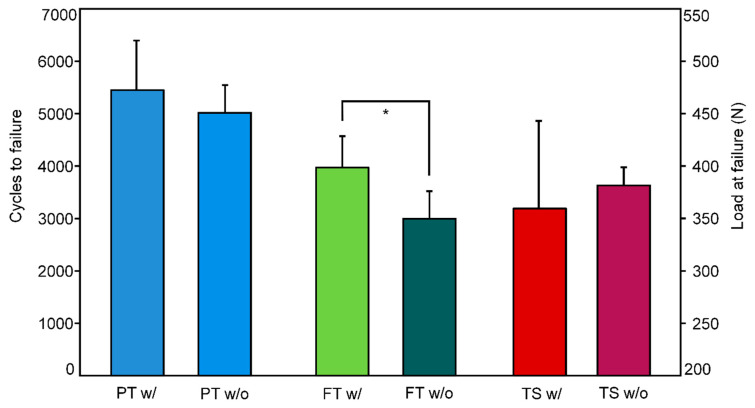
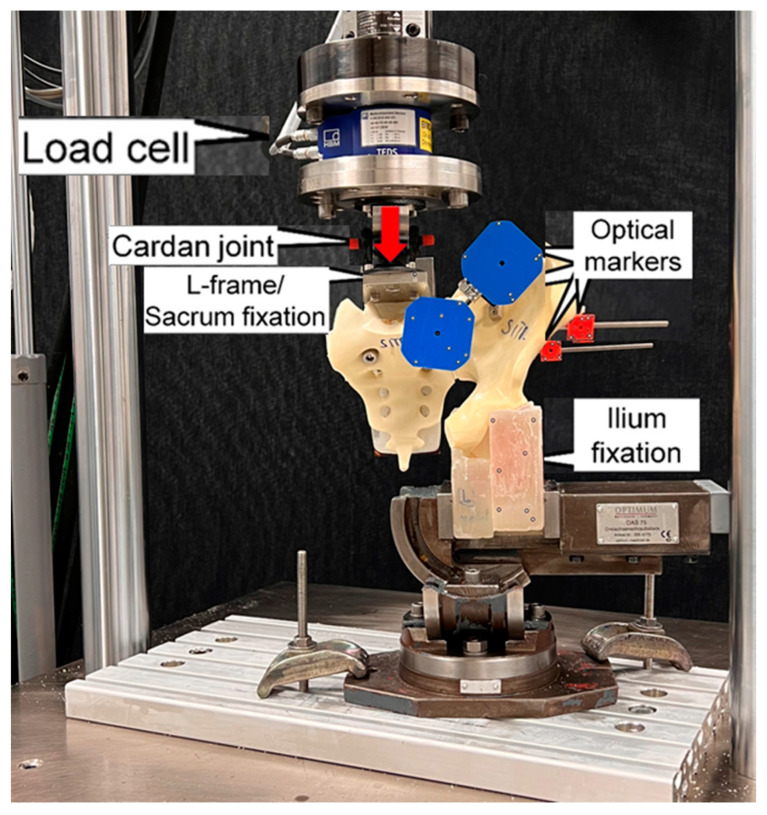
: Cannulated screws are standard implants for percutaneous fixa-tion of posterior pelvis ring injuries. The choice of whether to use these screws in combination with a washer is still undecided. The aim of this study was to evaluate the biomechanical competence of S1-S2 sacroiliac (SI) screw fixation with and without using a washer across three different screw designs. : Twenty-four composite pelvises were used and an SI joint injury type APC III according to the Young and Burgess classification was simulated. Fixation of the posterior pelvis ring was performed using either partially threaded short screws, fully threaded short screws, or fully threaded long transsacral screws. Biomechanical testing was performed under progressively increasing cyclic loading until failure, with monitoring of the intersegmental and bone-implant movements via motion tracking. : The number of cycles to failure and the corresponding load at failure (N) were significantly higher for the fully threaded short screws with a washer (3972 ± 600/398.6 ± 30.0) versus its counterpart without a washer (2993 ± 527/349.7 ± 26.4), = 0.026. In contrast, these two parameters did not reveal any significant differences when comparing fixations with and without a washer using either partially threaded short of fully threaded long transsacral screws, ≥ 0.359. : From a biomechanical perspective, a washer could be optional when using partially threaded short or fully threaded long transsacral S1-S2 screws for treatment of posterior pelvis ring injuries in young trauma patients. Yet, the omission of the washer in fully threaded short screws could lead to a significant diminished biomechanical stability.
: 带螺纹的空心螺钉是经皮固定骨盆后环损伤的标准植入物。是否联合垫圈使用这些螺钉仍存在争议。本研究旨在评估三种不同螺钉设计在 S1-S2 骶髂(SI)螺钉固定时联合和不联合垫圈的生物力学性能。 : 我们使用 24 个复合材料骨盆,并根据 Young 和 Burgess 分类模拟了一种类型 APC III 的 SI 关节损伤。采用部分螺纹短螺钉、全螺纹短螺钉或全螺纹长经骶螺钉固定骨盆后环。在逐渐增加的循环载荷下进行生物力学测试,直至失效,并通过运动跟踪监测节段间和骨-植入物运动。 : 带垫圈的全螺纹短螺钉的失效循环数和相应的失效载荷(N)(3972 ± 600/398.6 ± 30.0)明显高于无垫圈的全螺纹短螺钉(2993 ± 527/349.7 ± 26.4), = 0.026。相比之下,当使用部分螺纹短螺钉或全螺纹长经骶螺钉固定时,带或不带垫圈的这两个参数之间没有显著差异, ≥ 0.359。 : 从生物力学角度来看,对于年轻创伤患者的骨盆后环损伤,在使用部分螺纹短螺钉或全螺纹长经骶螺钉治疗时,垫圈可以是可选的。然而,在全螺纹短螺钉中省略垫圈可能会导致生物力学稳定性显著降低。